
Close Menu
    Facebook X (Twitter) Instagram
    SciTechDaily
    • Biology
    • Chemistry
    • Earth
    • Health
    • Physics
    • Science
    • Space
    • Technology
    Facebook X (Twitter) Pinterest YouTube RSS
    SciTechDaily
    Home»Space»MUSE Views the Strange Structures of the Saturn Nebula
    Space

    MUSE Views the Strange Structures of the Saturn Nebula

    By European Southern ObservatorySeptember 27, 20172 Comments4 Mins Read
    Facebook Twitter Pinterest Telegram LinkedIn WhatsApp Email Reddit
    Share
    Facebook Twitter LinkedIn Pinterest Telegram Email Reddit
    The Strange Structures of the Saturn Nebula
    Planetary nebula NGC 7009, or the Saturn Nebula, is located approximately 5000 light-years away in the constellation of Aquarius (The Water Bearer).

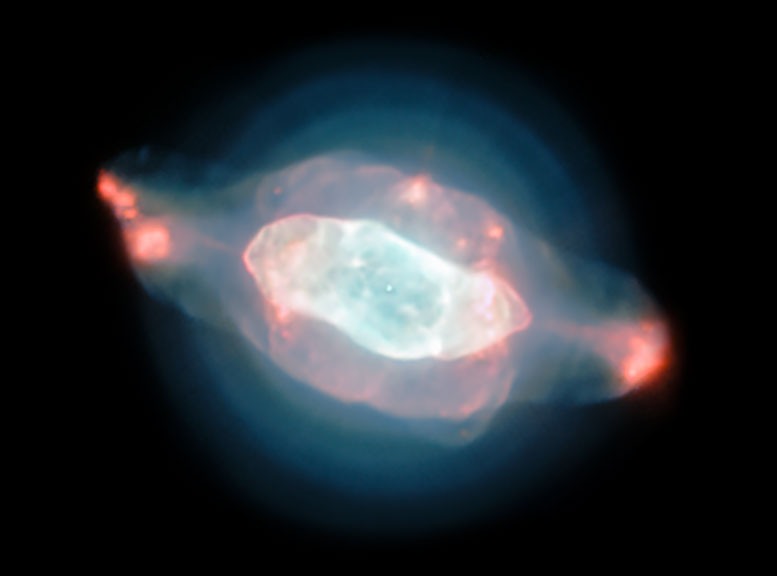
    This new ESO image shows planetary nebula NGC 7009, or the Saturn Nebula, as it emerges from the darkness like a series of oddly-shaped bubbles.

    The image was captured by the powerful MUSE instrument on ESO’s Very Large Telescope (VLT), as part of a study which mapped the dust inside a planetary nebula for the first time. The map — which reveals a wealth of intricate structures in the dust, including shells, a halo, and a curious wave-like feature — will help astronomers understand how planetary nebulae develop their strange shapes and symmetries.

    The Saturn Nebula is located approximately 5000 light-years away in the constellation of Aquarius (The Water Bearer). Its name derives from its odd shape, which resembles everyone’s favorite ringed planet seen edge-on.

    But in fact, planetary nebulae have nothing to do with planets. The Saturn Nebula was originally a low-mass star, which expanded into a red giant at the end of its life and began to shed its outer layers. This material was blown out by strong stellar winds and energized by ultraviolet radiation from the hot stellar core left behind, creating a circumstellar nebula of dust and brightly colored hot gas. At the heart of the Saturn Nebula lies the doomed star, visible in this image, which is in the process of becoming a white dwarf.
    MUSE Image of Planetary Nebula NGC 7009
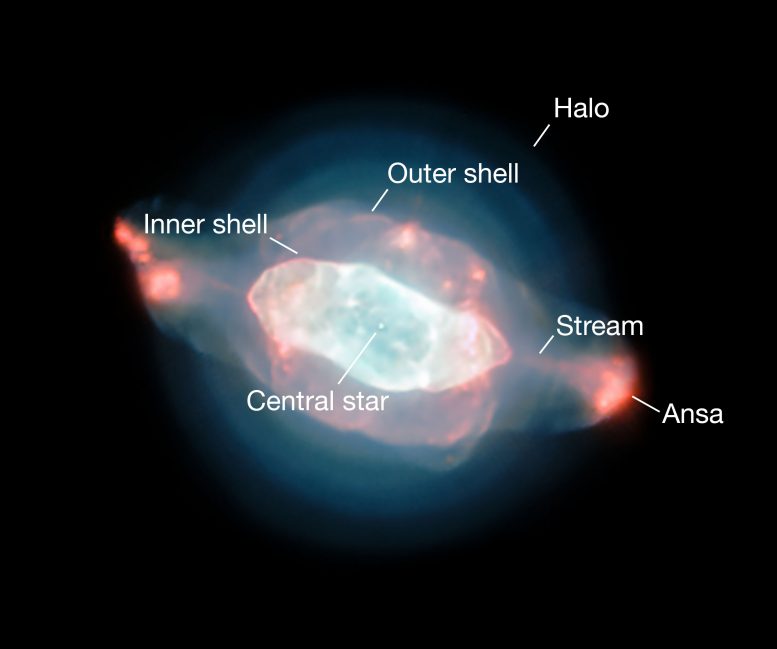
    The spectacular planetary nebula NGC 7009, or the Saturn Nebula, emerges from the darkness like a series of oddly-shaped bubbles, lit up in glorious pinks and blues. This colourful image was captured by the powerful MUSE instrument on ESO’s Very Large Telescope (VLT), as part of a study which mapped the dust inside a planetary nebula for the first time. This annotated version labels the features of this curious object.
    Planetary Nebula NGC 7009
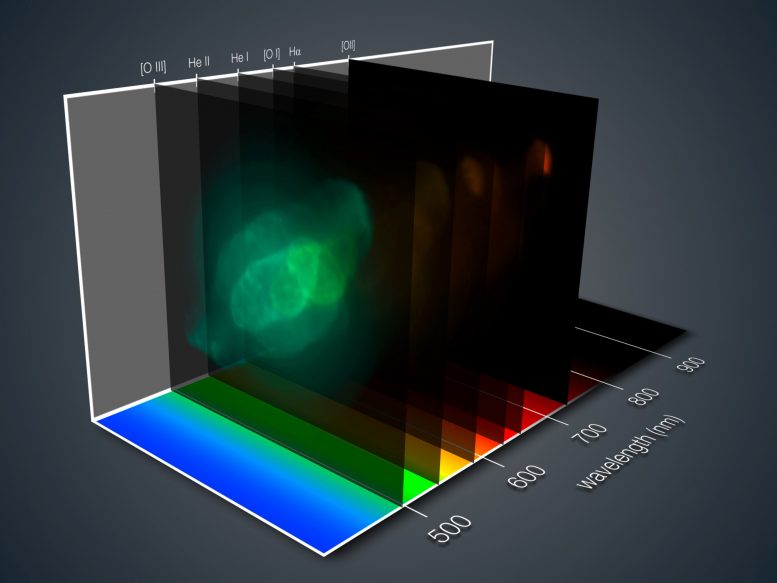
    This view shows how the MUSE instrument on ESO’s Very Large Telescope gives a three-dimensional depiction of the Saturn Nebula. For each part of this spectacular nebula, the light has been split up into its component colors — revealing in detail the chemical and physical properties of each pixel. During the subsequent analysis the astronomer can move through the data and study different views of the object at different wavelengths, just like tuning a television to different channels at different frequencies.

    In order to better understand how planetary nebulae are molded into such odd shapes, an international team of astronomers led by Jeremy Walsh from ESO used the Multi Unit Spectroscopic Explorer (MUSE) to peer inside the dusty veils of the Saturn Nebula. MUSE is an instrument installed on one of the four Unit Telescopes of the Very Large Telescope at ESO’s Paranal Observatory in Chile. It is so powerful because it doesn’t just create an image, but also gathers information about the spectrum — or range of colors — of the light from the object at each point in the image.

    The team used MUSE to produce the first detailed optical maps of the gas and dust distributed throughout a planetary nebula. The resulting image of the Saturn Nebula reveals many intricate structures, including an elliptical inner shell, an outer shell, and a halo. It also shows two previously imaged streams extending from either end of the nebula’s long axis, ending in bright ansae (Latin for “handles”).

    Intriguingly, the team also found a wave-like feature in the dust, which is not yet fully understood. Dust is distributed throughout the nebula, but there is a significant drop in the amount of dust at the rim of the inner shell, where it seems that it is being destroyed. There are several potential mechanisms for this destruction. The inner shell is essentially an expanding shock wave, so it may be smashing into the dust grains and obliterating them, or producing an extra heating effect that evaporates the dust.

    Mapping the gas and dust structures within planetary nebulae will aid in understanding their role in the lives and deaths of low-mass stars, and it will also help astronomers understand how planetary nebulae acquire their strange and complex shapes.

    But MUSE’s capabilities extend far beyond planetary nebulae. This sensitive instrument can also study the formation of stars and galaxies in the early Universe, as well as map the dark matter distribution in galaxy clusters in the nearby Universe. MUSE has also created the first 3D map of the Pillars of Creation in the Eagle Nebula and imaged a spectacular cosmic crash in a nearby galaxy.

    Never miss a breakthrough: Join the SciTechDaily newsletter.
    Follow us on Google and Google News.

    Astronomy European Southern Observatory MUSE
    Share. Facebook Twitter Pinterest LinkedIn Email Reddit

    Related Articles

    MUSE Spectrograph Reveals a Universe Aglow

    MUSE Instrument Reveals a Black Hole Hiding in Star Cluster NGC 3201

    MUSE Conducts the Deepest Spectroscopic Survey Ever

    MUSE Instrument Reveals a Gigantic Cosmic Bubble

    AOF and MUSE Provide Sharp Views of Planetary Nebulae and Galaxies

    Scientists Detect Dark Galaxies for the First Time

    Gas Cloud Headed Towards Milky Way’s Supermassive Black Hole

    No Evidence of Dark Matter Around the Sun

    Astronomers Combine Hundreds of Images of Carina Nebula to Reveal Thousands of Stars in Stellar Nursery

    2 Comments

    1. Smitty on December 13, 2020 2:12 am

      Awesome.

      Reply
    2. Smitty smith on December 13, 2020 2:14 am

      Awesome.

      Reply
    Leave A Reply Cancel Reply

    • Facebook
    • Twitter
    • Pinterest
    • YouTube

    Don't Miss a Discovery

    Subscribe for the Latest in Science & Tech!

    Trending News

    One of the Universe’s Largest Stars May Be Getting Ready To Explode

    Scientists Discover Enzyme That Could Supercharge Ozempic-Like Weight Loss Drugs

    Popular Sweetener Linked to DNA Damage – “It’s Something You Should Not Be Eating”

    Ancient “Rock” Microbes May Reveal How Complex Life Began

    Researchers Capture Quantum Interference in One of Nature’s Rarest Atoms

    “A Plague Is Upon Us”: The Mass Death That Changed an Ancient City Forever

    Scientists Discover Game-Changing New Way To Treat High Cholesterol

    This Small Change to Your Exercise Routine Could Be the Secret to Living Longer

    Follow SciTechDaily
    • Facebook
    • Twitter
    • YouTube
    • Pinterest
    • Newsletter
    • RSS
    SciTech News
    • Biology News
    • Chemistry News
    • Earth News
    • Health News
    • Physics News
    • Science News
    • Space News
    • Technology News
    Recent Posts
    • New Study Challenges 40-Year Puzzle About Childhood Body Fat
    • 20-Year Study Finds Daily Multivitamins Don’t Extend Lifespan
    • Landmark Study Links Never Marrying to Significantly Higher Cancer Risk
    • Revolutionary Imaging Technique Unlocks Secrets of Matter at Extreme Speeds
    • Where Does Mass Come From? Scientists Find Evidence of a New Exotic Nuclear State
    Copyright © 1998 - 2026 SciTechDaily. All Rights Reserved.
    • Science News
    • About
    • Contact
    • Editorial Board
    • Privacy Policy
    • Terms of Use

    Type above and press Enter to search. Press Esc to cancel.