
A novel telescope method detects faint nebulae in distant galaxies, improving distance measurements and refining estimates of the universe’s expansion rate.
Using data from the MUSE instrument, researchers at the Leibniz Institute for Astrophysics Potsdam (AIP) succeeded in detecting extremely faint planetary nebulae in distant galaxies. The method used, a filter algorithm in image data processing, opens up new possibilities for cosmic distance measurement – and thus also for determining the Hubble constant.
Planetary nebulae are known in the neighborhood of the Sun as colorful objects that appear at the end of a star’s life as it evolves from the red giant to white dwarf stage: when the star has used up its fuel for nuclear fusion, it blows off its gas envelope into interstellar space, contracts, becomes extremely hot, and excites the expanding gas envelope to glow. Unlike the continuous spectrum of the star, the ions of certain elements in this gas envelope, such as hydrogen, oxygen, helium, and neon, emit light only at certain wavelengths. Special optical filters tuned to these wavelengths can make the faint nebulae visible. The closest object of this kind in our Milky Way is the Helix Nebula, 650 light-years away.

The Challenge of Measuring Distant Nebulae
As the distance of a planetary nebula increases, the apparent diameter in an image shrinks, and the integrated apparent brightness decreases with the square of the distance. In our neighboring galaxy, the Andromeda Galaxy, at a distance almost 4000 times greater, the Helix Nebula would only be visible as a dot, and its apparent brightness would be almost 15 million times fainter. With modern large telescopes and long exposure times, such objects can nevertheless be imaged and measured using optical filters or imaging spectroscopy.
Martin Roth, first author of the new study and head of the innoFSPEC department at AIP: “Using the PMAS instrument developed at AIP, we succeeded in doing this for the first time with integral field spectroscopy for a handful of planetary nebulae in the Andromeda Galaxy in 2001 to 2002 on the 3.5 m (11.5 ft)telescope of the Calar Alto Observatory. However, the relatively small PMAS field-of-view did not allow yet to investigate a larger sample of objects.”
MUSE’s Vast Field of View Opens New Possibilities
It took a good 20 years to develop these first experiments further using a more powerful instrument with a more than 50 times larger field-of-view on a much larger telescope. MUSE at the Very Large Telescope in Chile was developed primarily for the discovery of extremely faint objects at the edge of the universe currently observable to us – and has produced spectacular results for this purpose since the first observations. It is precisely this property that also comes into play in the detection of extremely faint PN in a distant galaxy.
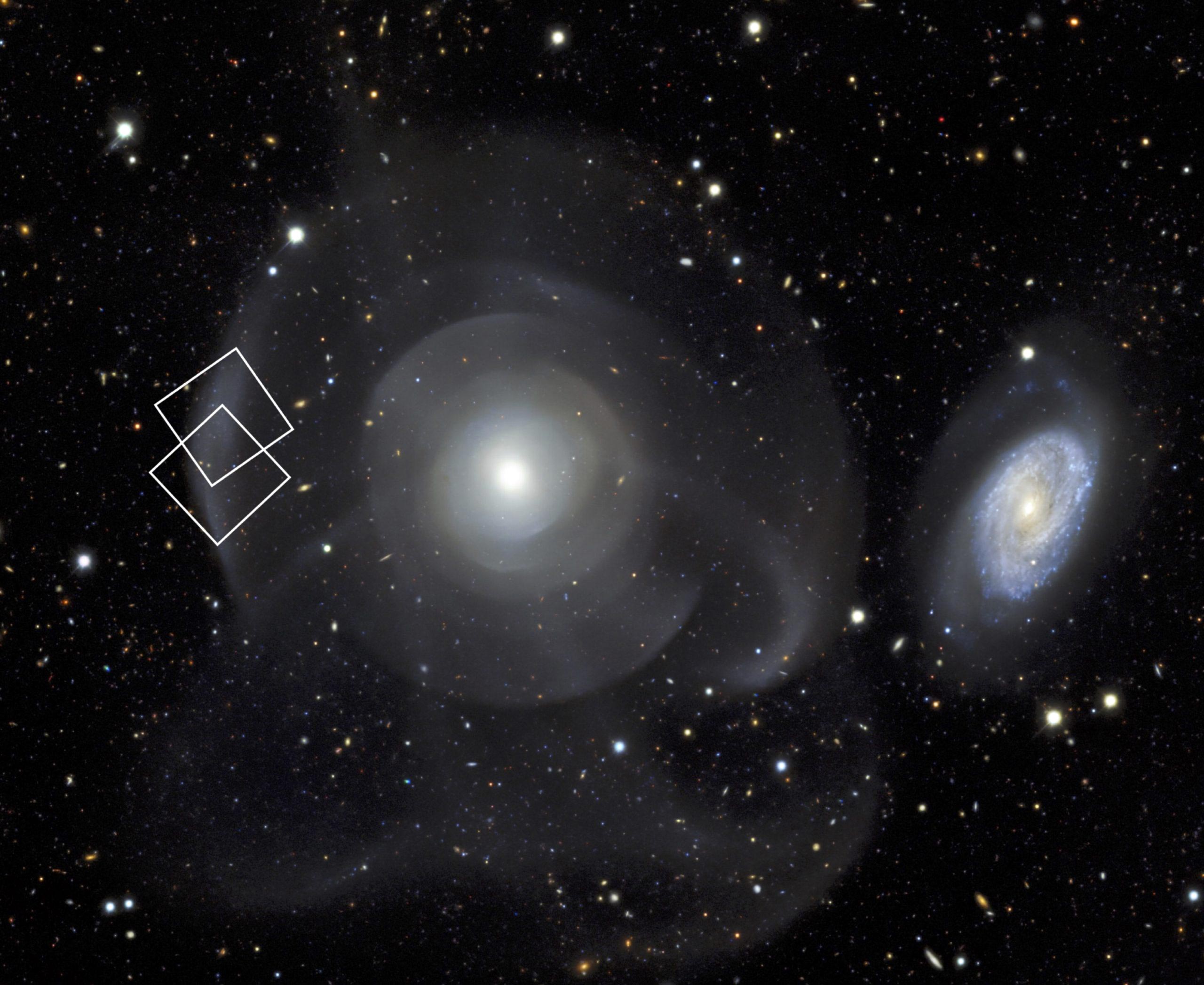
The galaxy NGC 474 is a particularly fine example of a galaxy that, through collision with other, smaller galaxies, has formed a conspicuous ring structure from the stars scattered by gravitational effects. It lies roughly 110 million light-years away, which is about 170,000 times further than the Helix Nebula. The apparent brightness of a planetary nebula in this galaxy is therefore almost 30 billion times lower than that of the Helix Nebula and is in the range of cosmologically interesting galaxies for which the team designed the MUSE instrument.
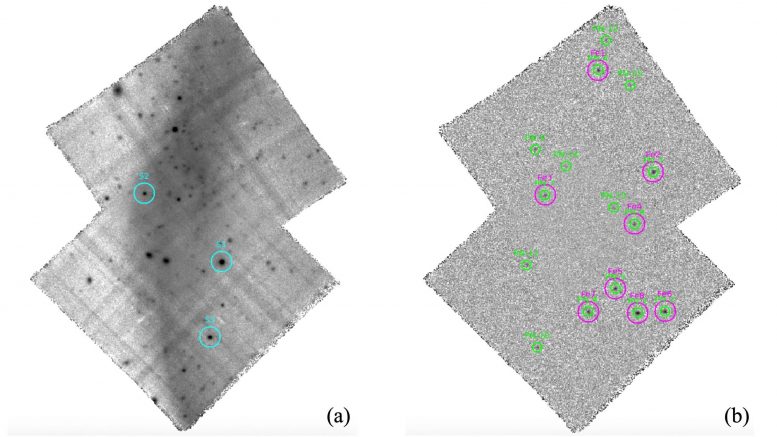
A team of researchers at the AIP, together with colleagues from the USA, has developed a method for using MUSE to isolate and precisely measure the extremely faint signals of planetary nebulae in distant galaxies with high sensitivity. A particularly effective filter algorithm in image data processing plays an important role here. For the ring galaxy NGC 474, ESO archive data were available, based on two very deep MUSE exposures with 5 hours of observation time each. The result of the data processing: after applying the filter algorithm, a total of 15 extremely faint planetary nebulae became visible.
Planetary Nebulae as Standard Candles
This highly sensitive procedure opens up a new method for distance measurement that is suitable for contributing to the solution of the currently discussed discrepancy in the determination of the Hubble constant. Planetary nebulae have the property that, physically, a certain maximum luminosity cannot be exceeded. The distribution function of the luminosities of a sample in a galaxy, i.e., the luminosity function of planetary nebulae (PNLF), breaks off at the bright end. This property is that of a standard candle, which can be used to calculate a distance by statistical methods. The PNLF method has been developed already in 1989 by team members George Jacoby (NSF’s NOIRLab) and Robin Ciardullo (Penn State University). It has been successfully applied to more than 50 galaxies over the past 30 years, but was limited by the filter measurements used so far. Galaxies with distances greater than that of the Virgo or Fornax clusters were beyond the range.
The study, now published in The Astrophysical Journal, shows that MUSE can achieve more than twice the range, allowing an independent measurement of the Hubble constant.
Reference: “Toward Precision Cosmology with Improved PNLF Distances Using VLT-MUSEI. Methodology and Tests” by Martin M. Roth, George H. Jacoby, Robin Ciardullo, Brian D. Davis, Owen Chase and Peter M. Weilbacher, 22 July 2021, The Astrophysical Journal.
DOI: 10.3847/1538-4357/ac02ca
Never miss a breakthrough: Join the SciTechDaily newsletter.
Follow us on Google and Google News.