

New findings reveal magnetic fields in three massive stars in the Magellanic Clouds, shedding light on the influence of magnetism on stellar evolution and the formation of neutron stars and black holes. The use of advanced spectropolarimetry techniques was crucial to overcome past observational challenges.
Magnetic fields have been discovered in three massive, hot stars within our neighboring galaxies, the Large and Small Magellanic Clouds, for the first time. Although magnetic fields in massive stars are not new to our own galaxy, their detection in the Magellanic Clouds is particularly significant due to the abundance of young, massive stars in these galaxies. This discovery offers a rare chance to investigate actively forming stars and explore the maximum mass a star can achieve while maintaining stability.
Impact of Magnetism on Star Evolution
Notably, magnetism is considered to be a key component in massive star evolution, with a far-reaching impact on their ultimate fate. It’s the massive stars with initially more than eight solar masses that leave behind neutron stars and black holes by the end of their evolution. Spectacular merging events of such compact remnant systems have been observed by gravitational wave observatories. Furthermore, theoretical studies propose a magnetic mechanism for the explosion of massive stars, relevant for gamma-ray bursts, x-ray flashes and supernovae.
“Studies of magnetic fields in massive stars in galaxies with young stellar populations provide crucial information on the role of magnetic fields in star formation in the early Universe with star-forming gas not polluted by metals,” says Dr. Swetlana Hubrig, from the Leibniz Institute for Astrophysics Potsdam (AIP) and first author of the study.
Challenges in Measuring Stellar Magnetism
Stellar magnetic fields are measured using spectropolarimetry. For this circularly polarised starlight is recorded and the smallest changes in spectral lines are investigated. However, in order to achieve the necessary accuracy of the polarization measurements, this method requires high-quality data.
“The method is extremely hungry for photons. This is a special challenge because even the brightest massive stars, which have more than eight solar masses, are relatively light-poor when observed in our neighboring galaxies, the Large and the Small Magellanic Clouds,” as Dr. Silva Järvinen from the AIP explains.
Because of these conditions, conventional high-resolution spectropolarimeters and smaller telescopes are unsuitable for such investigations. Therefore, the low-resolution spectropolarimeter FORS2 was used, which is mounted on one of the four 8-meter telescopes of the Very Large Telescope (VLT) of the European Southern Observatory (ESO).
Previous Challenges and Breakthroughs in Detection
Previous attempts to detect magnetic fields in massive stars outside our galaxy were unsuccessful. These measurements are complex and depend on several factors. The magnetic field that is measured with circular polarization is called the longitudinal magnetic field, and it corresponds exclusively to the field component that points in the direction of the observer. It is similar to the light coming from a lighthouse, which is easy to see when the beam shines towards the observer.
Because the magnetic field structure in massive stars is usually characterized by a global dipole with the axis inclined to the rotation axis, the strength of the longitudinal magnetic field can be zero at rotation phases when the observer is looking directly at the magnetic equator of the rotating star. The detectability of the polarization signal also depends on the number of spectral features used to investigate the polarization. The observation of a broader spectral region with a larger number of spectral features is preferable. In addition, longer exposure times are crucial for recording polarimetric spectra with a sufficiently high signal-to-noise ratio.
Recent Observations and Findings
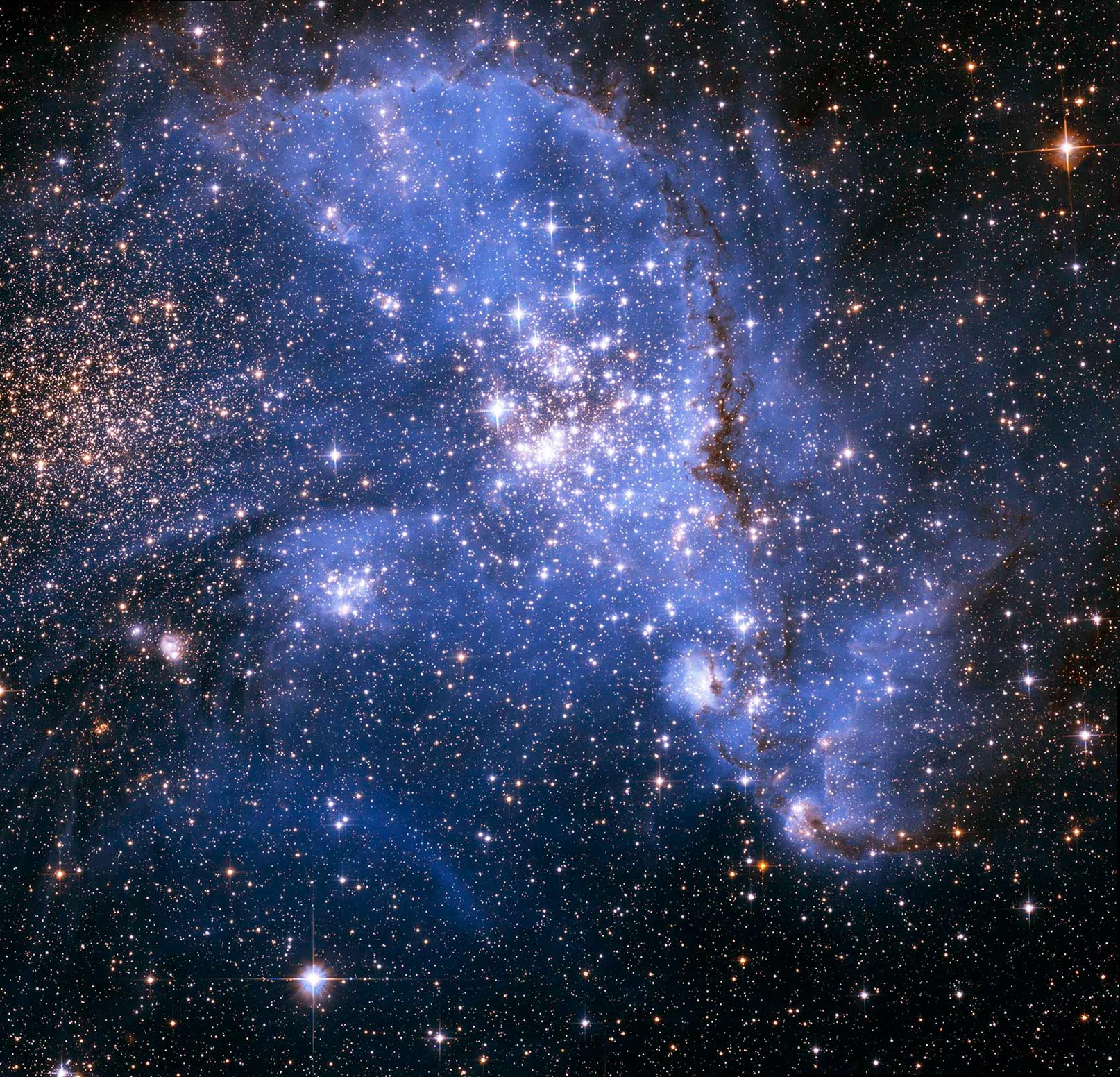
Taking these important factors into account, the team carried out spectropolarimetric observations of five massive stars in the Magellanic Clouds. In two presumably single stars with spectral characteristics typical for magnetic massive stars in our own galaxy and in one actively interacting massive binary system (Cl*NGC346 SSN7) located within the core of the most massive star-forming region NGC346 in the Small Magellanic Cloud, they succeeded to detect magnetic fields of the order of kiloGauss. On our Sun’s surface, such strong magnetic fields can only be detected in small highly magnetized regions — the sunspots.
The reported magnetic field detections in the Magellanic Clouds present the first indication that massive star formation proceeds in galaxies with young stellar populations in a similar way as in our galaxy.
Never miss a breakthrough: Join the SciTechDaily newsletter.
Follow us on Google and Google News.