
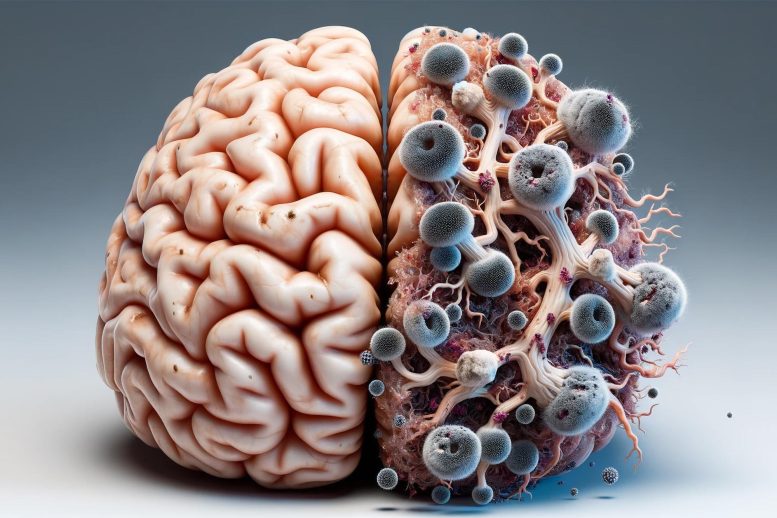
A study from Baylor College of Medicine found that the fungus Candida albicans can produce toxic peptides linked to Alzheimer’s disease, suggesting the fungus might play a role in its development. This new insight warrants further research for potential treatments.
Previous research has implicated fungi in chronic neurodegenerative conditions such as Alzheimer’s disease, but there is limited understanding of how these common microbes could be involved in the development of these conditions.
Working with animal models, researchers at Baylor College of Medicine and collaborating institutions discovered how the fungus Candida albicans enters the brain, activates two separate mechanisms in brain cells that promote its clearance, and, important for the understanding of Alzheimer’s disease development, generates amyloid beta (Ab)-like peptides, toxic protein fragments from the amyloid precursor protein that are considered to be at the center of the development of Alzheimer’s disease. The study was published on October 10 in the journal Cell Reports.
Connecting the Fungus and Alzheimer’s Disease
“Our lab has years of experience studying fungi, so we embarked on the study of the connection between C. albicans and Alzheimer’s disease in animal models,” said corresponding author Dr. David Corry, Fulbright Endowed Chair in Pathology and professor of pathology and immunology and medicine at Baylor. He also is a member of Baylor’s Dan L Duncan Comprehensive Cancer Center. “In 2019, we reported that C. albicans does get into the brain where it produces changes that are very similar to what is seen in Alzheimer’s disease. The current study extends that work to understand the molecular mechanisms.”
“Our first question was, how does C. albicans enter the brain? We found that C. albicans produces enzymes called secreted aspartic proteases (Saps) that breakdown the blood-brain barrier, giving the fungus access to the brain where it causes damage,” said first author Dr. Yifan Wu, postdoctoral scientist in pediatrics working in the Corry lab.
Fungal Clearance Mechanisms
Next, the researchers asked, how is the fungus effectively cleared from the brain? Corry and his colleagues had previously shown that a C. albicans brain infection is fully resolved in otherwise healthy mice after 10 days. In this study, they reported that this occurred thanks to two mechanisms triggered by the fungus in brain cells called microglia.
“The same Saps that the fungus uses to break the blood-brain barrier also break down the amyloid precursor protein into AB-like peptides,” Wu said. “These peptides activate microglial brain cells via a cell surface receptor called Toll-like receptor 4, which keeps the fungi load low in the brain, but does not clear the infection.”
C. albicans also produces a protein called candidalysin that also binds to microglia via a different receptor, CD11b. “Candidalysin-mediated activation of microglia is essential for clearance of Candida in the brain,” Wu said. “If we take away this pathway, fungi are no longer effectively cleared in the brain.”
New Insights on Alzheimer’s Disease Development
“This work potentially contributes an important new piece of the puzzle regarding the development of Alzheimer’s disease,” Corry said. “The current explanation for this condition is that it is mostly the result of the accumulation of toxic Ab-like peptides in the brain that leads to neurodegeneration. The dominant thinking is that these peptides are produced endogenously, our own brain proteases break down the amyloid precursor proteins generating the toxic Ab peptides.”
Here, the researchers show that the Ab-like peptides also can be generated from a different source – C. albicans. This common fungus, which has been detected in the brains of people with Alzheimer’s disease and other chronic neurodegenerative disorders, has its own set of proteases that can generate the same Ab-like peptides the brain can generate endogenously.
“We propose that the brain Ab-peptide aggregates that characterize multiple Candida-associated neurodegenerative conditions including Alzheimer’s disease, Parkinson’s disease, and others, may be generated both intrinsically by the brain and by C. albicans,” Corry said. “These findings in animal models support conducting further studies to evaluate the role of C. albicans in the development of Alzheimer’s disease in people, which can potentially lead to innovative therapeutic strategies.”
Reference: “Toll-like receptor 4 and CD11b expressed on microglia coordinate eradication of Candida albicans cerebral mycosis” by Yifan Wu, Shuqi Du, Lynn H. Bimler, Kelsey E. Mauk, Léa Lortal, Nessim Kichik, James S. Griffiths, Radim Osicka, Lizhen Song, Katherine Polsky, Lydia Kasper, Peter Sebo, Jill Weatherhead, J. Morgan Knight, Farrah Kheradmand, Hui Zheng, Jonathan P. Richardson, Bernhard Hube, Julian R. Naglik and David B. Corry, 10 October 2023, Cell Reports.
DOI: 10.1016/j.celrep.2023.113240
Never miss a breakthrough: Join the SciTechDaily newsletter.
Follow us on Google and Google News.