
Close Menu
    Facebook X (Twitter) Instagram
    SciTechDaily
    • Biology
    • Chemistry
    • Earth
    • Health
    • Physics
    • Science
    • Space
    • Technology
    Facebook X (Twitter) Pinterest YouTube RSS
    SciTechDaily
    Home»Science»Musicians Have Brains With Stronger Connections Than Non-musicians
    Science

    Musicians Have Brains With Stronger Connections Than Non-musicians

    By Society for NeuroscienceJanuary 25, 20211 Comment2 Mins Read
    Facebook Twitter Pinterest Telegram LinkedIn WhatsApp Email Reddit
    Share
    Facebook Twitter LinkedIn Pinterest Telegram Email Reddit
    Brain Network Artist Concept
    New research shows that musicians exhibit stronger structural and functional connections in their brains compared to non-musicians, regardless of their innate pitch ability.

    Musicians’ Brains Are Uniquely Wired

    The brains of musicians have stronger structural and functional connections compared to those of non-musicians, regardless of innate pitch ability, according to new research from JNeurosci.

    Years of musical training shape the brain in dramatic ways. A minority of musicians — with Mozart and Michael Jackson in their ranks — also possess absolute pitch, the ability to identify a tone without a reference. But, it remains unclear how this ability impacts the brain.
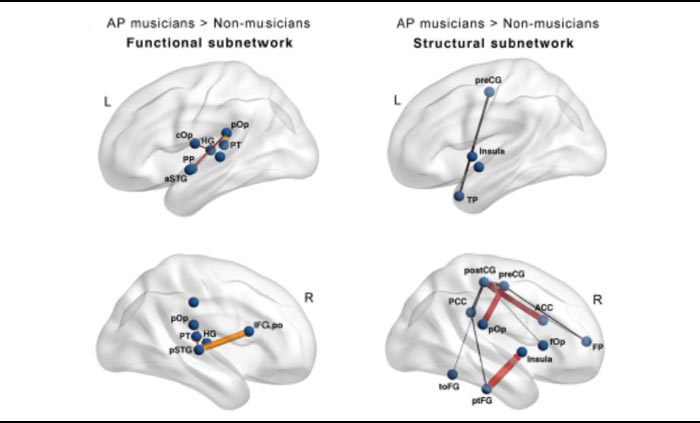
    Musicians Have More Connected Brains
    Subnetworks with increased connectivity in absolute pitch (AP) musicians compared to non-musicians. Credit: Leipold et al., JNeurosci 2021

    In the biggest sample to date, Leipold et al. compared the brains of professional musicians, some with absolute pitch and some without, to non-musicians. To the team’s surprise, there were no strong differences between the brains of musicians with and without absolute pitch ability; instead absolute pitch may shape the brain in more subtle ways.

    The Power of Early Musical Training

    Compared to non-musicians, both types of musicians had stronger functional connectivity — the synchronized activity of brain regions — in the auditory regions of both brain hemispheres. Musicians also had stronger white matter connections between auditory regions and lobes involved in various types of high-level processing. Musicians that began their training at a younger age had stronger structural connections than musicians with a later start.

    These results demonstrate how experience shapes the brain, especially early in life, and how enhanced musical skills are represented in our brain.

    Reference: “Musical Expertise Shapes Functional and Structural Brains Networks Independent of Absolute Pitch Ability” by Simon Leipold, Carina Klein and Lutz Jäncke, 25 January 2021, Journal of Neuroscience.
    DOI: 10.1523/JNEUROSCI.1985-20.2020

    Never miss a breakthrough: Join the SciTechDaily newsletter.
    Follow us on Google and Google News.

    Behavioral Science Brain Neuroscience Society for Neuroscience
    Share. Facebook Twitter Pinterest LinkedIn Email Reddit

    Related Articles

    New Research Reveals Why We Help Some People but Not Others

    A Mathematical Equation Can Uncover Your Preferences via Brain Activity and Mood

    Brain Activity Reveals When White Lies Are Selfish

    Neuroscientists Track How Bad Moods Develop and Persist in the Brain

    Infant Brain Circuitry Shaped by Language Exposure

    “Area 32” – How the Brain Balances Emotion and Reason

    Why Time Sometimes Flies or Drags: How the Brain Creates the Experience of Time

    Scientists Can See the Bias in Your Brain – Even Before You Make Your Decision

    The Science of a Hit Song – Unlocking the Secrets of Musical Pleasure

    1 Comment

    1. Carolyn L Zaremba on January 25, 2021 2:10 pm

      And yet in American public schools, funding for the arts and especially music have been slashed to the bone. I am a singer, but do not play an instrument. This article doesn’t differentiate between instrument players and singers who only sing. I would like to know more. I was classically trained in voice.

      Reply
    Leave A Reply Cancel Reply

    • Facebook
    • Twitter
    • Pinterest
    • YouTube

    Don't Miss a Discovery

    Subscribe for the Latest in Science & Tech!

    Trending News

    A Woman Who Lived 30,000 Years Ago Is Changing What We Know About Ice Age Europe

    A Rare Radioactive Element Reveals a Hidden Secret About the Heaviest Atoms

    Breakthrough Cancer Treatment Wipes Out Deadly Brain Tumors in Every Mouse Tested

    Something Remarkable Is Happening to Dogs Living Near Chernobyl’s Nuclear Plant

    Hubble Uncovers a Mysterious 93-Billion-Mile Structure Hiding in a Nearby Star System

    Earth’s Oceans Were Slowly Suffocating Millions of Years Before a Devastating Mass Extinction

    Why Are Men Twice As Likely To Develop Parkinson’s? Scientists Discover a Hidden Clue in the Brain

    Scientists Finally Identify Mysterious Creature Nearly 90 Years After It Was First Found

    Follow SciTechDaily
    • Facebook
    • Twitter
    • YouTube
    • Pinterest
    • Newsletter
    • RSS
    SciTech News
    • Biology News
    • Chemistry News
    • Earth News
    • Health News
    • Physics News
    • Science News
    • Space News
    • Technology News
    Recent Posts
    • Scientists Spent 7 Years Studying Moth Wings and Discovered Something Unexpected
    • Scientists Discover Crows Make Decisions Twice As Fast as Humans
    • A Tiny, Jelly-Like Implant Could Change How We Treat High Blood Pressure
    • Less Sugar in Early Life Could Protect Your Mental Health Decades Later
    • Animal vs. Plant Protein: New Study Reveals Unexpected Testosterone Differences
    Copyright © 1998 - 2026 SciTechDaily. All Rights Reserved.
    • Science News
    • About
    • Contact
    • Editorial Board
    • Privacy Policy
    • Terms of Use

    Type above and press Enter to search. Press Esc to cancel.