
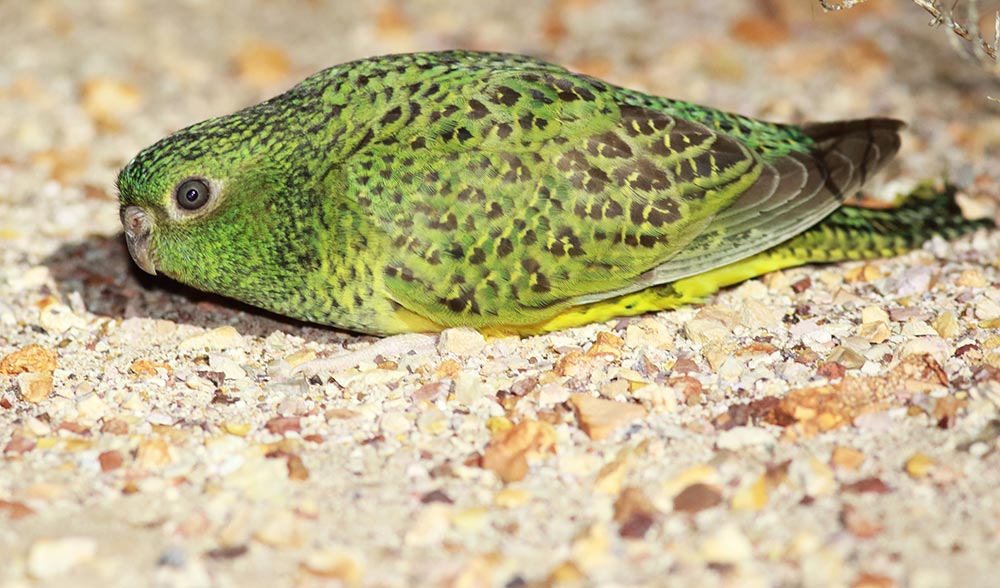
Australia’s most elusive bird, the Night Parrot, may not be much better at seeing in the dark than other parrots active during the day.
An international study, co-led by Flinders University’s Dr. Vera Weisbecker, has revealed the critically endangered parrot’s visual system is not as well-adapted to life in the dark as would be expected for a nocturnal bird, raising concerns it might be adversely impacted by fencing in the Australian outback.
“Night Parrots must be able to find their way at night — to find food, avoid obstacles while flying, and escape predators,” says Dr. Weisbecker.
“We therefore expect their visual system to show adaptations for seeing in the dark, similar to other nocturnal birds — New Zealand’s Kakapo parrot and owls with enlarged eyes for example. However, we found that this wasn’t the case.”
Dr. Karine Mardon, from The National Imaging Facility at The University of Queensland Centre for Advanced Imaging, scanned the then only known intact skull of the exceedingly rare species, as well as skulls from related parrots, using computed tomography (CT scanning).
Co-author Aubrey Keirnan then compared 3D reconstructions of the Night Parrot’s skull and brain with that of related parrot species.
“We found that the Night Parrot has similar eye size to other parrots, with smaller optic nerves. It also has smaller optic lobes, which are visual processing areas in the brain.”

“This suggests that the Night Parrot may not be great at seeing in the dark: its vision is likely sensitive, but with poor resolution, so that it might not be good at distinguishing obstacles like wire fences or even predators in dark conditions.”
The findings raise questions about the night parrot’s ability to survive with low numbers in remote outback Australia- where fencing is important for stock management and predator exclusion.
Dr. Andrew Iwaniuk, from The University of Lethbridge (Canada), says the use of anatomical observations to infer the species’ behavior was an innovative approach to understanding a species so rare it was considered extinct for most of the 20th Century.
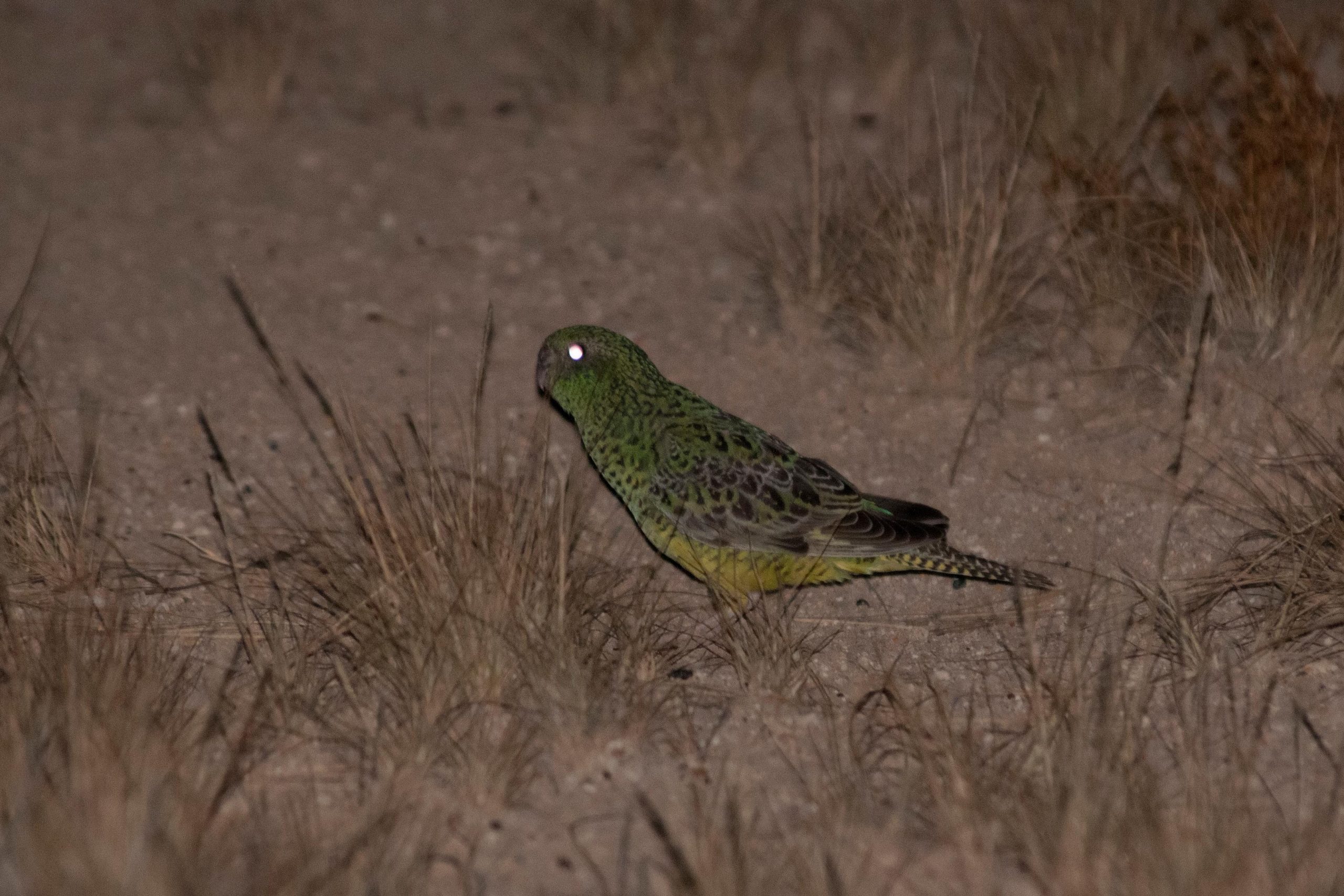
“The species is so elusive that we do not even know how many individuals are left. To conserve the species, it is critical that we understand its behavioral needs and capabilities, but these are nearly impossible to observe.”
“The Queensland Museum bird collection is an important research resource and co-author, collection manager Heather Janetzki, made available the extremely valuable Night Parrot specimen along with several other species for this comparative study.”
Dr. Weisbecker says the research team were lucky to have this specimen — found in 1990 by Australian Museum bird expert Dr. Walter Boles.
“He spotted its mummified body by accident, lying by the side of the road after apparently being hit by a truck — it is amazing that its skull stayed intact!”
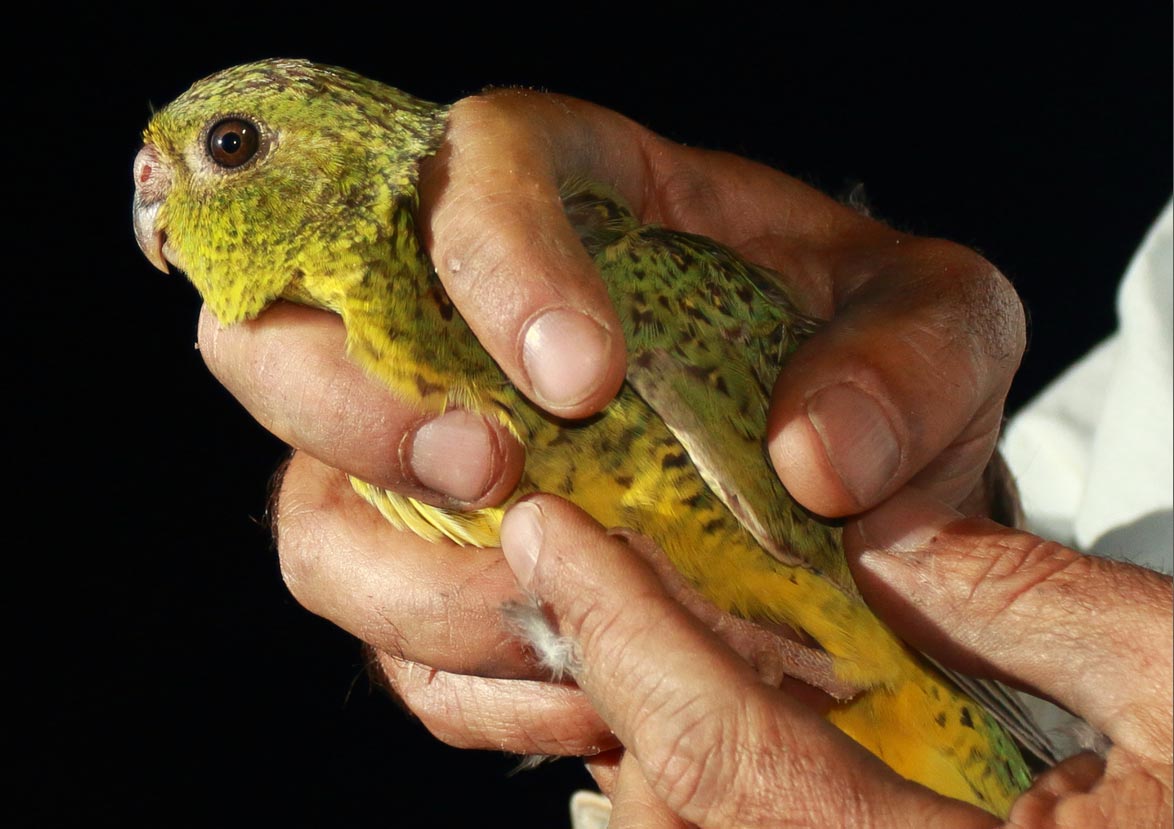
Night Parrot specialist and Ph.D. student Nick Leseberg from UQ’s School of Earth and Environmental Sciences was a co-author of the study.
“These results suggest that removal of unused fences should be a priority in areas where night parrots are known to occur. However, we probably can’t go entirely without fences — stock needs to be managed with fences, and some forms of predator exclusion could be important for protecting the Night Parrot.”
“We therefore need to be very careful with our fencing strategies, at least by increasing the visibility of wire fences, but alternatives such as low-tension electric fencing could be even better.”
Background info
Night parrots are one of only two nocturnal parrot species worldwide (the other is New Zealand’s famous Kakapo), exceedingly rare, and live well-hidden in remote outback Australia.
So well-hidden in fact that the first physical evidence of the Night Parrot’s persistence after 1875 came in 1990, when the then curator of birds at the Australian Museum, Walter Boles, literally bumped into a mummified specimen lying by the side of the road.
It took another 23 years for the first verified live sightings of the species in Queensland. Since then, a team of scientists and conservationists have been working hard to protect the night parrot.
Reference: “The endocast of the Night Parrot (Pezoporus occidentalis) reveals insights into its sensory ecology and the evolution of nocturnality in birds” by Andrew N. Iwaniuk, Aubrey R. Keirnan, Heather Janetzki, Karine Mardon, Stephen Murphy, Nicholas P. Leseberg and Vera Weisbecker, 9 June 2020, Scientific Reports.
DOI: 10.1038/s41598-020-65156-0
Never miss a breakthrough: Join the SciTechDaily newsletter.
Follow us on Google and Google News.
1 Comment
Please amend the credits for the CT image correctly.
The correct image credit for this image is: Dr Karine Mardon and Aubrey Keirnan, UQ Centre for Advanced Imaging.
Thank you.