
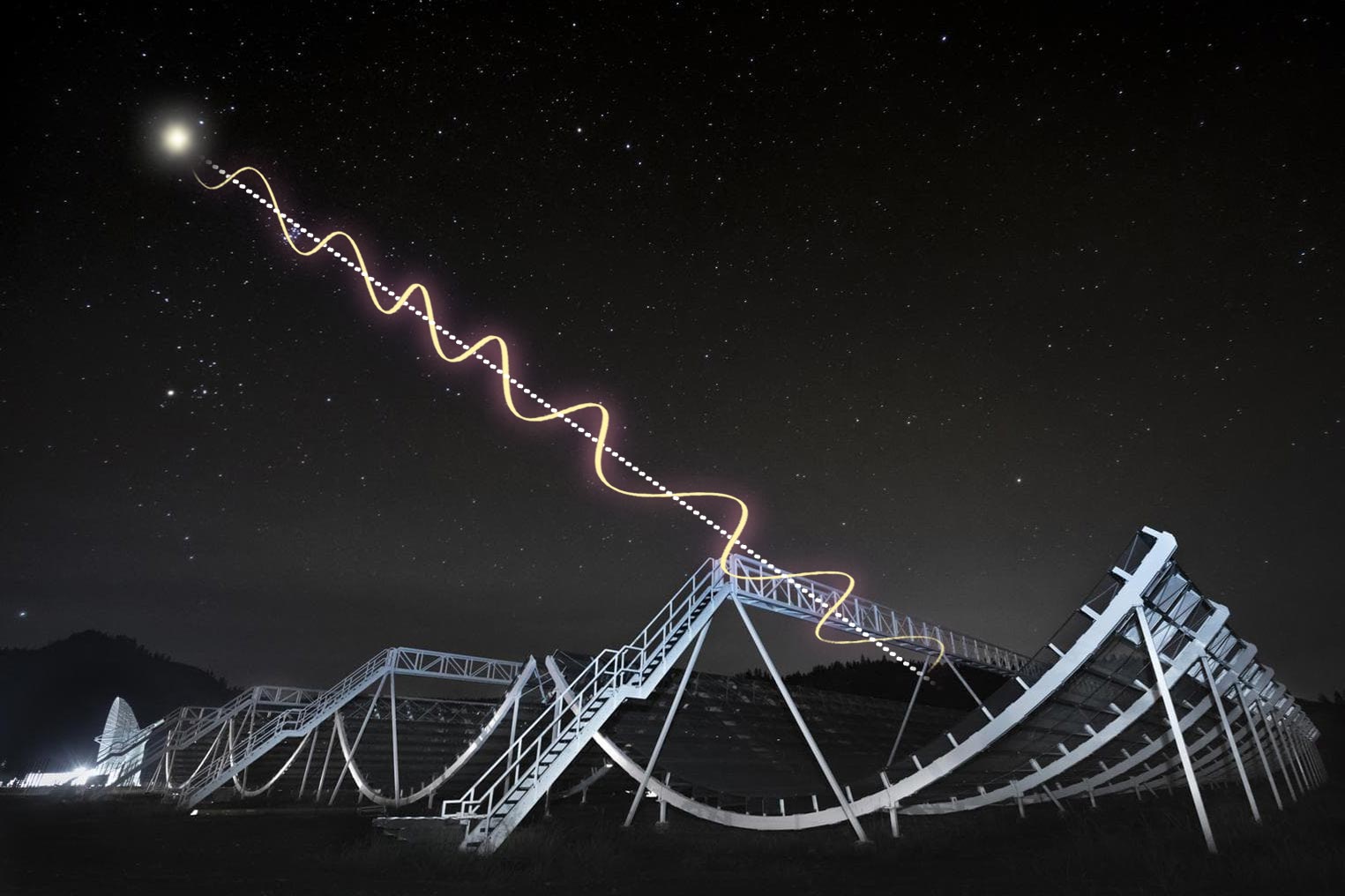
A study analyzing the properties of polarized light from 128 non-repeating FRBs reveals mysterious cosmic explosions originate in far-away galaxies like our own Milky Way.
New research from the University of Toronto utilizing data from the Canadian Hydrogen Intensity Mapping Experiment reveals that the majority of Fast Radio Bursts (FRBs) likely originate from environments similar to our Milky Way, with modest densities and magnetic fields. This finding contrasts with earlier studies which suggested that repeating FRBs come from highly magnetized areas.
Fast Radio Burst Research Advancements
What scientists previously thought about where Fast Radio Bursts (FRBs) come from is just the tip of the iceberg, according to new research led by astronomers at the University of Toronto. The mysteries of the millisecond-long cosmic explosions are unfolding with a new way of analyzing data from the Canadian Hydrogen Intensity Mapping Experiment (CHIME).
Published today (June 11) in The Astrophysical Journal, the study details the properties of polarized light from 128 non-repeating FRBs — those from sources that have only produced a single burst to date. It finds that they appear to come from galaxies like our own Milky Way with modest densities and modest magnetic fields.
Contrasting FRB Sources
Previous studies of FRBs have focused on much smaller samples of hyperactive repeating sources that, in contrast, appear to originate in dense, extremely magnetized environments. Only about 3 percent of known FRBs repeat, coming from a source that has produced multiple bursts since being found.
Most radio telescopes can only see small points in the sky, making it easier to focus on repeating FRBs with known positions. CHIME can survey an extremely large area of the sky to detect both repeating and non-repeating FRBs.
New Analytical Techniques for FRBs
“This was the first look at the other 97 percent,” says lead author Ayush Pandhi, a PhD student at the Dunlap Institute for Astronomy & Astrophysics and the David A. Dunlap Department of Astronomy & Astrophysics at the University of Toronto. “It allows us to reconsider what we think FRBs are and see how repeating and non-repeating FRBs may be different.”
First detected in 2007, FRBs are extremely energetic flashes from distant sources across the universe. While over 1,000 FRBs have been cataloged since then, scientists do not yet know exactly where or how they are produced. They have also questioned whether repeating and non-repeating FRBs originate in similar environments.
Understanding FRB Light Properties
“This is a new way to analyze the data we have on FRBs. Instead of just looking at how bright something is, we’re also looking at the angle of the light’s vibrating electromagnetic waves,” says Pandhi. “It gives you additional information about how and where that light is produced, and what it has passed through on its journey to us over many millions of light years.”
All light travels as waves that we interpret as different colors depending on the lengths between its peaks and valleys. Much of the light in the universe travels in wavelengths that the human eye cannot see, including light from FRBs, but radio telescopes like CHIME can.
Polarized light is made up of waves that vibrate in a single plane—vertically, horizontally, or another angle in between. The direction that light from FRBs is polarized was seen to change in two ways: with time and with the color of the light. These changes can explain how an FRB might have been produced and what kind of material it passes through on its journey to Earth.
Studying how the direction of polarization changes for different colors of the light can tell us about the local density of where an FRB is produced and the strength of the magnetism that is present within it.
Conclusions on FRB Origins
To determine what FRBs are and how they are produced, scientists need to understand their local environments. This study concludes that most FRBs, those that do not repeat, are not like the few repeating sources that have been previously studied. It suggests that this sample is either a separate population or more evolved versions of the same population that originate in a less extreme environment with a lower burst rate.
Reference: “Polarization Properties of 128 Nonrepeating Fast Radio Bursts from the First CHIME/FRB Baseband Catalog” by Ayush Pandhi, Ziggy Pleunis, Ryan Mckinven, B. M. Gaensler, Jianing Su, Cherry Ng, Mohit Bhardwaj, Charanjot Brar, Tomas Cassanelli, Amanda Cook, Alice P. Curtin, Victoria M. Kaspi, Mattias Lazda, Calvin Leung, Dongzi Li, Kiyoshi W. Masui, Daniele Michilli, Kenzie Nimmo, Aaron B. Pearlman, Emily Petroff, Masoud Rafiei-Ravandi, Ketan R. Sand, Paul Scholz, Kaitlyn Shin, Kendrick Smith and Ingrid Stairs, 11 June 2024, The Astrophysical Journal.
DOI: 10.3847/1538-4357/ad40aa
Collaborating institutions include the Dunlap Institute at the University of Toronto, the University of California Santa Cruz, University of Amsterdam, and McGill University.
The CHIME project is co-led by the University of British Columbia, McGill University, University of Toronto and the Dominion Radio Astrophysical Observatory with collaborating institutions across North America. It is located at the Dominion Radio Astrophysical Observatory, a national facility for astronomy operated by the National Research Council of Canada, on the traditional, ancestral, and unceded territory of the Syilx/Okanagan people.
The Dunlap Institute for Astronomy & Astrophysics in the Faculty of Arts & Science at the University of Toronto is an endowed research institute with over 80 faculty, postdocs, students and staff, dedicated to innovative technology, groundbreaking research, world-class training and public engagement.
The research themes of its faculty and Dunlap Fellows span the Universe and include: optical, infrared and radio instrumentation, Dark Energy, large-scale structure, the Cosmic Microwave Background, the interstellar medium, galaxy evolution, cosmic magnetism, and time-domain science.
The Dunlap Institute, the David A. Dunlap Department of Astronomy & Astrophysics and other researchers across the University of Toronto’s three campuses together comprise the leading concentration of astronomers in Canada, at the leading research university in the country.
Never miss a breakthrough: Join the SciTechDaily newsletter.
Follow us on Google and Google News.