

Researchers have linked the origins of fast radio bursts to magnetars, highly magnetized neutron stars, which often arise from the mergers of massive stars in star-forming galaxies.
By utilizing the Deep Synoptic Array-110, they’ve localized 70 FRBs, discovering that these bursts are more frequent in massive, metal-rich galaxies. This suggests that the environmental conditions conducive to FRB occurrence are also ideal for magnetar formation.
Unveiling the Mystery of Fast Radio Bursts
Since their discovery in 2007, fast radio bursts (FRBs)—extremely energetic pulses of radio waves—have been repeatedly observed, sparking an intense search by astronomers to identify their origins. Hundreds of these bursts have now been confirmed, and scientists believe they are likely triggered by highly magnetized neutron stars, known as magnetars. Neutron stars, remnants of massive stars that have exploded in supernovae, are among the densest objects in the universe. A critical piece of evidence supporting the magnetar theory came when a magnetar in our own galaxy erupted, and several observatories, including Caltech’s STARE2 project (Survey for Transient Astronomical Radio Emission 2), captured the event in real time.
In new research published in Nature, a Caltech-led team has pinpointed where FRBs are most likely to occur: in massive, star-forming galaxies rather than in smaller, low-mass ones. This discovery offers fresh insights into how magnetars might form. The study suggests that these unusual dead stars, with magnetic fields a staggering 100 trillion times stronger than Earth’s, often arise when two stars merge and subsequently explode as a supernova. Previously, it was unclear if magnetars formed in this way—from the explosion of two merging stars—or if they could also form from the explosion of a single star.

Insights on Magnetar Formation
“The immense power output of magnetars makes them some of the most fascinating and extreme objects in the universe,” says Kritti Sharma, lead author of the new study and a graduate student working with Vikram Ravi, an assistant professor of astronomy at Caltech. “Very little is known about what causes the formation of magnetars upon the death of massive stars. Our work helps to answer this question.”
The project began with a search for FRBs using the Deep Synoptic Array-110 (DSA-110), a Caltech project funded by the National Science Foundation and based at the Owens Valley Radio Observatory near Bishop, California. To date, the sprawling radio array has detected and localized 70 FRBs to their specific galaxy of origin (only 23 other FRBs have been localized by other telescopes). In the current study, the researchers analyzed 30 of these localized FRBs.

FRB Occurrences in Star-Forming Galaxies
“DSA-110 has more than doubled the number of FRBs with known host galaxies,” says Ravi. “This is what we built the array to do.”
Although FRBs are known to occur in galaxies that are actively forming stars, the team, to its surprise, found that the FRBs tend to occur more often in massive star-forming galaxies than low-mass star-forming galaxies. This alone was interesting because the astronomers had previously thought that FRBs were going off in all types of active galaxies.
Metal-Rich Galaxies: A Hotspot for Magnetars
With this new information, the team started to ponder what the results revealed about FRBs. Massive galaxies tend to be metal-rich because the metals in our universe—elements that are manufactured by stars—take time to build up over the course of cosmic history. The fact that FRBs are more common in these metal-rich galaxies implies that the source of FRBs, magnetars, are also more common to these types of galaxies.
Stars that are rich in metals—which in astronomical terms means elements heavier than hydrogen and helium—tend to grow larger than other stars. “Over time, as galaxies grow, successive generations of stars enrich galaxies with metals as they evolve and die,” Ravi says.
What is more, massive stars that explode in supernovae and can become magnetars are more commonly found in pairs. In fact, 84 percent of massive stars are binaries. So, when one massive star in a binary is puffed up due to extra metal content, its excess material gets yanked over to its partner star, which facilitates the ultimate merger of the two stars. These merged stars would have a greater combined magnetic field than that of a single star.
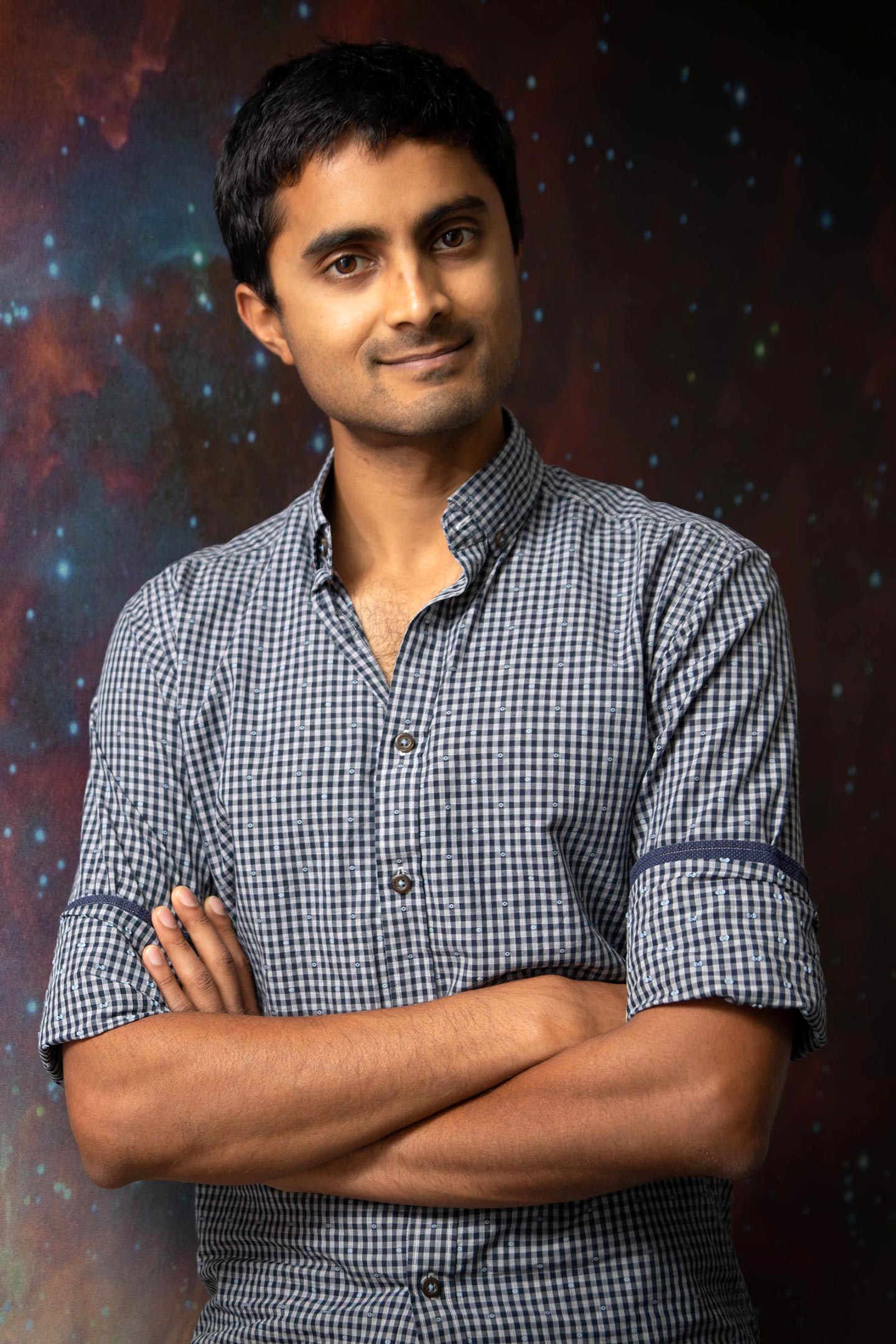
“A star with more metal content puffs up, drives mass transfer, culminating in a merger, thus forming an even more massive star with a total magnetic field greater than what the individual star would have had,” Sharma explains.
In summary, since FRBs are preferentially observed in massive and metal-rich star-forming galaxies, then magnetars (which are thought to trigger FRBs) are probably also forming in metal-rich environments conducive to the merging of two stars. The results therefore hint that magnetars across the universe originate from the remnants of stellar mergers.
Future Plans for FRB Exploration
In the future, the team hopes to hunt down more FRBs and their places of origin using DSA-110, and eventually the DSA-2000, an even bigger radio array planned to be built in the Nevada desert and completed in 2028.
“This result is a milestone for the whole DSA team. A lot of the authors on this paper helped build the DSA-110,” Ravi says. “And the fact that the DSA-110 is so good at localizing FRBs bodes well for the success of DSA-2000.”
Reference: “Preferential occurrence of fast radio bursts in massive star-forming galaxies” by Kritti Sharma, Vikram Ravi, Liam Connor, Casey Law, Stella Koch Ocker, Myles Sherman, Nikita Kosogorov, Jakob Faber, Gregg Hallinan, Charlie Harnach, Greg Hellbourg, Rick Hobbs, David Hodge, Mark Hodges, James Lamb, Paul Rasmussen, Jean Somalwar, Sander Weinreb, David Woody, Joel Leja, Shreya Anand, Kaustav Kashyap Das, Yu-Jing Qin, Sam Rose, Dillon Z. Dong, Jessie Miller and Yuhan Yao, 6 November 2024, Nature.
DOI: 10.1038/s41586-024-08074-9
The studywas funded by the National Science Foundation. Other Caltech authors include Liam Connor, Casey Law, Stella Koch Ocker, Myles Sherman, Nikita Kosogorov, Jakob Faber, Gregg Hallinan, Charlie Harnach, Greg Hellbourg, Rick Hobbs, David Hodge, Mark Hodges, James Lamb, Paul Rasmussen, Jean Somalwar, Sander Weinreb, David Woody, Shreya Anand, Kaustav Kashyap Das, Yu-Jing Qin, Sam Rose, Dillon Z. Dong, Jessie Miller, and Yuhan Yao. Joel Leja from The Pennsylvania State University is also an author.
Never miss a breakthrough: Join the SciTechDaily newsletter.
Follow us on Google and Google News.