
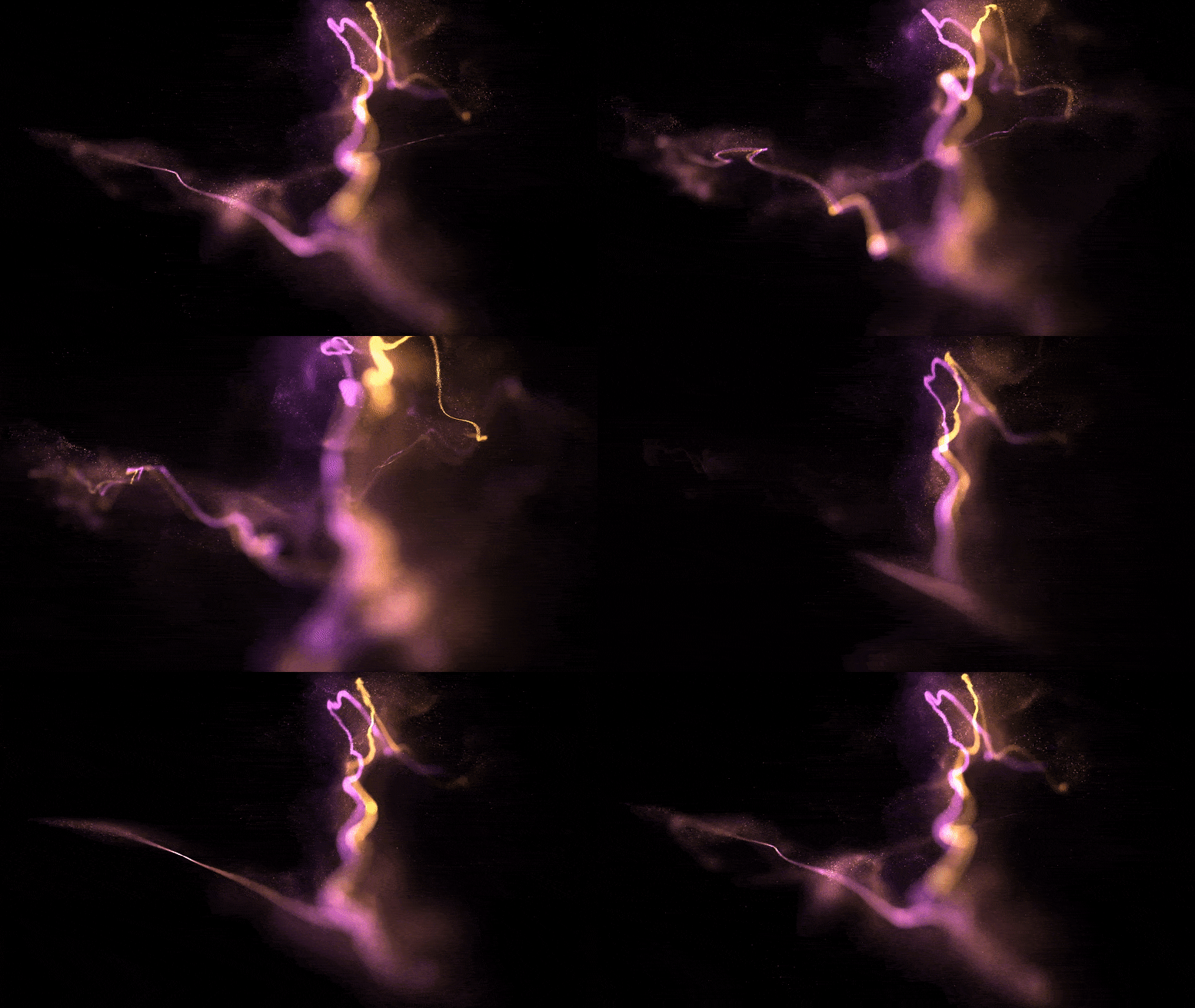
New insights could advance microfluidics and drug delivery systems.
- New study finds obstacles can trap rolling microparticles in fluid
- Through simulations and experiments, physicists attribute the trapping effect to stagnant pockets of fluid, created by hydrodynamics
- Random motions of the molecules within the fluid then ‘kick’ the microroller into a stagnant pocket, effectively trapping it
- Size of the obstacle also controls how easy it is to trap a microroller and how long it remains trapped
When physicists steered a tiny microparticle toward a cylindrical obstacle, they expected one of two outcomes to occur. The particle would either collide into the obstacle or sail around it. The particle, however, did neither.
Exploring the Trapping Phenomenon
The researcher team — led by Northwestern University and École Polytechnique in France — was surprised and puzzled to watch the particle curve around the obstacle and then stick to its backside. The obstacle, it seemed, had the particle effectively trapped.
After a series of simulations and experiments, the researchers unraveled the physics at play behind this strange phenomenon. Three factors caused the unexpected trapping behavior: electrostatics, hydrodynamics, and erratic random movement of the surrounding molecules. The size of the obstacle also determined how long the particle remained trapped before escaping.
The new insights could be leveraged to advance microfluidic applications and drug delivery systems — both of which rely on microparticles to navigate complex, structured landscapes.
The study will be published on March 8 in the journal Science Advances.
An obstacle (ring in the middle) effectively traps a microparticle as it attempts to pass by. Credit: Michelle Driscoll/Northwestern University
“I didn’t expect to see trapping in this system at all,” said Northwestern’s Michelle Driscoll, who co-led the study. “But trapping adds a lot of utility to the system because now we have a way to gather up particles. Tasks like trapping, mixing and sorting are very difficult to do at such small scales. You can’t just scale down standard processes for mixing and sorting because a different kind of physics kicks in at this size limit. So, it’s important to have different ways to manipulate particles.”
Driscoll is an assistant professor of physics at Northwestern’s Weinberg College of Arts and Sciences. She co-led the study with Blaise Delmotte, a researcher at École Polytechnique.
A microparticle successfully passes by an obstacle (ring in the center) to escape becoming trapped. Credit: Michelle Driscoll/Northwestern University
Microrollers: A Tool for Microfluidics and Drug Delivery
Similar in size to bacteria, microrollers are synthetic, microscopic particles with the ability to move in a fluid environment. Driscoll and her team are particularly interested in microrollers for their ability to move freely — and quickly — in different directions and their potential to carry and deliver cargo in complex, confined environments, including within the human body.
The microrollers in Driscoll’s lab are plastic with an iron oxide core, which gives them a weak magnetic field. By putting the microrollers in a sealed microchamber (100 millimeters by 2 millimeters by 0.1 millimeters in size), researchers can control the direction they move by manipulating a rotating magnetic field around the sample. To change the way the microrollers move, researchers simply reprogram the motion of the magnetic field to pull the microrollers in different directions.
But microfluidic devices and the human body are, of course, much more complex landscapes compared to a featureless sample chamber. So, Driscoll and her collaborators added obstacles to the system to see how microrollers could navigate the environment.
“For true-to-life applications, you aren’t just going to have this system with particles sitting in an open space,” Driscoll said. “It’s going to be a complex landscape. You might have to move the particles through winding channels. So, we wanted to first explore the simplest version of the problem: One microroller and one obstacle.”
In both computer simulations and the experimental environment, Driscoll and her team added cylindrical obstacles to the sample chamber. Sometimes the microroller sailed around the obstacle without issue, but other times it would swing around the obstacle and then get trapped behind it.
“We watched the particle stop moving past the obstacle and kind of get stuck,” Driscoll said. “We saw the same behavior in the simulations and in the experiments.”
Hydrodynamics and Brownian Motion
By changing the parameters within the simulations and analyzing the data, Driscoll and her team found the hydrodynamics of the fluid inside the sample chamber created stagnant areas. In other words, the spinning microroller caused the fluid to flow in the chamber. But the flows also created pockets — including one directly behind the obstacle — where the fluid remained still and unflowing. When the particle entered the stagnant area, it stopped moving and became stuck.
But to reach the stagnant area, the particle had to perform a baffling U-turn. After moving past the obstacle, the microroller curved around it, becoming stuck to its backside. Driscoll found that random motions (called Brownian motion) of the molecules within the fluid “kicked” the microroller into the stagnant area.
“Tiny materials are subject to Brownian fluctuations,” Driscoll explained. “The fluid is not actually a continuum but is composed of individual, little molecules. Those molecules are constantly ramming into the particle at random orientations. If the particle is small enough, these collisions can move it. That’s why if you look at tiny particles under a microscope, they look like they are juggling around a little bit.”
Applications of Hydrodynamic Trapping
Driscoll’s team also found that the size of the obstacle controls how long the particle will remain trapped before escaping. For example, it’s easier for Brownian fluctuations to kick the particle into the trapping region when the obstacle is smaller. By changing the obstacle size, researchers can increase the trapping time by orders of magnitude.
“Usually, Brownian fluctuations are destructive to experiments because they are a source of noise,” Driscoll said. “Here, we can leverage Brownian motion to do something useful. We can enable this hydrodynamic trapping effect.”
Reference: “A simple catch: Fluctuations enable hydrodynamic trapping of microrollers by obstacles” by Ernest B. van der Wee, Brendan C. Blackwell, Florencio Balboa Usabiaga, Andrey Sokolov, Isaiah T. Katz, Blaise Delmotte and Michelle M. Driscoll, 8 March 2023, Science Advances.
DOI: 10.1126/sciadv.ade0320
The study was supported by the National Science Foundation under award number CBET-1706562, “la Caixa” Foundation (award numbers 100010434 and fellowship LCF/BQ/-PI20/11760014), the European Union’s Horizon 2020 research and innovation program under the Marie Skłodowska-Curie grant (award number 847648), the French National Research Agency (award number ANR- 20-CE30-0006) and the NVIDIA Academic Partnership.
Never miss a breakthrough: Join the SciTechDaily newsletter.
Follow us on Google and Google News.