
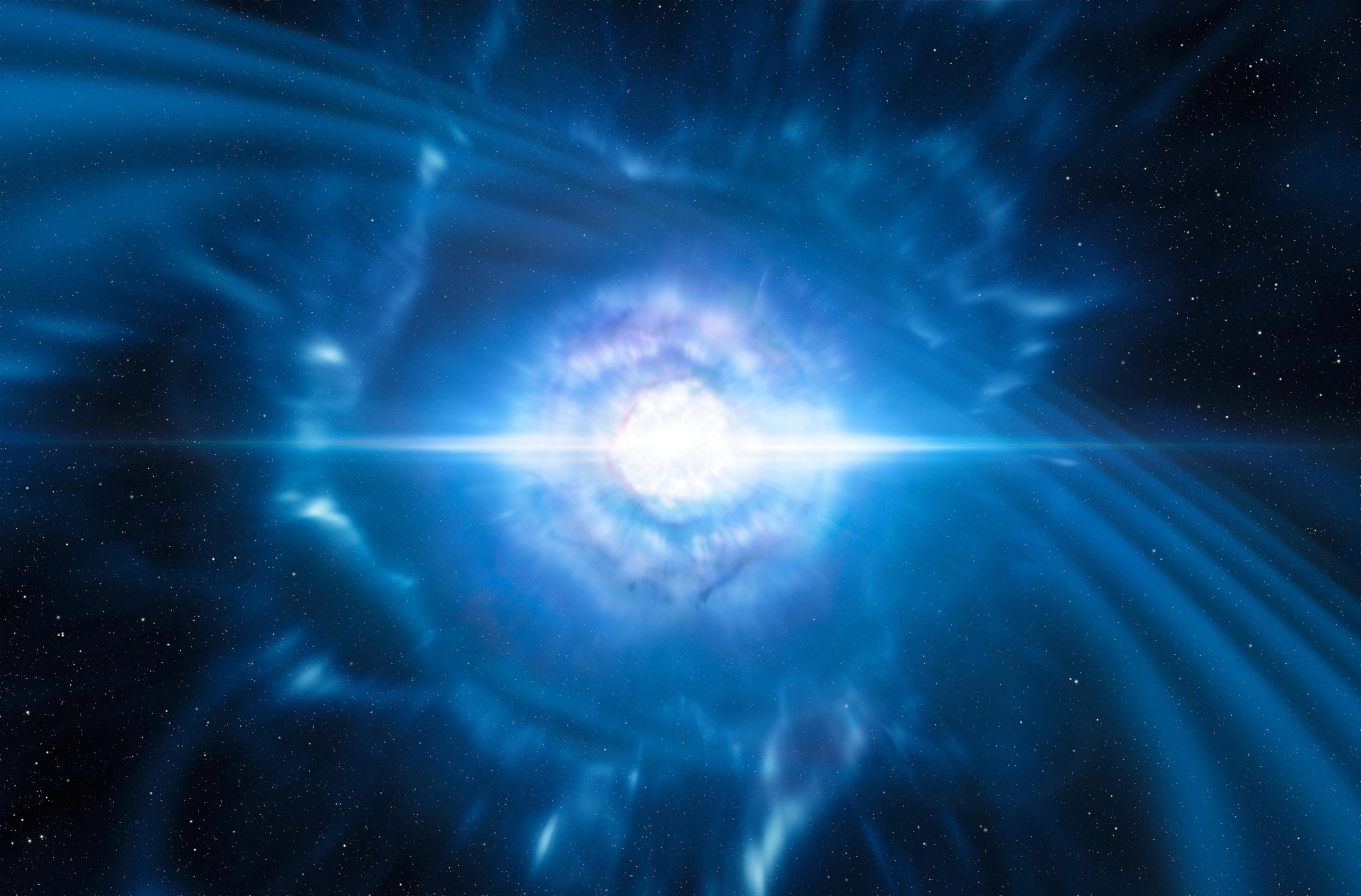
For the first time, scientists have directly measured a weak r-process reaction using a radioactive ion beam, shedding light on how heavy elements form in cosmic cataclysms like supernovae and neutron star mergers.
By accelerating strontium-94 into helium-infused nanomaterial targets, researchers gained unprecedented real-world data to refine astrophysical models. Beyond space, this breakthrough holds promise for nuclear reactor advancements, ensuring more efficient designs and longer-lasting components.
First-Ever Measurement of a Weak r-Process Reaction
Researchers from the University of Surrey, in collaboration with the University of York, the Materials Science Institute of Seville (CSIC-Univ. Seville), and TRIUMF, Canada’s national particle accelerator center, have achieved a major breakthrough in nuclear astrophysics.
For the first time, scientists have directly measured the cross-section of a weak r-process nuclear reaction using a radioactive ion beam. Specifically, the team studied the reaction 94Sr(α,n)97Zr, where a radioactive isotope of strontium (strontium-94) absorbs an alpha particle (a helium nucleus), emits a neutron, and becomes zirconium-97.
The findings have been published as an Editors’ Suggestion in Physical Review Letters, highlighting the significance of the work.
Unlocking the Secrets of Heavy Element Formation
Dr. Matthew Williams, lead author from the University of Surrey, explained:
“The weak r-process plays a crucial role in the formation of heavy elements, which astronomers have observed in ancient stars – celestial fossils that carry the chemical fingerprints of perhaps only one prior cataclysmic event, like a supernovae or neutron star merger. Until now, our understanding of how these elements form has relied on theoretical predictions, but this experiment provides the first real-world data to test those models that involve radioactive nuclei.”
The experiment was enabled by the use of novel helium targets. Since helium is a noble gas, meaning it is neither reactive nor solid, researchers at the University of Seville developed an innovative nano-material target, embedding helium inside ultra-thin silicon films to form billions of microscopic helium bubbles, each only a few 10s of nanometers across.
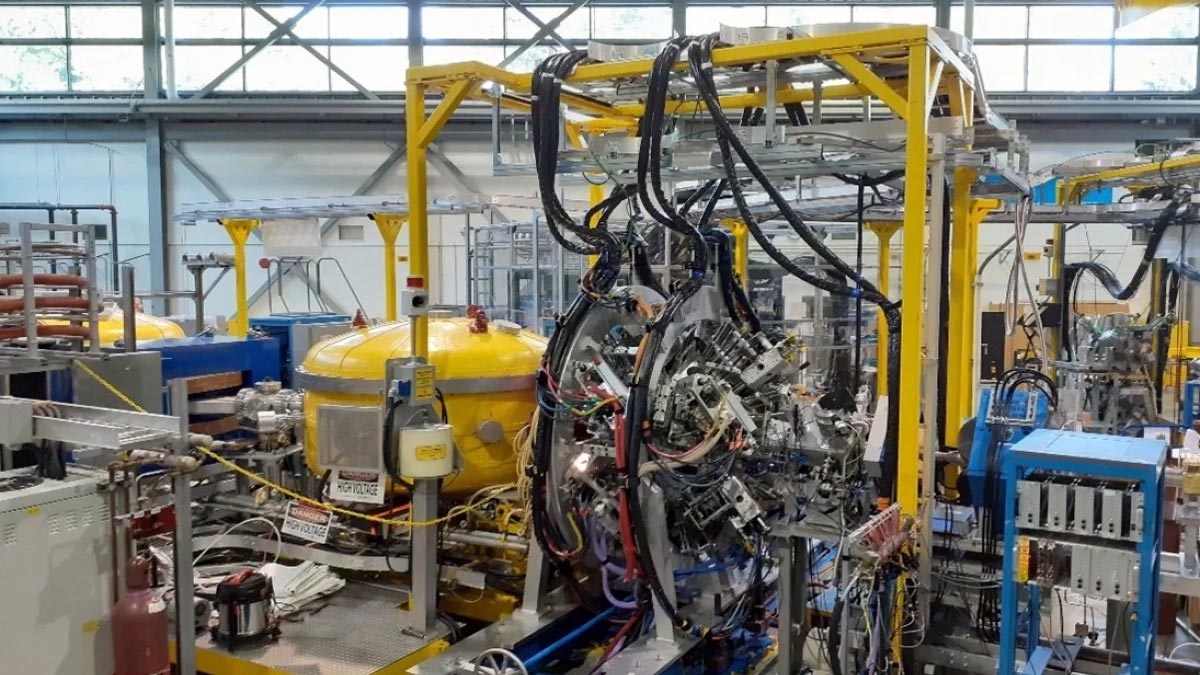
TRIUMF’s Cutting-Edge Radioactive Ion Beam Technology
Using TRIUMF’s advanced radioactive ion beam technology, the team accelerated short-lived strontium-94 isotopes into these targets, allowing them to measure the nuclear reaction under conditions similar to those found in extreme cosmic environments.
Dr. Williams said:
“This is a major achievement for astrophysics and nuclear physics, and the first-time nanomaterials have been used in this way, opening exciting new possibilities for nuclear research.
“Beyond astrophysics, understanding how radioactive nuclei behave is crucial for improving nuclear reactor design. These types of nuclei are constantly produced in nuclear reactors, but until recently, studying their reactions has been extremely difficult. Reactor physics depends on this kind of data to predict how often components need replacing, how long they’ll last and how to design more efficient, modern systems.”
Future Applications in Astrophysics and Nuclear Technology
The next phase of research will apply the findings to astrophysical models, helping scientists to better understand the origins of the heaviest known elements. As researchers continue to explore these processes, their work could deepen our understanding of both the extreme physics of neutron star collisions and practical applications in nuclear technology.
Reference: “First Measurement of a Weak 𝑟-Process Reaction on a Radioactive Nucleus” by M. Williams, C. Angus, A. M. Laird, B. Davids, C. Aa. Diget, A. Fernandez, E. J. Williams, A. N. Andreyev, H. Asch, A. A. Avaa, G. Bartram, S. Chakraborty, I. Dillmann, K. Directo, D. T. Doherty, E. Geerlof, C. J. Griffin, A. Grimes, G. Hackman, J. Henderson, K. Hudson, D. Hufschmidt, J. Jeong, M. C. Jiménez de Haro, V. Karayonchev, A. Katrusiak, A. Lennarz, G. Lotay, B. Marlow, M. S. Martin, S. Molló, F. Montes, J. R. Murias, J. O’Neill, K. Pak, C. Paxman, L. Pedro-Botet, A. Psaltis, E. Raleigh-Smith, D. Rhodes, J. S. Rojo, M. Satrazani, T. Sauvage, C. Shenton, C. E. Svensson, D. Tam, L. Wagner and D. Yates, 17 March 2025, Physical Review Letters.
DOI: 10.1103/PhysRevLett.134.112701
Never miss a breakthrough: Join the SciTechDaily newsletter.
Follow us on Google and Google News.
3 Comments
The findings have been published as an Editors’ Suggestion in Physical Review Letters, highlighting the significance of the work.
WHY?
Scientific research requires the use of correct theories to interpret. The editor of Physical Review Letters stubbornly insists that two sets of cobalt-60 reverse rotations can become mirror images of each other, and promotes pseudoscientific theories and ideas everywhere. Is Physical Review Letters a publication that respects science? Is the so-called Editors’ Suggestion of Physical Review Letters trustworthy? Does the editor of Physical Review Letters have a profound understanding of physics and science?
Are so-called peer review, editors’ suggestion and renowned journals the criteria for distinguishing science from pseudoscience?
ASK The editor of Physical Review Letters:
1. If there were no observable features and markings, would ocean currents in the ocean cease to exist?
2. Similarly, if there are no observable objects and wortex in space, does space cease to exist?
Topological Vortex Theory (TVT) and Fluidized Absolute Space Theory (FAST) will tell you how to understand physics and science. Topological Vortex Theory (TVT) and Fluidized Absolute Space Theory (FAST) will tell you how to be a good person.