
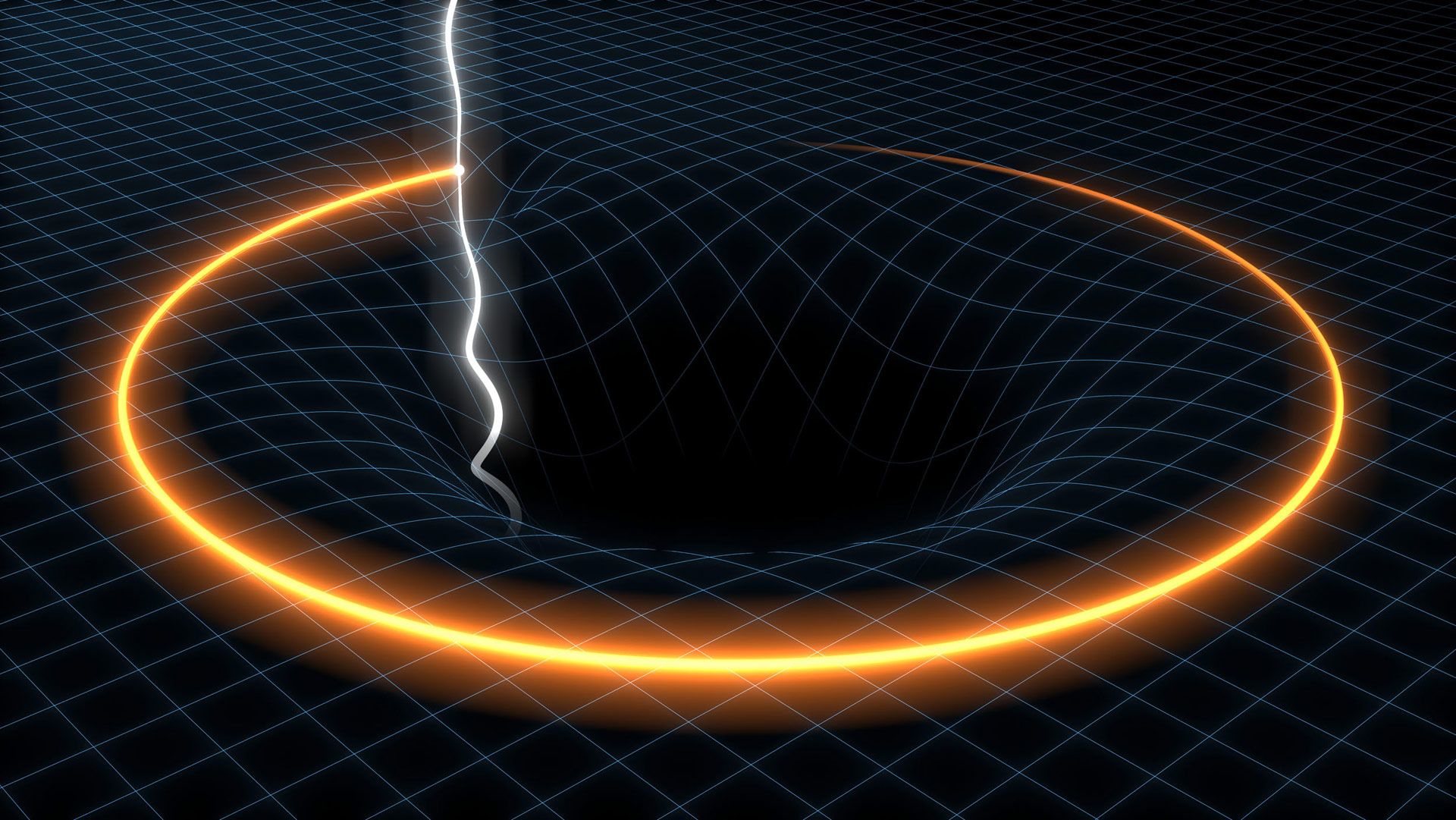
A new study examines in what sense a neutron star-black hole binary could be the ‘holy grail’ for testing gravity.
The intermittent light emitted by pulsars, the most precise timekeepers in the universe, allows scientists to verify Einstein’s theory of relativity, especially when these objects are paired up with another neutron star or white dwarf that interferes with their gravity. However, this theory could be analyzed much more effectively if a pulsar with a black hole were found, except in two particular cases, according to researchers from Spain and India.
Pulsars are very dense neutron stars that are the size of a city (their radius approaches ten kilometers), which, like lighthouses for the universe, emit gamma radiation beams or X-rays when they rotate up to hundreds of times per second. These characteristics make them ideal for testing the validity of the theory of general relativity, published by Einstein between 1915 and 1916.
“Pulsars act as very precise timekeepers, such that any deviation in their pulses can be detected,” Diego F. Torres, ICREA researcher from the Institute of Space Sciences (IEEC-CSIC), explains to SINC. “If we compare the actual measurements with the corrections to the model that we have to use in order for the predictions to be correct, we can set limits or directly detect the deviation from the base theory.”
These deviations can occur if there is a massive object close to the pulsar, such as another neutron star or a white dwarf. A white dwarf can be defined as the stellar remnant left when stars such as our Sun use up all of their nuclear fuel. The binary systems, comprised of a pulsar and a neutron star (including double pulsar systems) or a white dwarf, have been very successfully used to verify the theory of gravity.
Last year, the very rare presence of a pulsar (named SGR J1745-2900) was also detected in the proximity of a supermassive black hole (Sgr A*, made up of millions of solar masses), but there is a combination that is still yet to be discovered: that of a pulsar orbiting a ‘normal’ black hole; that is, one with a similar mass to that of stars.
Until now scientists had considered this strange pair to be an authentic ‘holy grail’ for examining gravity, but there exist at least two cases where other pairings can be more effective. This is what is stated in the study that Torres and the physicist Manjari Bagchi, from the International Center of Theoretical Sciences (India) and now postdoc at the IEEC-CSIC, have published in the Journal of Cosmology and Astroparticle Physics. The work also received an Honorable Mention in the 2014 Essays of Gravitation Prize.
The first case occurs when the so-called principle of strong equivalence is violated. This principle of the theory of relativity indicates that the gravitational movement of a body that we test only depends on its position in space-time and not on what it is made up of, which means that the result of any experiment in a free fall laboratory is independent of the speed of the laboratory and where it is found in space and time.
The other possibility is if one considers a potential variation in the gravitational constant that determines the intensity of the gravitational pull between bodies. Its value is G = 6.67384(80) x 10-11 N m2/kg2. Despite it being a constant, it is one of those that is known with the least accuracy, with a precision of only one in 10,000.
In these two specific cases, the pulsar-black hole combination would not be the perfect ‘holy grail’, but in any case scientists are anxious to find this pair, because it could be used to analyze the majority of deviations. In fact, it is one of the desired objectives of X-ray and gamma-ray space telescopes (such as Chandra, NuStar, or Swift), as well as that of large radio telescopes that are currently being built, such as the enormous ‘Square Kilometer Array’ (SKA) in Australia and South Africa.
Reference: “In what sense a neutron star-black hole binary is the holy grail for testing gravity?” by Manjari Bagchi and Diego F. Torres, 26 August 2014, Journal of Cosmology and Astroparticle Physics.
DOI: 10.1088/1475-7516/2014/08/055
Never miss a breakthrough: Join the SciTechDaily newsletter.
Follow us on Google and Google News.
1 Comment
Actually the only difference between a Neutron star and a Pulsar is a Pulsar is rotating and emitting a beam of electromagnetic radiation.