
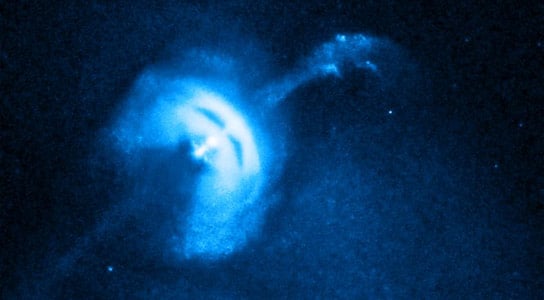
A new video from NASA’s Chandra X-ray Observatory shows the Vela pulsar, a neutron star that is 12 miles in diameter, located about 1,000 light-years from Earth, and spins faster than a helicopter rotor.
Unlike with some blockbuster films, the sequel to a movie from NASA’s Chandra X-ray Observatory is better than the first. This latest movie features a deeper look at a fast-moving jet of particles produced by a rapidly rotating neutron star, and may provide new insight into the nature of some of the densest matter in the universe.
The hero of this Chandra movie is the Vela pulsar, a neutron star that was formed when a massive star collapsed. The Vela pulsar is about 1,000 light-years from Earth, about 12 miles in diameter, and makes a complete rotation in 89 milliseconds, faster than a helicopter rotor.
As the pulsar whips around, it spews out a jet of charged particles that race along the pulsar’s rotation axis at about 70 percent of the speed of light. The new Chandra data, which were obtained from June to September 2010, suggest the pulsar may be slowly wobbling, or precessing, as it spins. The period of the precession, which is analogous to the slow wobble of a spinning top, is estimated to be about 120 days.
“We think the Vela pulsar is like a rotating garden sprinkler — except with the water blasting out at over half the speed of light,” said Martin Durant of the University of Toronto in Canada, who is the first author of the paper describing these results.
One possible cause of precession for a spinning neutron star is it has become slightly distorted and is no longer a perfect sphere. This distortion might be caused by the combined action of the fast rotation and “glitches,” sudden increases in the pulsar’s rotational speed due to the interaction of the superfluid core of the neutron star with its crust.
“The deviation from a perfect sphere may only be equivalent to about one part in 100 million,” said co-author Oleg Kargaltsev of The George Washington University in Washington, who presented these results Monday at the 221st American Astronomical Society meeting in Long Beach, California. “Neutron stars are so dense that even a tiny distortion like this would have a big effect.”
If the evidence for precession of the Vela pulsar is confirmed, it would be the first time a neutron star has been found to be this way. The shape and the motion of the Vela jet look strikingly like a rotating helix, a shape that is naturally explained by precession.
Another possibility is the strong magnetic fields around the pulsar are influencing the shape of the jet. For example, if the jet develops a small bend caused by precession, the magnetic field’s lines on the inside of the bend will become more closely spaced. This pushes particles toward the outside of the bend, increasing the effect.
“It’s like having an unsecured fire hose and a flow of water at high pressure,” said co-author George Pavlov, principal investigator of the Chandra proposal at Pennsylvania State University in University Park. “All you need is a small bend in the hose and violent motion can result.”
This is the second Chandra movie of the Vela pulsar. The original was released in 2003 by Pavlov and co-authors. The first Vela movie contained shorter, unevenly spaced observations so that the changes in the jet were less pronounced and the researchers did not argue that precession was occurring. However, based on the same data, Avinash Deshpande of Arecibo Observatory in Puerto Rico and the Raman Research Institute in Bangalore, India, and the late Venkatraman Radhakrishnan, argued in a 2007 paper the Vela pulsar might be precessing.
Astronomers have returned to observing Vela because it offers an excellent chance to study how a pulsar and its jet work. The 0.7 light-year-long jet in Vela is similar to those produced by accreting supermassive black holes in other galaxies, but on a much smaller scale. Because Vela’s jet changes dramatically over a period of months and is relatively close, it can be studied in great detail unlike jets from black holes that change over much longer timescales.
If precession is confirmed and the Vela pulsar is indeed a distorted neutron star, it should be a persistent source of gravitational waves, and would be a prime target for the next generation of gravitational wave detectors designed to test Einstein’s theory of general relativity.
A paper describing these results is published in The Astrophysical Journal…Other co-authors of the paper were Julia Kropotina and Kseniya Levenfish from St. Petersburg State Polytechnical University in St. Petersburg, Russia.
Reference: “The Helical Jet of the Vela Pulsar” by Martin Durant, Oleg Kargaltsev, George G. Pavlov, Julia Kropotina and Kseniya Levenfish, 10 January 2013, The Astrophysical Journal.
DOI: 10.1088/0004-637X/763/2/72
NASA’s Marshall Space Flight Center in Huntsville, Alabama, manages the Chandra program for NASA’s Science Mission Directorate in Washington. The Smithsonian Astrophysical Observatory controls Chandra’s science and flight operations from Cambridge, Massachusetts.
Never miss a breakthrough: Join the SciTechDaily newsletter.
Follow us on Google and Google News.
1 Comment
Well, where is a link to the video? We don’t just want to hear about the video, we want to SEE the video… This is a common mistake in journalism. Let people see the source materilal and come to their own conclusions please!