
Researchers have developed a new computational method to explore the neutron matter inside neutron stars at densities higher than previously studied.
This method provides insights into the behavior of neutrinos during supernova explosions, enhancing the accuracy of simulations and potentially improving our understanding of such cosmic events.
Advances in Neutron Matter Simulation
When a star dies in a supernova, its remnants may collapse into a neutron star. In these incredibly dense objects, protons and electrons merge to form uncharged neutrons, creating a substance known as neutron matter.
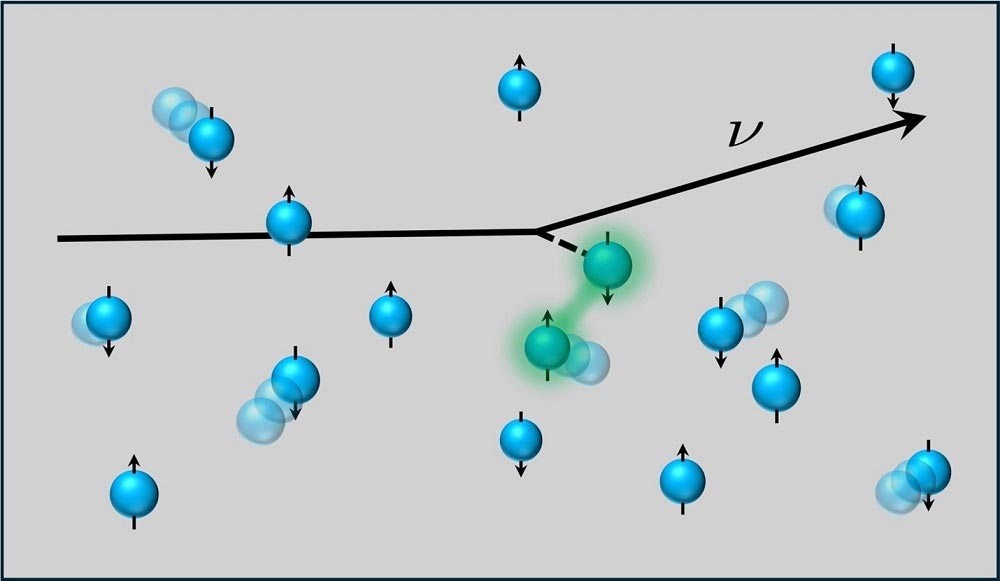
A team of researchers has recently explored neutron matter at higher densities than ever before, calculating its spin and density correlations using advanced nuclear interaction models. Spin and density correlations describe the likelihood of finding a neutron at a specific location and with a particular spin direction. These properties are crucial for understanding how neutrinos scatter and transfer heat during core-collapse supernovas.
To achieve these insights, the researchers used cutting-edge computational simulations and developed a novel algorithm. This algorithm significantly reduces the computational effort required for simulating the behavior of multiple particles, paving the way for more accurate and efficient models of neutron matter.
Impact on Supernova Simulation Technologies
Researchers can use the results of this new study in realistic simulations of supernova explosions. Nearly all the energy released in a core-collapse supernova is carried away by neutrinos. The outward flow of neutrinos energizes the neutron-rich matter in the supernova. This increases the likelihood of an explosion. This work calculates how spin and density distributions affect the neutrino-induced heating of neutron-rich matter. It provides important data for calibrating codes used in supernova simulations.
A team of researchers from the United States, China, Turkey, and Germany performed ab initio (from the most fundamental principles) simulations to compute spin and density correlations in neutron matter using realistic nuclear interactions. The team performed the new calculations at higher neutron densities than had previously been explored. The results can be used to calibrate codes used for realistic simulations of core-collapse supernova.
Enhancing Computational Efficiency in Nuclear Physics
To perform the calculations, the researchers introduced a new algorithm called the “rank-one operator method” that greatly reduces the computational effort needed to calculate observables involving several particles. The rank-one operator method exploits a simplification in the complicated mathematics used in computing neutrino transport through dense nuclear matter, resulting in much more efficient computation. The rank-one operator method has since been applied to calculations of other observables in nuclear physics as well as other fields.
Reference: “Structure Factors for Hot Neutron Matter from Ab Initio Lattice Simulations with High-Fidelity Chiral Interactions” by Yuan-Zhuo Ma, Zidu Lin, Bing-Nan Lu, Serdar Elhatisari, Dean Lee, Ning Li, Ulf-G. Meißner, Andrew W. Steiner and Qian Wang, 5 June 2024, Physical Review Letters.
DOI: 10.1103/PhysRevLett.132.232502
This work was supported by the Guangdong Major Project of Basic and Applied Basic Research, the National Natural Science Foundation of China , China Postdoctoral Science Foundation. Individual researchers were supported by the U.S. National Science Foundation, the Department of Energy Office of Science, Nuclear Physics program, the NSAF, the European Research Council, Deutsche Forschungsgemeinschaft, and the Chinese Academy of Sciences. Computational resources were provided by the Oak Ridge Leadership Computing Facility at Oak Ridge National Laboratory, the Southern Nuclear Science Computing Center in the South China Normal University, the Gauss Centre for Supercomputing at the Jülich Supercomputing Centre (JSC), and the Institute for Cyber-Enabled Research at Michigan State University.
Never miss a breakthrough: Join the SciTechDaily newsletter.
Follow us on Google and Google News.
2 Comments
When a star dies in a supernova, its remnants may collapse into a neutron star. In these incredibly dense objects, protons and electrons merge to form uncharged neutrons, creating a substance known as neutron matter.
Please ask the researchers to think deeply:
1. Is this description a fact or an imagination?
2. Is what you observe necessarily all the facts?
3. What you haven’t observed is irrelevant to what you have observed?
Scientific research guided by correct theories can help people avoid detours, failures, and exaggeration. The physical phenomena observed by researchers in experiments are always appearances, never the natural essence of things. The natural essence of things needs to be extracted and sublimated based on mathematical theories via appearances , rather than being imagined arbitrarily.
Everytime scientific revolution, the scientific research space brought by the new paradigm expands exponentially. Physics should not ignore the analyzable physical properties of topological vortices.
(1) Traditional physics: based on mathematical formalism, experimental verification and arbitrary imagination.
(2) Topological Vortex Theory (TVT): Although also based on mathematics (such as topology), it focuses more on non intuitive geometry and topological structures, challenging traditional physical intuition.
Topological Vortex Theory (TVT) points out the limitations of the Standard Model in describing the large-scale structure of the universe, proposes the need to consider non-standard model components such as dark matter and dark energy, and suggests that topological vortex fields may be key to understanding these phenomena. Topological vortex theory (TVT) heralds innovative technologies such as topological electronics, topological smart batteries, topological quantum computing, etc., which may bring low-energy electronic components, almost inexhaustible currents, and revolutionary computing platforms, etc.
Topology tells us that topological vortices and antivortices can form new spacetime structures via the synchronous effect of superposition, deflection, or twisting of them. Mathematics does not tell us that there must be God particles, Devil particles, Fermions, or Bosons present. When physics and mathematics diverge, arbitrary imagination will make physics no different from theology. Topological vortex research reflections on the philosophy and methodology of science help us understand the nature essence of science and the limitations of scientific methods. This not only has guiding significance for scientific research itself, but also has important implications for science education and popularization.
All things follow certain laws, which can be revealed through observation and research ( such as topological structures ). Today, so-called academic publications (such as PRL, Nature, Science, etc.) obstinately believe that two sets of cobalt 60 rotating in opposite directions can become two mirror images of each other. This is a public humiliation to the normal intelligence of the public. They conducted extensive pseudo scientific research based on CP violations, published countless pseudo scientific papers, and received various awards. The so-called scientific evaluation system constructed based on these so-called academic publications opened the dirtiest, ugliest, and most evil era in the history of modern science. They hardly know what shame is.
Please witness the exemplary collaboration between theoretical physicists and experimentalists (https://scitechdaily.com/microscope-spacecrafts-most-precise-test-of-key-component-of-the-theory-of-general-relativity/#comment-854286). It is normal to make mistakes in scientific research, but what is abnormal is to stubbornly adhere to erroneous positions and not repent.
Let us continue to witness via facts the dirtiest and ugliest era in the history of sciences and humanities in human society. The laws of nature will not change due to misleading of certain so-called academic publications or endorsements from certain so-called scientific awards.
As some comments have stated ( https://scitechdaily.com/super-photons-unveiled-sculpting-light-into-unbreakable-communication-networks/#comment-861546 ): Fortunately, we have enough pieces to put the puzzle together properly, and there are folks who have chosen to forego today’s societal structures in order to do exactly that.
Additionally, some comments have stated ( https://scitechdaily.com/science-made-simple-what-is-nuclear-fission/#comment-862083 ): You have been spewing this type of nonsensical word salad for several years now. Outrage doesn’t equal competence. If anything, your inability to convince anyone is a sign of your incompetence. Ask the commenter:Today, so-called official (such as PRL, Nature, Science, etc.) in physics stubbornly believes that two sets of cobalt-60 rotating in opposite directions can become two sets of objects that mirror each other, and it even won awards. These so-called academic publications have the audacity to blatantly talk nonsense in public. Do you think this is personal misfortune or misfortune of humanity?
My repetition may make some people feel disgusted ( https://scitechdaily.com/spooky-action-at-ultra-short-distances-unlocking-the-quantum-core-of-matter/#comment-866750 ). Nevertheless, in order to oppose rampant pseudoscience, I can only do so.
Isn’t this the evil consequence of the Physics Review family misleading science? Academic circle is not Entertainment industry. Have some people really never know what shame is?
Since anyone dare to share your ideas with the world, don’t be afraid of being repeatedly commented upon.
Topological spins create everything, topological spins shape the world.
If anyone is interested in science, you can browse https://zhuanlan.zhihu.com/p/4659236468.