
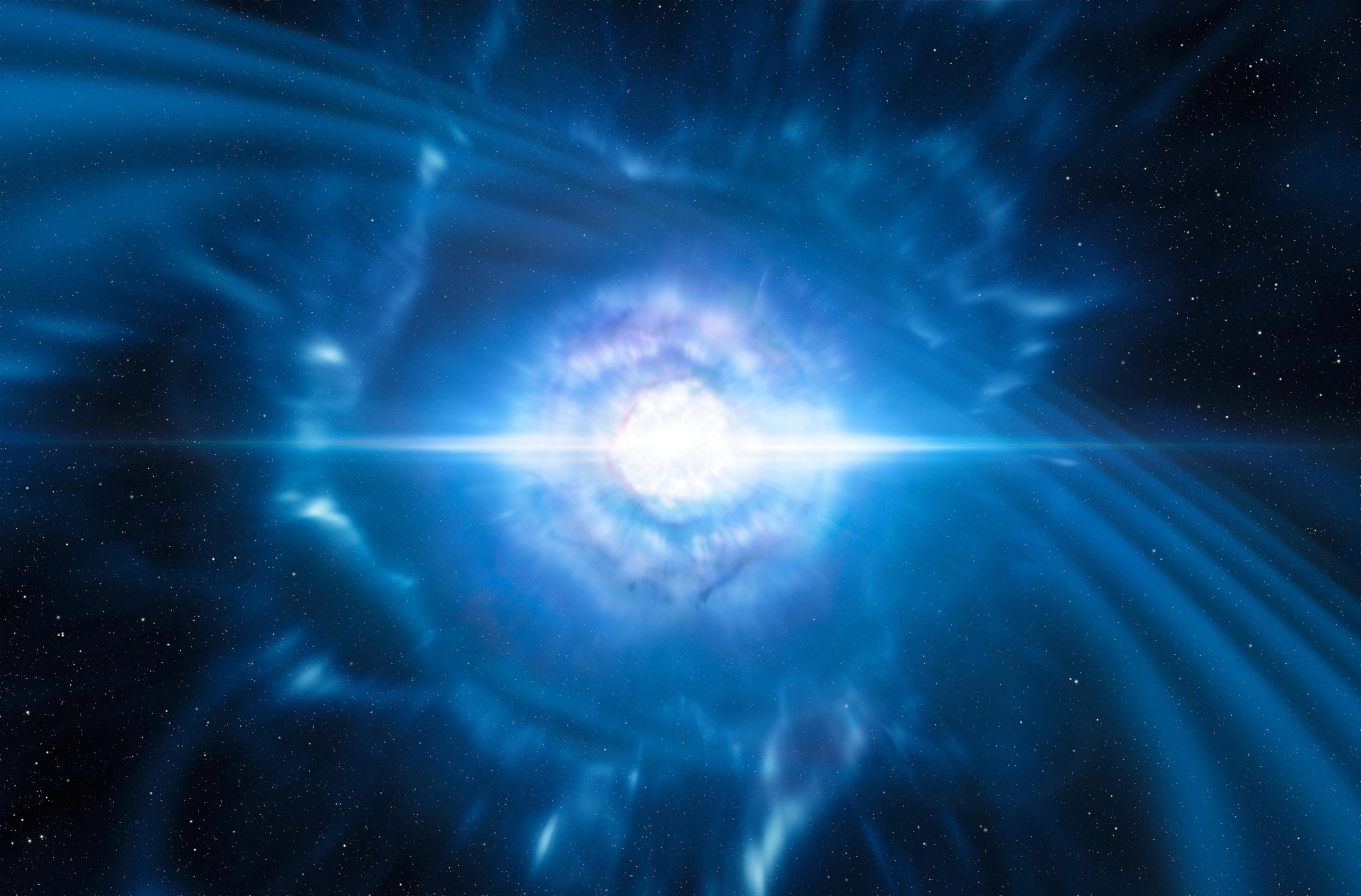
Using precision laser measurements, scientists have quantified the nuclear radii of silicon isotopes to improve nuclear theories and our understanding of neutron star matter.
These findings contribute significantly to both nuclear physics and astrophysics, providing insights into the structure of dense cosmic objects.
Isotope Shifts and Nuclear Radius Measurements
Adding or removing neutrons from an atomic nucleus results in changes in the size of the nucleus. This in turn causes tiny changes in the energy levels of the atom’s electrons, known as isotope shifts. Scientists can use precision measurements of these energy shifts to measure the radius of the nucleus of an isotope.
In this research, scientists made laser-assisted measurements of the nuclear radii of the stable silicon isotopes silicon-28, silicon-29, and silicon-30. They also measured the radius of the unstable silicon-32 nucleus, which has 14 protons and 18 neutrons. The researchers used the difference between the radius of the silicon-32 nucleus and its mirror nucleus, argon-32, which has 18 protons and 14 neutrons, to set limits on variables that help to describe the physics of astrophysical objects such as neutron stars. The results are an important step in developing nuclear theory, the study of nuclei and their components.

Challenges and Progress in Nuclear Theory
Despite progress in nuclear theory, scientists still face long-standing challenges in their understanding of nuclei. For instance, researchers have not connected the description of nuclear size with the underlying theory of the strong nuclear force. Moreover, it is not clear whether nuclear theories that describe finite atomic nuclei can provide a reliable description of nuclear matter. This special form of matter consists of interacting protons and neutrons. Nuclear matter includes matter in extreme conditions such as neutron stars. Precision measurements of charge radii—the radius of atomic nuclei—help solve these open questions.
Precision Techniques in Isotope Measurement
Researchers used laser spectroscopy measurements of atomic isotope shifts to measure the nuclear radius of different silicon isotopes at the BEam COoler and LAser spectroscopy facility (BECOLA) at the Facility for Rare Isotope Beams (FRIB) at Michigan State University. They performed the measurements for the stable silicon isotopes silicon-28, silicon-29, and silicon-30, as well as for the unstable silicon-32, which has 14 protons and 18 neutrons.
Implications for Nuclear Theory and Astrophysics
The results provide an important benchmark for the development of nuclear theory. The charge radii difference between the silicon-32 nucleus and its mirror nucleus argon-32, which has 18 protons and 14 neutrons, was used to constrain parameters needed to describe the properties of dense neutron matter within neutron stars. The obtained results agree with the constraints from gravitational wave observations and other complementary observables.
Reference: “Nuclear Charge Radii of Silicon Isotopes” by Kristian König, Julian C. Berengut, Anastasia Borschevsky, Alex Brinson, B. Alex Brown, Adam Dockery, Serdar Elhatisari, Ephraim Eliav, Ronald F. Garcia Ruiz, Jason D. Holt, Bai-Shan Hu, Jonas Karthein, Dean Lee, Yuan-Zhuo Ma, Ulf-G. Meißner, Kei Minamisono, Alexander V. Oleynichenko, Skyy V. Pineda, Sergey D. Prosnyak, Marten L. Reitsma, Leonid V. Skripnikov, Adam Vernon and Andréi Zaitsevskii, 16 April 2024, Physical Review Letters.
DOI: 10.1103/PhysRevLett.132.162502
This work was supported in part by the Department of Energy Office of Science, Office of Nuclear Physics’ SciDAC-5 NUCLEI Collaboration and by the National Science Foundation.
Never miss a breakthrough: Join the SciTechDaily newsletter.
Follow us on Google and Google News.
1 Comment
The results provide an important benchmark for the development of nuclear theory. The charge was used to constrain parameters needed to describe the properties of dense neutron matter within neutron stars. The obtained results agree with the constraints from gravitational wave observations and other complementary observables.
VERY GOOD.
Please ask researchers to think deeply:
1. What is the theoretical basis of neutron matter?
2. Why does physics require parameters?
Scientific research guided by correct theories can help people avoid detours, failures, and exaggeration. The physical phenomena observed by researchers in experiments are always appearances, never the natural essence of things. The natural essence of things needs to be extracted and sublimated based on mathematical theories via appearances , rather than being imagined arbitrarily.
Everytime scientific revolution, the scientific research space brought by the new paradigm expands exponentially. Physics should not ignore the analyzable physical properties of topological vortices.
(1) Traditional physics: based on mathematical formalism, experimental verification and arbitrary imagination.
(2) Topological Vortex Theory: Although also based on mathematics (such as topology), it focuses more on non intuitive geometry and topological structures, challenging traditional physical intuition.
Extension of the Standard Model: Topological Vortex Theory points out the limitations of the Standard Model in describing the large-scale structure of the universe, proposes the need to consider non-standard model components such as dark matter and dark energy, and suggests that topological vortex fields may be key to understanding these phenomena.
Topological vortex theory heralds innovative technologies such as topological electronics, topological smart batteries, topological quantum computing, etc., which may bring low-energy electronic components, almost inexhaustible currents, and revolutionary computing platforms, etc.
Topology tells us that topological vortices and antivortices can form new spacetime structures via the synchronous effect of superposition, deflection, or twisting of them. In fact, mathematics does not tell us that there must be God particles, ghost particles, fermions, or bosons present. When physics and mathematics diverge, arbitrary imagination will make physics no different from theology.
Today, so-called official (such as PRL, Nature, Science, PNAS, etc.) in physics stubbornly believes that two sets of cobalt-60 rotating in opposite directions can become two sets of objects that mirror each other, is a typical case that pseudoscience is rampant and domineering. Please witness the exemplary collaboration between theoretical physicists and experimentalists (https://scitechdaily.com/microscope-spacecrafts-most-precise-test-of-key-component-of-the-theory-of-general-relativity/#comment-854286).
Let us continue to witness together the dirtiest and ugliest era in the scientific and humanistic history of human society. The laws of nature will not change due to misleading of so-called academic publications.