
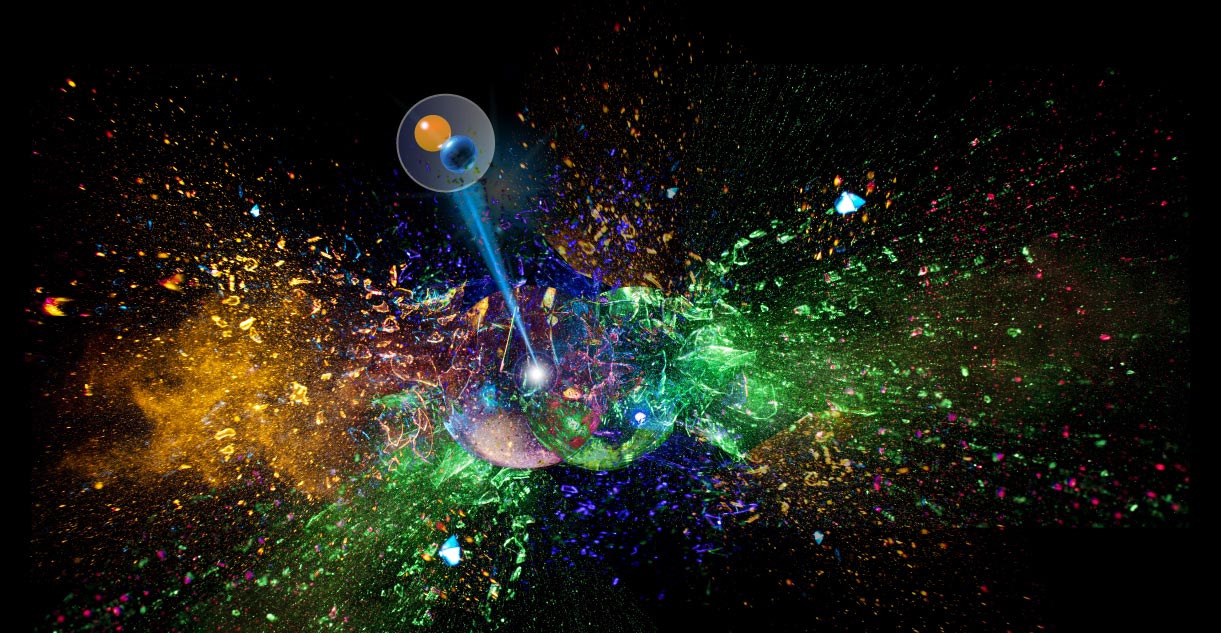
An international research team led by Michigan State University has helped create cosmic conditions at RIKEN’s heavy-ion accelerator in Japan.
Imagine taking all of the water in Lake Michigan — more than a quadrillion gallons — and squeezing it into a 4-gallon (15-liter) bucket, the kind you’d find at a hardware store.
A quick review of the numbers suggests that this should be impossible: that’s too much stuff and not enough space. But this outlandish density is a defining feature of celestial objects known as neutron stars. These stars are only about 15 miles (24 kilometers) across, yet they hold more mass than our sun thanks to some extreme physics.
Led by researchers from Michigan State University, an international collaboration has now emulated a neutron star’s cosmic conditions on Earth to better probe that extreme science. The team shared its results in the journal Physical Review Letters on April 19, 2021.
For the experiment, the team selected tin to help create a dense nuclear soup that’s rich in neutrons, helping it mimic the environment of neutron stars more closely. The team accelerated a beam made of tin nuclei to nearly two-thirds the speed of light at Japan’s RIKEN Nishina Center for Accelerator-Based Science. The research was funded by the Office of Nuclear Physics in the U.S. Department of Energy Office of Science, or DOE-SC, and the Ministry of Education, Culture, Sports, Science and Technology – Japan, or MEXT, Japan.
The researchers sent that beam barreling through a thin tin target, or foil, to smash together tin nuclei. The nuclei shatter and for just an instant — a billionth of a trillionth of a second — the wreckage exists as a super-dense region of nuclear building blocks called protons and neutrons. Although this environment is fleeting, it lives long enough to create rare particles called pions (which is pronounced “pie-ons” — the “pi” comes from the Greek letter π).
By creating and detecting these pions, the team is enabling scientists to better answer lingering questions about nuclear science and neutron stars. For example, this work can help scientists better characterize the internal pressure that keeps neutron stars from collapsing under their own gravity and becoming black holes.
A Peek into Extreme Physics
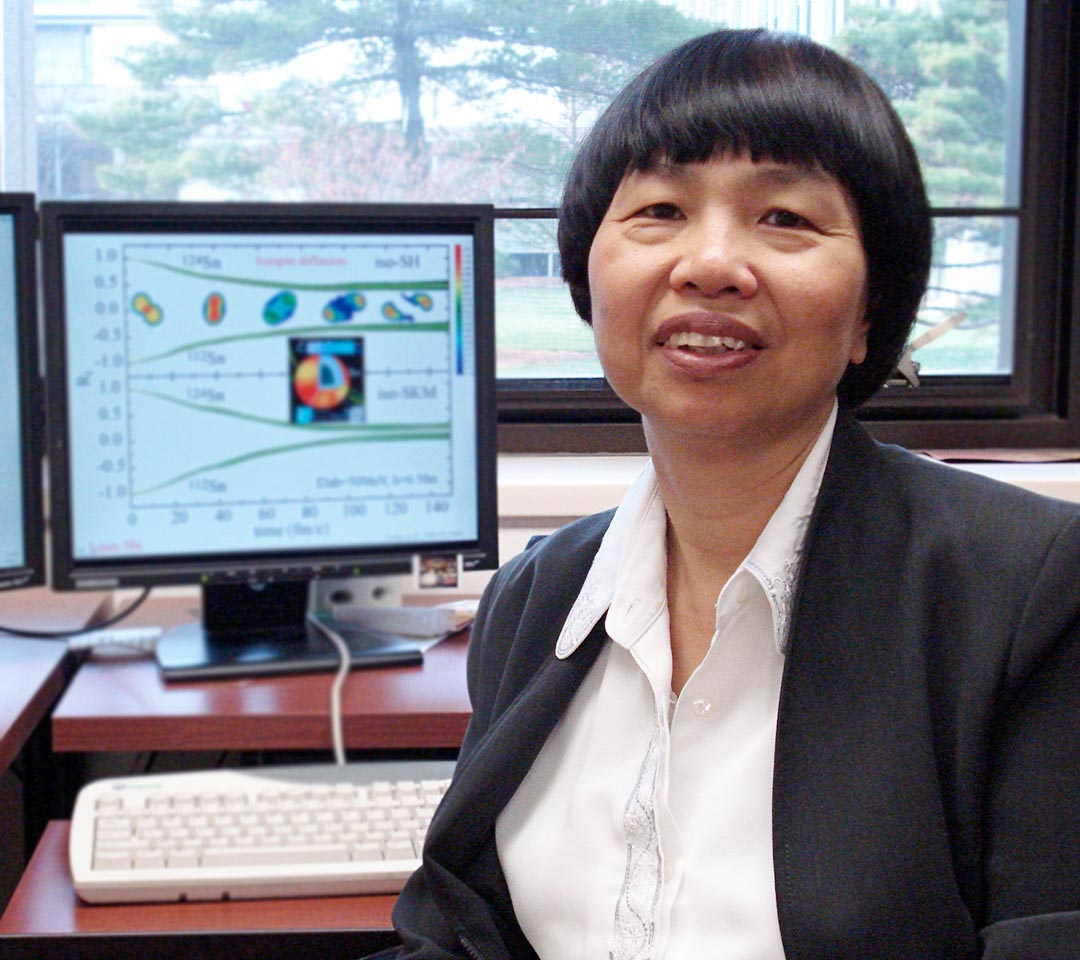
“The experiment that we’ve performed cannot be done elsewhere, except inside of neutron stars,” said Betty Tsang, a professor of nuclear science and researcher at the National Superconducting Cyclotron Laboratory, or NSCL, at MSU.
Unfortunately, scientists can’t set up shop inside neutron stars. Aside from blistering temperatures and crushing gravitational forces, the nearest neutron star is about 400 light-years away.
There is, however, another place in the universe where scientists can observe matter packed to such an incredible density. That is in particle accelerator laboratories, where scientists can smash together the cores of atoms, or nuclei, to squeeze large amounts of nuclear matter into very tiny volumes.
Of course, this is no cakewalk either.

“The experiment is very difficult,” Tsang said. “That’s why the team is so excited about this.” Tsang and William Lynch, a professor of nuclear physics in MSU’s Department of Physics and Astronomy, lead the Spartan contingent of researchers on the international team.
To realize their collective goals in this study, the collaborating institutes each played to their strengths.
“That’s why we accumulate collaborators,” Tsang said. “We solve problems by expanding the group and inviting people who really know what they’re doing.”
Building the Tools to See the Invisible
MSU, which is home to the United States’ top-ranked nuclear physics graduate program, took the lead on building the pion detector. The instrument, called the SπRIT Time Projection Chamber, was built with collaborators from Texas A&M University and RIKEN.
RIKEN’s particle accelerator offered the power and rare neutron-rich tin nuclei necessary to create an environment reminiscent of a neutron star. Researchers from the Technical University, Darmstadt, in Germany contributed the tin targets that had to meet exacting specifications. Students, staff, and faculty from other institutions across Asia and Europe helped build the experiment and analyze data.
This experiment at RIKEN’s accelerator helped push that understanding to new heights in terms of both energy and density, but there are many more challenges.
When the Facility for Rare Isotope Beams, or FRIB, is operational in 2022, it too promises to be a hub of international collaboration in nuclear science. And the facility will be uniquely equipped to continue exploring how nuclear systems behave at extreme energies and densities.
“When FRIB comes online, it will give us more choice of beams and let us make much more precise measurements,” Tsang said. “And that will let us understand the interiors of the neutron stars better and discover things that are even more intriguing, more surprising.”
Reference: “Probing the Symmetry Energy with the Spectral Pion Ratio” by J. Estee et al. (SπRIT Collaboration), 19 April 2021, Physical Review Letters.
DOI: 10.1103/PhysRevLett.126.162701
This work was supported by the DOE-SC under grants No. DOE DESC0004835, DOE DESC0014530, and DOE-SC0021235.
Never miss a breakthrough: Join the SciTechDaily newsletter.
Follow us on Google and Google News.
2 Comments
… and use Fukushima water to send it to a parallel Universe…
… one could strain all that dirty water with sifts, rather than dump it into the ocean…