
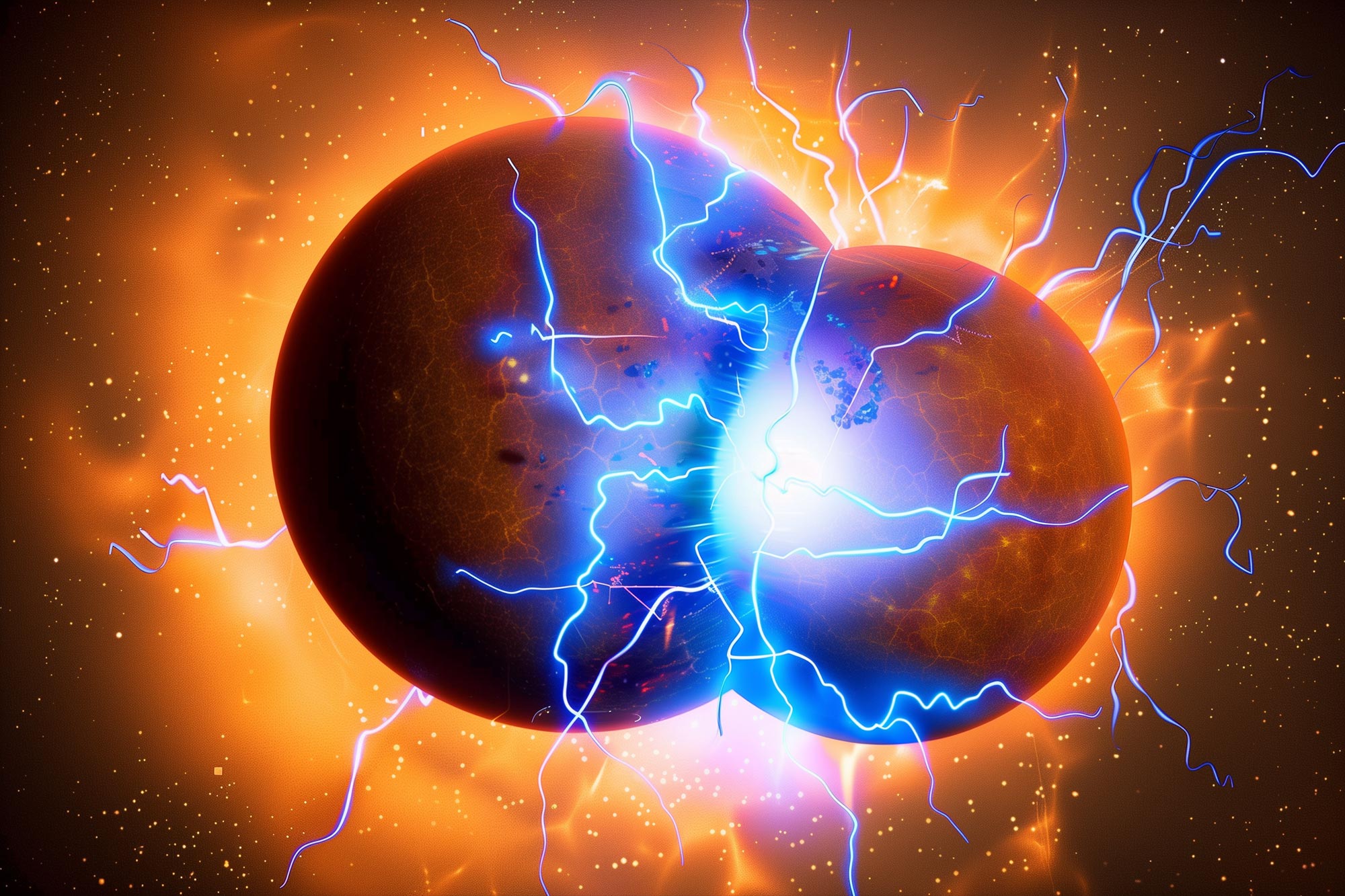
The strong force is essential in particle physics, binding subatomic particles like quarks into protons and neutrons, and these into nuclei, despite the repulsive electromagnetic force between like-charged protons.
This force is mediated by gluons and is notably stronger than electromagnetism, but it operates over minuscule distances. The DOE has significantly advanced our understanding of the strong force through extensive research and collaboration, contributing to major discoveries and the ongoing exploration of the Standard Model.
The strong force is the force that holds subatomic particles together to form larger subatomic particles. It is one of the three fundamental forces in the Standard Model of particle physics—the forces that cannot be reduced to an even simpler force.
At the smallest level, the strong force holds quarks together to form protons and neutrons. These larger particles consist of three quarks. At a larger level, the strong force holds protons and neutrons together to form atomic nuclei.
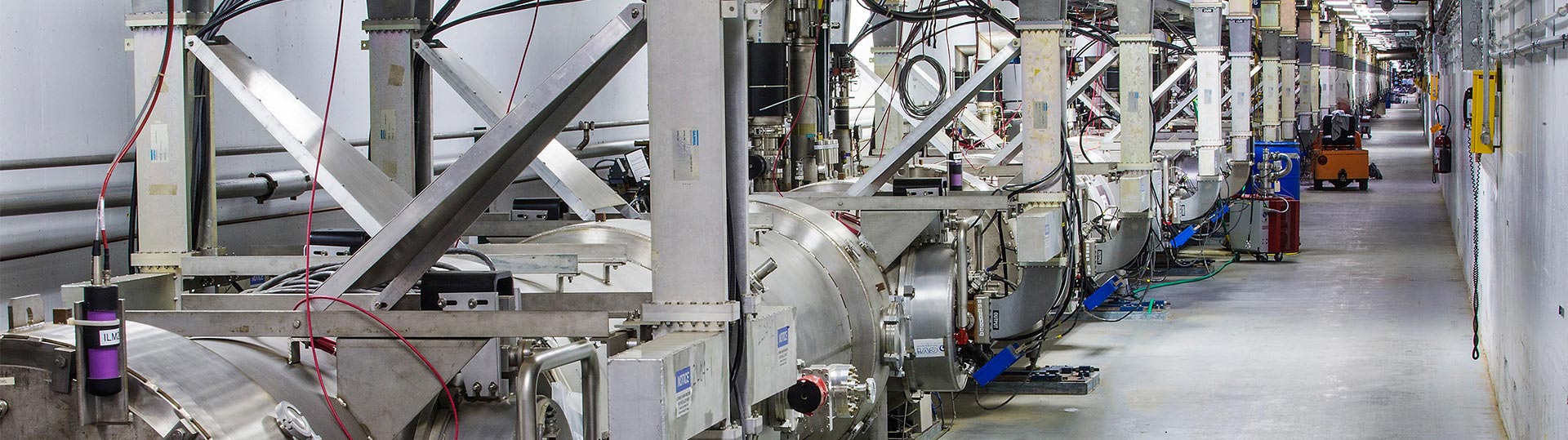
The strong force is carried by gluons. Gluons are a type of boson, particles that carry forces and allow those forces to move from particle to particle.
Scientists first proposed the strong force because they needed an explanation for why the electromagnetic force didn’t cause atomic nuclei to fly apart into their more fundamental particles. The electromagnetic force is responsible for how particles with electric charge interact. In an atomic nucleus, the electromagnetic force should force positively charged protons apart because they have the same electric change. The strong force overcomes this effect.
Strong Force Facts
- The strong force is about 100 times stronger than electromagnetism.
- The strong force only has influence over very, very small distances—it stops working when particles are even a tiny distance apart. How tiny? About 100,000 times smaller than the diameter of an atom.
- The strong force means that it takes so much energy to pull two quarks apart that the energy spawns two additional quarks. This is why quarks are always combined with other quarks and are never found in isolation.
- Learn more in this Fermilab video on the strong force and learn more about all the forces in this longer Fermilab video.
- Read Scientific American’s story on research into how the strong force gets its strength.
DOE Office of Science: Contributions to the Standard Model of Particle Physics
DOE has a long history of supporting research into fundamental particles and the forces that govern them. Five of the six types of quarks, one type of lepton, and all three neutrinos were discovered at institutions that are now DOE national laboratories. Researchers supported by the DOE Office of Science, often in collaboration with scientists from around the world, have contributed to Nobel Prize-winning discoveries and measurements that refined the Standard Model.
These efforts continue today. Scientists supported by the DOE Office of Science run experiments that make precision tests of the Standard Model and further improve measurements of particle properties and their interactions. Theorists work with experimental scientists to develop new avenues to explore the Standard Model using particle accelerators and other tools. This research may also provide insight into what sorts of unknown particles and forces might explain dark matter and dark energy as well as what happened to antimatter after the Big Bang.
Never miss a breakthrough: Join the SciTechDaily newsletter.
Follow us on Google and Google News.
3 Comments
This research may also provide insight into what sorts of unknown particles and forces might explain dark matter and dark energy as well as what happened to antimatter after the Big Bang.
This play was a miserable failure.
Theoretical basis:
(1) Traditional physics: based on mathematical formalism and experimental verification and free imagination..
(2) Topological Vortex Theory: Although also based on mathematics (such as topology), it focuses more on non intuitive geometry and topological structures, challenging traditional physical intuition.
Please witness the exemplary collaboration between theoretical physicists and experimentalists ( https://scitechdaily.com/microscope-spacecrafts-most-precise-test-of-key-component-of-the-theory-of-general-relativity/#comment-854286 ).
My ruthless repetition may make some people unhappy, but in order to fight against rampant pseudoscience, I can only do so.
Extension of the Standard Model: Topological Vortex Theory points out the limitations of the Standard Model in describing the large-scale structure of the universe, proposes the need to consider non-standard model components such as dark matter and dark energy, and suggests that topological vortex fields may be key to understanding these phenomena.
Topological vortex theory heralds innovative technologies such as topological electronics, topological smart batteries, topological quantum computing, etc., which may bring low-energy electronic components, almost inexhaustible currents, and revolutionary computing platforms, etc.
Mathematics tells us that topological vortices and antivortices can form new spacetime structures via the synchronous effect of superposition, deflection, or twisting of them. Mathematics does not tell us that there must be God particles, ghost particles, fermions, or bosons present. Today, so-called official in physics stubbornly believes that two sets of cobalt-60 rotating in opposite directions can become two sets of objects that mirror each other, had deen a typical case of rampant pseudoscience.