
Researchers are developing a method to simplify the calculation of neutrinos’ quantum flavor changes in dense astrophysical settings like supernovae. By integrating quantum mechanics into traditional transport models, this approach helps predict neutrino behavior and elemental production in stellar explosions, showing promise in initial tests.
Neutrinos have a quantum mechanical property called “flavor.” This flavor can transform as neutrinos move through space. A major challenge is to keep track of both the physical movement of the neutrinos and their change of flavor in astrophysical systems such as core-collapse supernovae and neutron star mergers. The complicated arrangement and large number of neutrinos in these systems make it nearly impossible to follow all or even a subset of the neutrinos.
In this study, physicists examined a potential way to solve this challenge. The approach involves expanding traditional methods of calculating neutrino movement to include quantum mechanical flavor change. This approach reduces the complexity of calculating how neutrinos behave in complex systems
Expanding Calculation Methods for Neutrino Movement
A supernova or neutron star merger sends out many types of messengers, from photons to gravitational waves, from neutrinos to heavy elements. These messengers provide scientists with new insights into the physics of these stellar objects. However, scientists need to understand neutrino physics to use these messengers. Neutrinos carry a substantial proportion of the energy of these systems.
In addition, scientists need to understand the interactions that involve neutrinos to predict the heavy elements produced from the explosions of stars and star mergers. Angular moments encapsulate the total number and flux of the neutrinos into a small set of equations of motion. Scientists can then use these equations to calculate the change in neutrino flavor.
The reduced number of equations in the angular moment method offers a path forward for solving neutrino flavor-transformation problems in compact astrophysical objects, such as a neutron star merger.
Testing the Angular-Moment-Based Approach
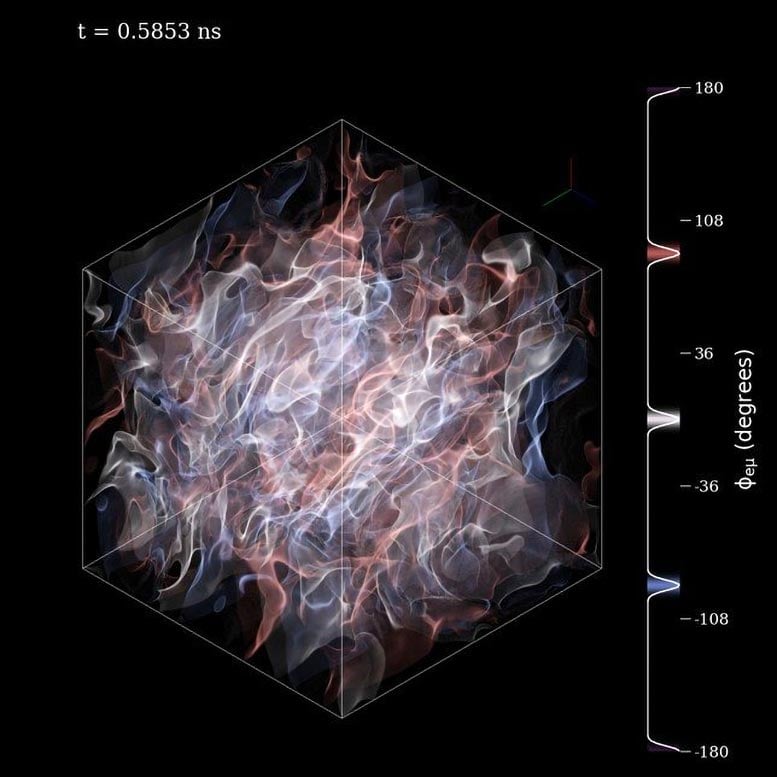
This research examined the prospects for using a semi-classical angular-moment-based approach to include the quantum mechanical effects of flavor in the transport of neutrinos in a neutron star merger remnant. The researchers tested the method on a type of neutrino flavor transformation called “fast-flavor,” for which angular information about the neutrinos is a known requirement for the transformation. The result was that the method captured the growth of the transformation well and that this method warrants further exploration.
This work used computational resources from the National Energy Research Scientific Computing Center, a Department of Energy user facility. The work also used the Payne machine at North Carolina State University, which is supported in part by the Research Corporation for Science Advancement.
References:
“Neutrino fast flavor instability in three dimensions for a neutron star merger” by Evan Grohs, Sherwood Richers, Sean M. Couch, Francois Foucart, James P. Kneller and G.C. McLaughlin, 29 September 2023, Physics Letters B.
DOI: 10.1016/j.physletb.2023.138210
“Two-moment Neutrino Flavor Transformation with Applications to the Fast Flavor Instability in Neutron Star Mergers” by Evan Grohs, Sherwood Richers, Sean M. Couch, Francois Foucart, Julien Froustey, James P. Kneller and Gail C. McLaughlin, 21 February 2024, The Astrophysical Journal.
DOI: 10.3847/1538-4357/ad13f2
This research was primarily funded by the Department of Energy (DOE) Office of Science, Nuclear Physics program. Additional funding was provided by the DOE Office of Science, Office of Advanced Scientific Computing Research; the National Science Foundation; the Heising-Simons Foundation; and the National Aeronautics and Space Administration.
Never miss a breakthrough: Join the SciTechDaily newsletter.
Follow us on Google and Google News.
1 Comment
Researchers are developing a method to simplify the calculation of neutrinos’ quantum flavor changes in dense astrophysical settings like supernovae. By integrating quantum mechanics into traditional transport models, this approach helps predict neutrino behavior and elemental production in stellar explosions, showing promise in initial tests.
Please ask researchers to think deeply:
Do you really understand quantum mechanics?
The universe does not do algebra, formulas, or fractions; it is a superposition, deflection, and entanglement of geometric shapes. When physics no longer believes in geometric shapes, it can only believe in God, angels, and even a strange cat (quantum mechanics). Contemporary physics should not always live in a children’s story world.
Scientific research guided by correct theories can help humanity avoid detours, failures, and pomposity. Please witness the exemplary collaboration between theoretical physicists and experimentalists (https://scitechdaily.com/microscope-spacecrafts-most-precise-test-of-key-component-of-the-theory-of-general-relativity/#comment-854286). Is this the children’s story of contemporary physics?