
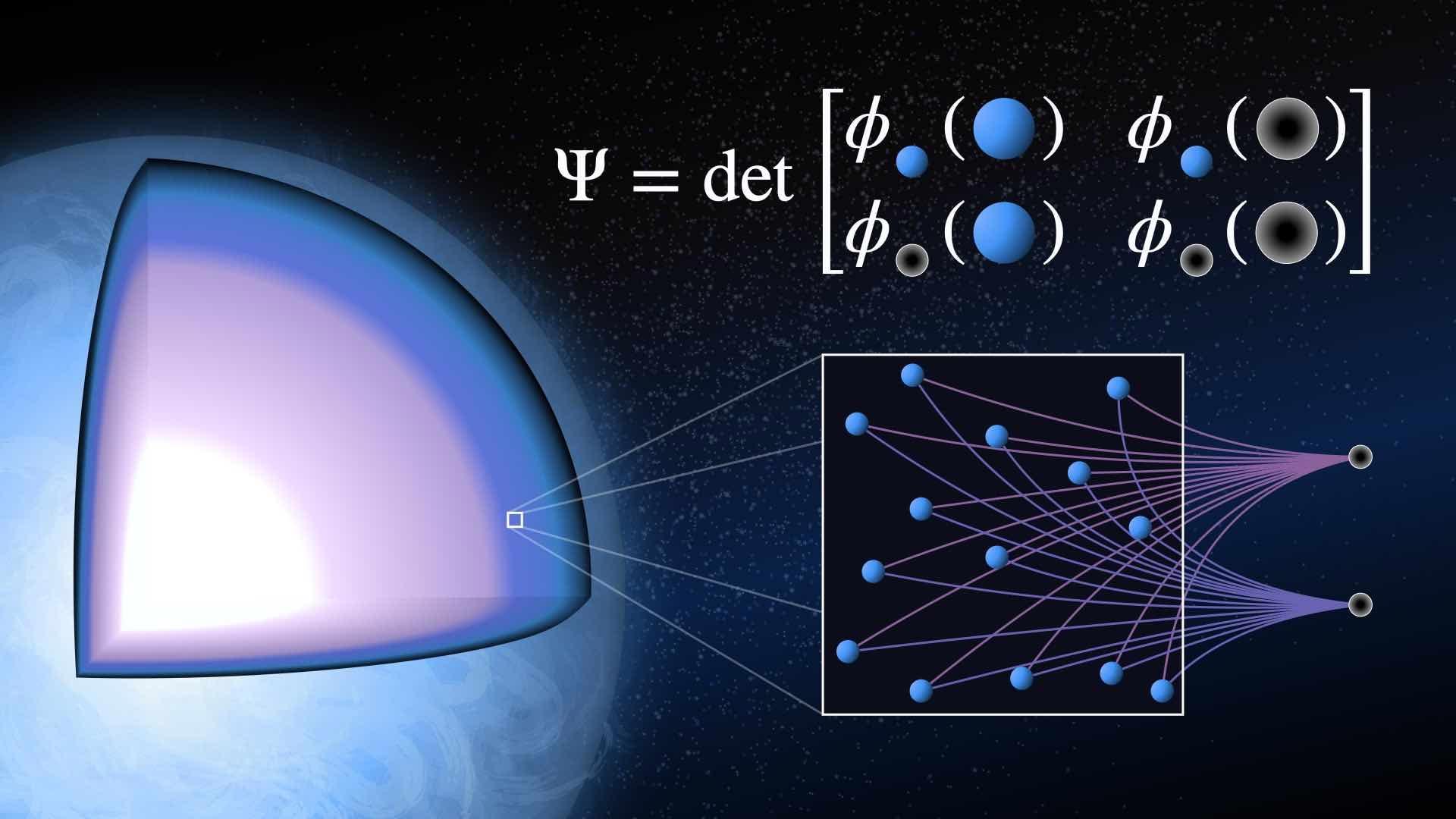
Researchers find evidence of superfluidity in low-density neutron matter by using highly flexible neural-network representations of quantum wave functions.
A groundbreaking study employing artificial neural networks has refined our understanding of neutron superfluidity in neutron stars, proposing a cost-effective model that rivals traditional computational approaches in predicting neutron behavior and emergent quantum phenomena.
Neutron Superfluidity in Neutron Stars
The inner crust of a neutron star contains a fascinating phenomenon known as neutron superfluidity, where neutrons flow without resistance due to the absence of viscosity. Traditionally, researchers predict the properties of low-density neutron matter by assuming that neutrons pair up into “Cooper pairs,” a fundamental concept in quantum mechanics.
However, this study took a different approach, using artificial neural networks to achieve accurate predictions without relying on this assumption. By enhancing the standard “single-particle” model, the researchers introduced “hidden” neutrons, which mediate interactions among the “real” neutrons and capture complex quantum many-body correlations. This innovative method allows Cooper pairs to emerge naturally during the calculations, offering new insights into the quantum behavior of neutron matter.
Implications of Neutron Superfluidity Research
Understanding neutron superfluidity provides important insights into neutron stars. It sheds light on their cooling mechanisms, their rotation, and phenomena such as glitches—sudden changes in their rotation rate. While scientists cannot directly access neutron star matter experimentally, the fundamental interactions that govern this matter’s behavior are the same as those that govern atomic nuclei on Earth.
Researchers are working to construct nuclear interactions that are simple, yet predictive. Accurately solving the quantum many-body problem is a crucial part of assessing the quality of these interactions. This work uses simple interactions that agree well with previous calculations that assume much more complex interactions.
Quantum Phenomena in Low-Density Neutron Matter
Low-density neutron matter is characterized by fascinating emergent quantum phenomena, such as the formation of Cooper pairs and the onset of superfluidity. Researchers used artificial neural networks alongside advanced optimization techniques to study this density regime. Using a simplified model of the interactions between neutrons, the researchers calculated the energy per particle and compared the results to those obtained from highly realistic interactions. This approach is competitive with other computational methods at a fraction of the cost.
Reference: “Dilute neutron star matter from neural-network quantum states” by Bryce Fore, Jane M. Kim, Giuseppe Carleo, Morten Hjorth-Jensen, Alessandro Lovato and Maria Piarulli, 31 July 2023, Physical Review Research.
DOI: 10.1103/PhysRevResearch.5.033062
This work is supported by the Department of Energy (DOE) Office of Science, Office of Nuclear Physics, the DOE Office of Science, Office of Advanced Scientific Computing Research, Scientific Discovery through Advanced Computing (SciDAC) NUCLEI program, and the U.S. National Science Foundation. Numerical calculations used the Laboratory Computing Resource Center at Argonne National Laboratory and the computers of the Argonne Leadership Computing Facility, a DOE Office of Science user facility.
Never miss a breakthrough: Join the SciTechDaily newsletter.
Follow us on Google and Google News.
4 Comments
Please ask the researchers to think deeply:
What is the relationship between fluids and particles?
Scientific research guided by correct theories can help people avoid detours, failures, and exaggeration. The physical phenomena observed by researchers in experiments are always appearances, never the natural essence of things. The natural essence of things needs to be extracted and sublimated based on mathematical theories via appearances , rather than being imagined arbitrarily.
Everytime scientific revolution, the scientific research space brought by the new paradigm expands exponentially. Physics should not ignore the analyzable physical properties of topological vortices.
(1) Traditional physics: based on mathematical formalism, experimental verification and arbitrary imagination.
(2) Topological Vortex Theory (TVT): Although also based on mathematics (such as topology), it focuses more on non intuitive geometry and topological structures, challenging traditional physical intuition.
Topological Vortex Theory (TVT) points out the limitations of the Standard Model in describing the large-scale structure of the universe, proposes the need to consider non-standard model components such as dark matter and dark energy, and suggests that topological vortex fields may be key to understanding these phenomena. Topological vortex theory (TVT) heralds innovative technologies such as topological electronics, topological smart batteries, topological quantum computing, etc., which may bring low-energy electronic components, almost inexhaustible currents, and revolutionary computing platforms, etc.
Topology tells us that topological vortices and antivortices can form new spacetime structures via the synchronous effect of superposition, deflection, or twisting of them. Mathematics does not tell us that there must be God particles, ghost particles, fermions, or bosons present. When physics and mathematics diverge, arbitrary imagination will make physics no different from theology. Topological vortex research reflections on the philosophy and methodology of science help us understand the nature essence of science and the limitations of scientific methods. This not only has guiding significance for scientific research itself, but also has important implications for science education and popularization.
All things follow certain laws, which can be revealed through observation and research ( such as topological structures ). Today, so-called official in physics stubbornly believes that two sets of cobalt-60 rotating in opposite directions can become two sets of objects that mirror each other, is a typical case that pseudoscience is rampant and domineering.
Please witness the exemplary collaboration between theoretical physicists and experimentalists (https://scitechdaily.com/microscope-spacecrafts-most-precise-test-of-key-component-of-the-theory-of-general-relativity/#comment-854286). It is normal to make mistakes in scientific research, but what is abnormal is to stubbornly adhere to erroneous positions and not repent.
Let us continue to witness via facts the dirtiest and ugliest era in the history of sciences and humanities in human society. The laws of nature will not change due to misleading of certain so-called academic publications or endorsements from certain so-called scientific awards.
As some comments have stated ( https://scitechdaily.com/super-photons-unveiled-sculpting-light-into-unbreakable-communication-networks/#comment-861546 ): Fortunately, we have enough pieces to put the puzzle together properly, and there are folks who have chosen to forego today’s societal structures in order to do exactly that.
Additionally, some comments have stated ( https://scitechdaily.com/science-made-simple-what-is-nuclear-fission/#comment-862083 ): You have been spewing this type of nonsensical word salad for several years now. Outrage doesn’t equal competence. If anything, your inability to convince anyone is a sign of your incompetence. Ask the commenter:Today, so-called official in physics stubbornly believes that two sets of cobalt-60 rotating in opposite directions can become two sets of objects that mirror each other, and it even won awards. These so-called academic publications blatantly talk nonsense, which is a public humiliation of the normal intellectual level of the public. Do you think this is human misfortune or personal misfortune?
Isn’t this the evil consequence of the Physics Review family misleading science? Academic circle is not Entertainment industry. Have some people really never know what shame is?
Hello sir namaste god bless all family members danke fur god, thanks for innen sir mear Lernen arbeit geben.ich prayer for alle,wenn wir alle ruhig studieren ,andere members Lernen.thanks for alls.schone gruss Rajveer Singh sun of karnail singh batth village kotala bet po chhourian district Ludhiana Punjab India for alls
Here are a series of papers I wrote to replace the standard model with a theoretical framework based on direct observations of atoms.
https://www.academia.edu/resource/work/124874380
https://www.academia.edu/resource/work/125744392
https://www.academia.edu/resource/work/125978573
Your diligence is admirable. Nevertheless, I would like to ask you two small questions:
1. What is the spacetime background of atoms?
2. Do you occupy a certain space and maintain your presence at a specific time?
The universe is not formula, algebra, or fraction. The universe is the superposition, deflection, and entanglement of geometric and topological shapes. The topological evolution of geometric shapes is the foundation of high-dimensional spacetime matter. Deviating from the mathematical principles of geometric shapes to imagine high-dimensional spacetime matter will make physics indistinguishable from theology.