
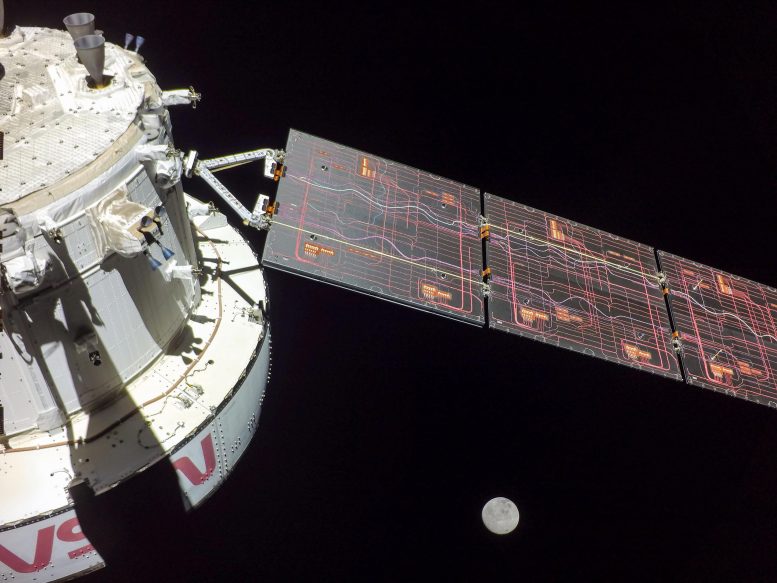
On Artemis I Flight Day 16, Orion left its distant lunar orbit and began its return journey home. The spacecraft successfully completed the distant retrograde departure burn at 3:53 p.m. CST, firing its main engine to set the spacecraft on course for a close lunar flyby before its return home.
The 1-minute 45-second burn changed Orion’s velocity by about 454 feet per second. It was performed using the Orion main engine on the European Service Module. The engine is an orbital maneuvering system engine modified for use on Orion and built by Aerojet Rocketdyne. The engine has the ability to provide 6,000 pounds of thrust. The proven engine flying on Artemis I flew on 19 Space Shuttle flights, beginning with STS-41G (the 13th flight of the Space Shuttle program) in October 1984 and ending with STS-112 (the 111th Space Shuttle Mission) in October 2002.
Artemis All Access is your look at the latest in Artemis I, the people and technology behind the mission, and what is coming up next. This uncrewed flight test around the Moon will pave the way for a crewed flight test and future human lunar exploration as part of Artemis. Credit: NASA
The burn is one of two maneuvers required ahead of Orion’s splashdown in the Pacific Ocean on December 11. The second will occur on Monday, December 5, when the spacecraft will fly 79.2 miles (127 km) above the lunar surface and perform the return powered flyby burn, which will commit Orion on its course toward Earth.
Teams also continued thermal tests of the star trackers during their eighth and final planned test. Star trackers are a navigation tool that measure the positions of stars to help the spacecraft determine its orientation. In the first three flight days of the mission, engineers evaluated initial data to understand star tracker readings correlated to thruster firings.
A trajectory correction burn occurred at approximately 9:53 p.m. CST on Thursday, December 1, with Orion’s auxiliary thrusters fine-tuning the spacecraft’s path.
Just after 4:30 p.m. CST on December 1, Orion was traveling 237,600 miles (382,400 km) from Earth and 52,900 miles (85,100 km) from the Moon, cruising at 2,300 mph (3,700 km/h).
Never miss a breakthrough: Join the SciTechDaily newsletter.
Follow us on Google and Google News.
2 Comments
Female astronauts have fewer opportunities in space than men because of strict lifetime radiation exposure restrictions, A six-month mission on the International Space Station exposes astronauts to 40 times the average yearly dose of background radiation that a person would receive living on Earth,
A six-month mission on the International Space Station exposes astronauts to 40 times yearly dose of background radiation that a person would receive on Earth,
While the level of risk allowed for women becouse they have a lower threshold for space radiation exposure than men,
“Depending on when you fly a space mission, a female will fly only 45 to 50 percent of the missions that a male can fly,”
And what happened to putting the best candidates in space like we did in the ’60s when we had a head-to-head competition to determine who had the best ability for which Mission instead of trying to fill political agendas to put a person of color and a female on the moon!
Female astronauts have fewer opportunities in space than men because of strict lifetime radiation exposure restrictions, A six-month mission on the International Space Station exposes astronauts to 40 times the average yearly dose of background radiation that a person would receive living on Earth,
A six-month mission on the International Space Station exposes astronauts to 40 times yearly dose of background radiation that a person would receive on Earth,
While the level of risk allowed for women becouse they have a lower threshold for space radiation exposure than men,
“Depending on when you fly a space mission, a female will fly only 45 to 50 percent of the missions that a male can fly,”
And what happened to putting the best candidates in space like we did in the ’60s when we had a head-to-head competition to determine who had the best ability for which Mission instead of trying to fill political agendas to put a person of color and a female on the moon!