
Close Menu
    Facebook X (Twitter) Instagram
    SciTechDaily
    • Biology
    • Chemistry
    • Earth
    • Health
    • Physics
    • Science
    • Space
    • Technology
    Facebook X (Twitter) Pinterest YouTube RSS
    SciTechDaily
    Home»Space»NASA Astronaut Gets a Good GRASP on Gravity
    Space

    NASA Astronaut Gets a Good GRASP on Gravity

    By European Space AgencyJanuary 7, 2021No Comments2 Mins Read
    Facebook Twitter Pinterest Telegram LinkedIn WhatsApp Email Reddit
    Share
    Facebook Twitter LinkedIn Pinterest Telegram Email Reddit
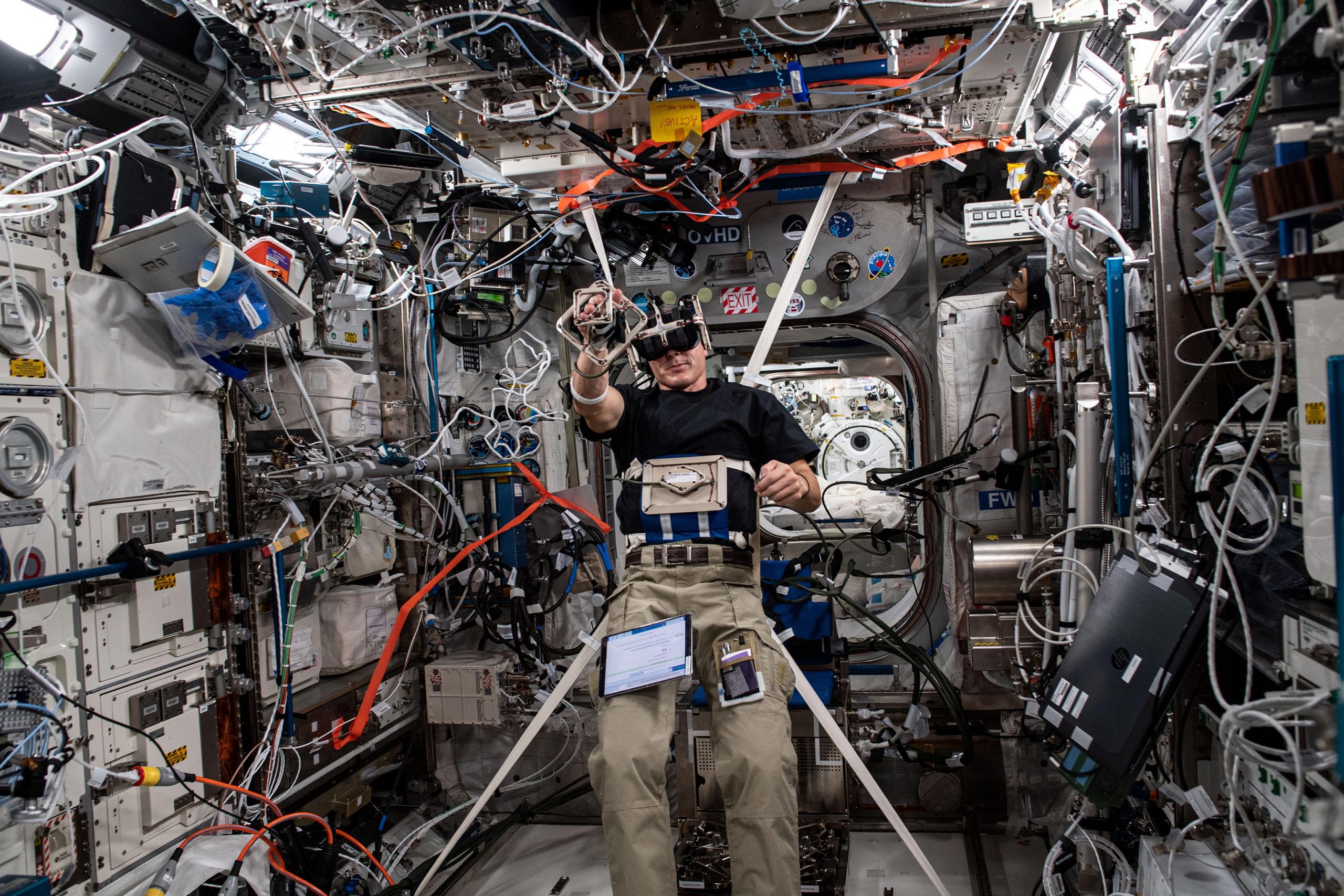
    NASA Astronaut Mike Hopkins Performs the Grasp Experiment
    NASA astronaut Mike Hopkins performs the Grasp experiment in the Columbus module of the International Space Station ahead of the New Year. The experiment studies how the central nervous system, specifically hand-eye coordination, adapts to microgravity. Credit: ESA/NASA

    Studying Hand-Eye Coordination in Space

    NASA astronaut Mike Hopkins performs the Grasp experiment in the Columbus module of the International Space Station ahead of the New Year. The experiment studies how the central nervous system, specifically hand-eye coordination, adapts to microgravity.

    Grasp stands for Gravitational References for Sensimotor Performance and seeks to better understand how the central nervous system integrates information from different senses, such as sight, sound and touch, to coordinate hand movements and determine what role gravity plays.

    How does the experiment work? Mike dons virtual reality (VR) gear that is coupled with a laptop and driven by an audio/graphics system. The VR headset simulates a series of tasks for him, while a 3D motion tracker updates the display in real-time in response to his hand, body, and arm movements. Measurements are taken on the ground and during spaceflight.

    ESA astronaut Thomas Pesquet was the first to use the VR gear to perform the experiment during his 2016 mission. ESA astronauts Alexander Gerst and Luca Parmitano followed suit during their respective missions. Watch a video of Alexander performing the experiment below.

    Researchers suspect that, on Earth, the brain uses gravity as a reference. When reaching for an object, the brain uses visual clues as well as how your shoulder muscles counteract the downward force of gravity to keep your arm straight to calculate the distance between your hand and the object.

    However, the sensation of floating for months on end is something our brains did not have to deal with until last century. Seeing how they adapt to this environment offers valuable insight.

    Spearheaded by researchers at French national space agency CNES, the study helps us identify the workings of the vestibular system that keeps our balance, and how it connects to the other sensory organs. In other words, Grasp investigates the physiology behind hand-eye coordination, shedding light on how to treat patients showing a loss of vestibular function on Earth.

    For astronauts, the research will be useful during spacewalks, where coordination in weightlessness with few visual clues is vital.

    Never miss a breakthrough: Join the SciTechDaily newsletter.
    Follow us on Google and Google News.

    Astronaut European Space Agency International Space Station NASA
    Share. Facebook Twitter Pinterest LinkedIn Email Reddit

    Related Articles

    Splashdown! NASA SpaceX Crew-3 Astronauts Safely Return to Earth

    NASA, ESA Assign Astronauts to Space Station Mission on SpaceX Crew Dragon

    Astronauts Complete 6 Hour and 54 Minute Spacewalk To Install Space Station Upgrades

    Astronauts Raja Chari & Matthias Maurer Spacewalk Outside the International Space Station [Watch Live]

    The First-Ever Space Olympics Aboard the ISS! [Video]

    Astronauts Chosen for NASA SpaceX Crew-3 Mission to Space Station

    Landmark NASA SpaceX Commercial Crew Test Flight Coverage Schedule

    NASA Astronauts Meir, Morgan, Crewmate Skripochka Return to Earth From Space Station

    “Beyond” Record-Breaking Spacewalker Returns From Orbit

    Leave A Reply Cancel Reply

    • Facebook
    • Twitter
    • Pinterest
    • YouTube

    Don't Miss a Discovery

    Subscribe for the Latest in Science & Tech!

    Trending News

    Artificial Sweeteners May Harm Future Generations, Study Suggests

    Splashdown! NASA Artemis II Returns From Record-Breaking Moon Mission

    What If Consciousness Exists Beyond Your Brain

    Scientists Finally Crack the 100-Million-Year Evolutionary Mystery of Squid and Cuttlefish

    Beyond “Safe Levels”: Study Challenges What We Know About Pesticides and Cancer

    Researchers Have Found a Dietary Compound That Increases Longevity

    Scientists Baffled by Bizarre “Living Fossil” From 275 Million Years Ago

    Your IQ at 23 Could Predict Your Wealth at 27, Study Finds

    Follow SciTechDaily
    • Facebook
    • Twitter
    • YouTube
    • Pinterest
    • Newsletter
    • RSS
    SciTech News
    • Biology News
    • Chemistry News
    • Earth News
    • Health News
    • Physics News
    • Science News
    • Space News
    • Technology News
    Recent Posts
    • What if Dark Matter Has Two Forms? Bold New Hypothesis Could Explain a Cosmic Mystery
    • Researchers Expose Hidden Chemistry of “Ore-Forming” Elements in Biology
    • Geologists Reveal the Americas Collided Earlier Than We Thought
    • 20x Difference: Study Reveals True Source of Airborne Microplastics
    • Scientists Uncover Hidden Force Powering Yellowstone’s Supervolcano
    Copyright © 1998 - 2026 SciTechDaily. All Rights Reserved.
    • Science News
    • About
    • Contact
    • Editorial Board
    • Privacy Policy
    • Terms of Use

    Type above and press Enter to search. Press Esc to cancel.