
Close Menu
    Facebook X (Twitter) Instagram
    SciTechDaily
    • Biology
    • Chemistry
    • Earth
    • Health
    • Physics
    • Science
    • Space
    • Technology
    Facebook X (Twitter) Pinterest YouTube RSS
    SciTechDaily
    Home»Space»NASA Has Reestablished Full Communications With Voyager 2
    Space

    NASA Has Reestablished Full Communications With Voyager 2

    By NASAAugust 5, 20232 Comments2 Mins Read
    Facebook Twitter Pinterest Telegram LinkedIn WhatsApp Email Reddit
    Share
    Facebook Twitter LinkedIn Pinterest Telegram Email Reddit
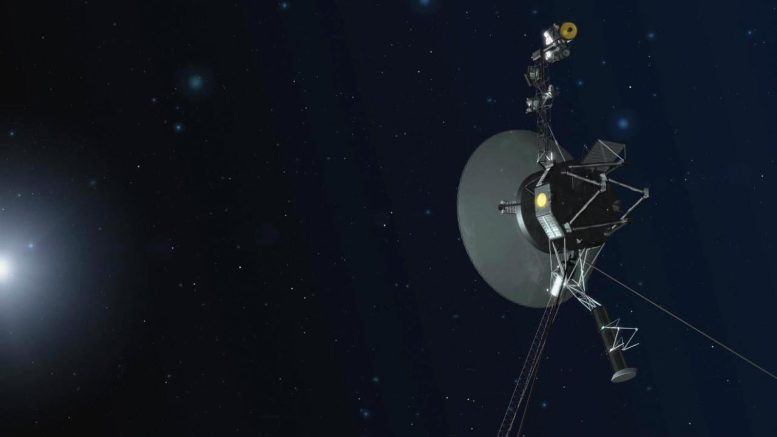
    NASA's Twin Voyager Spacecraft
    An artist concept depicting one of NASA’s twin Voyager spacecraft. Humanity’s farthest and longest-lived spacecraft celebrated 40 years in August and September 2017. Credit: NASA/JPL-Caltech

    NASA’s facility in Australia successfully reoriented Voyager 2, receiving science and telemetry data confirming the spacecraft’s normal operation and expected trajectory.

    NASA’s Deep Space Network facility in Canberra, Australia, sent the equivalent of an interstellar “shout” more than 12.3 billion miles (19.9 billion kilometers) to Voyager 2, instructing the spacecraft to reorient itself and turn its antenna back to Earth. With a one-way light time of 18.5 hours for the command to reach Voyager, it took 37 hours for mission controllers to learn whether the command worked. At 12:29 a.m. EDT on August 4, the spacecraft began returning science and telemetry data, indicating it is operating normally and that it remains on its expected trajectory.
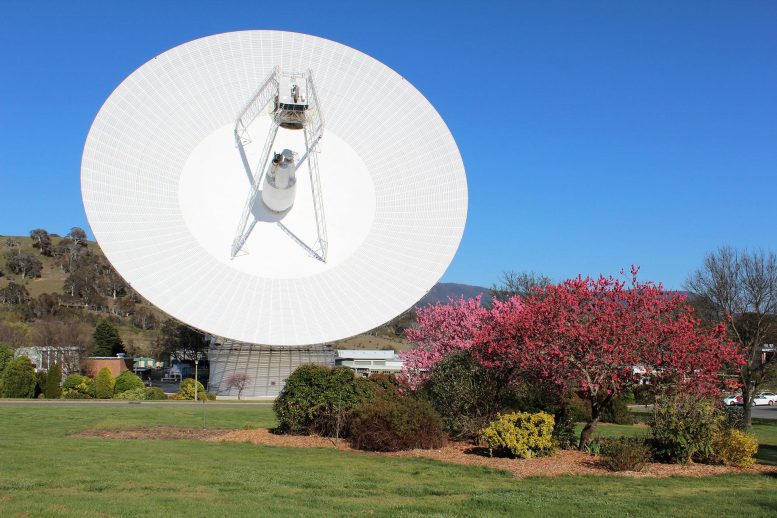
    Deep Space Station 43
    Deep Space Station 43 features a 70-meter diameter antenna and is the largest steerable parabolic antenna in the Southern Hemisphere. This colossal structure weighs over 3000 tonnes and rotates on a thin oil film. The reflector surface consists of 1,272 aluminum panels covering a total area of 4180 square meters, with outer panels perforated to allow wind and rain to pass through. Credit: NASA

    NASA’s Canberra Deep Space Communication Complex (CDSCC) features a number of ‘big dish’ antennas that are required daily to receive data from; and transmit commands to; a wide variety of spacecraft. In 1987, Deep Space Station 43 (DSS-43) was expanded from a 64-meter diameter antenna to a 70-meter diameter one to bolster its capabilities for Voyager 2’s 1989 encounter with Neptune.

    Never miss a breakthrough: Join the SciTechDaily newsletter.
    Follow us on Google and Google News.

    NASA Voyager
    Share. Facebook Twitter Pinterest LinkedIn Email Reddit

    Related Articles

    NASA Powers Down Voyager 1 Instrument As It Fights To Survive Deep Space

    Voyager 1 Presents the “Sounds” of Interstellar Space

    NASA’s Voyager 1 Explores the Outer Limits of Our Heliosphere

    Fly Along With the Voyager Spacecraft As They Head Towards Interstellar Space

    Voyager Spacecraft Poised to Make New Discoveries

    Voyager 1 Reports a Rapid Increase in High-Energy Cosmic Ray Particles

    NASA’s Voyager 1 at the Final Frontier

    Voyager May Become the First Human-Made Object to Enter Interstellar Space

    NASA’s Voyager 1 in “Cosmic Purgatory”

    2 Comments

    1. Mark Spector on August 5, 2023 8:15 pm

      WOW !

      Reply
    2. Greg Marsh on August 18, 2023 10:24 pm

      Double WOW!

      Reply
    Leave A Reply Cancel Reply

    • Facebook
    • Twitter
    • Pinterest
    • YouTube

    Don't Miss a Discovery

    Subscribe for the Latest in Science & Tech!

    Trending News

    Popular Supplement Ingredient Linked to Shorter Lifespan in Men

    Scientists May Have Found a Way To Repair Nerve Damage in Multiple Sclerosis

    “Totally Unexpected” – Scientists Discover Pancreatic Cancer’s Fatal Addiction

    A Strange Quantum Effect May Explain One of Biology’s Greatest Mysteries

    James Webb Telescope Reveals the Universe’s Hidden Cosmic Web in Stunning Detail

    Scientists Identify Simple Supplement That Greatly Reduces Alzheimer’s Damage

    You May Have a Dangerous Type of Cholesterol Even if Your Tests Look Normal

    Your Blood Pressure Reading Could Be Wrong Because of One Simple Mistake

    Follow SciTechDaily
    • Facebook
    • Twitter
    • YouTube
    • Pinterest
    • Newsletter
    • RSS
    SciTech News
    • Biology News
    • Chemistry News
    • Earth News
    • Health News
    • Physics News
    • Science News
    • Space News
    • Technology News
    Recent Posts
    • After 50 Years of Mystery, Researchers Identify New Human Blood Group
    • Leading Climate Scientist Rebuts “Factually Incorrect” US Government Climate Claims
    • You’re Breathing Plastic: Study Finds 4% of City Air Pollution Is Microplastics
    • Cancer Mystery Solved: Scientists Discover How Melanoma Becomes “Immortal”
    • Scientists Uncover Cancer-Fighting Power of Popular Fatty Liver Drug
    Copyright © 1998 - 2026 SciTechDaily. All Rights Reserved.
    • Science News
    • About
    • Contact
    • Editorial Board
    • Privacy Policy
    • Terms of Use

    Type above and press Enter to search. Press Esc to cancel.