
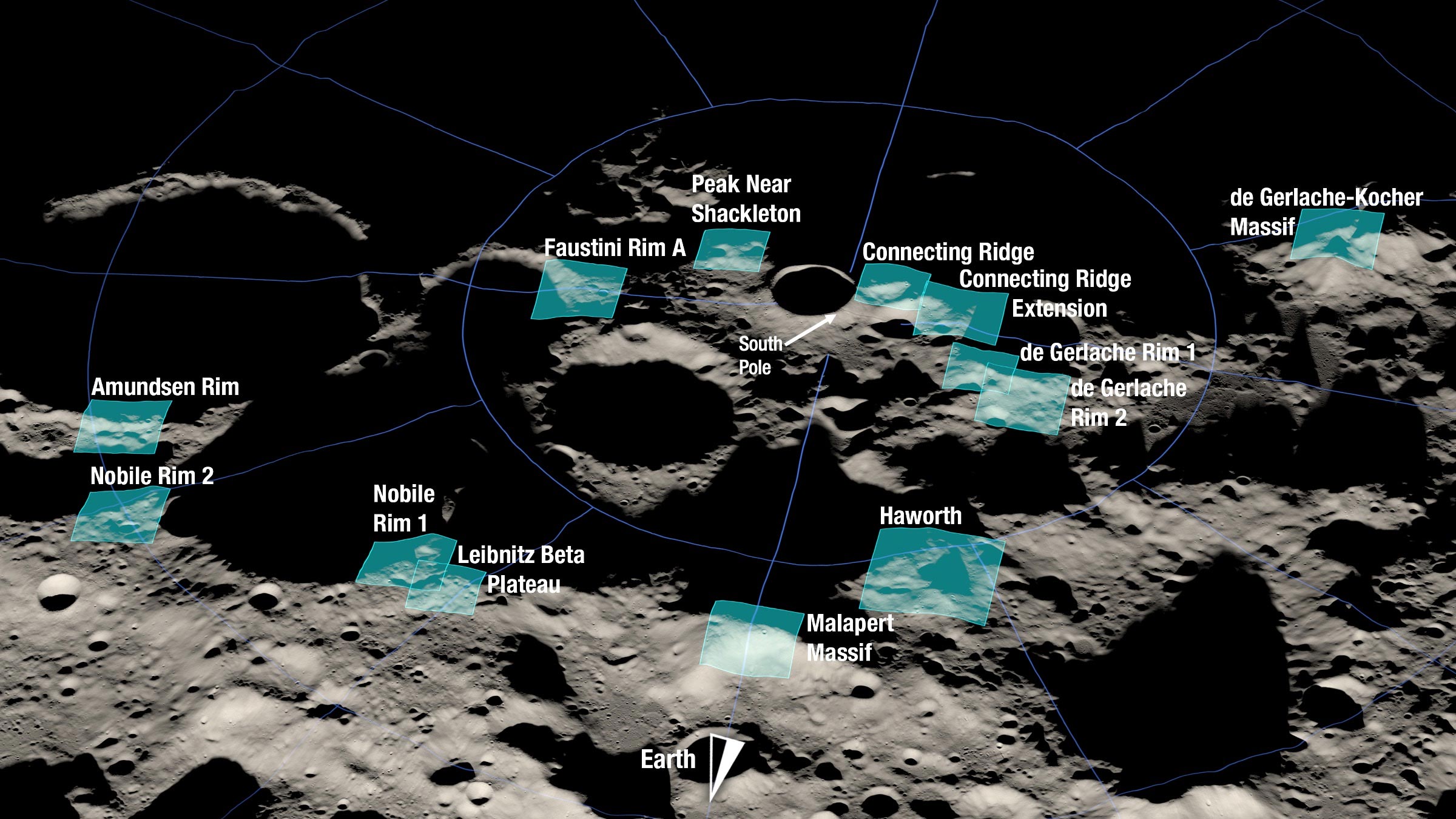
NASA has selected 13 candidate landing regions for Artemis III, prioritizing safety, scientific significance, and continuous sunlight for future lunar exploration.
NASA has identified 13 candidate landing regions near the lunar South Pole as it prepares to send astronauts back to the Moon under the Artemis program. Each region contains multiple potential landing sites for Artemis III. This will be the first of the Artemis missions to bring astronauts to the lunar surface and will include the first woman to set foot on the Moon.
“Selecting these regions means we are one giant leap closer to returning humans to the Moon for the first time since Apollo,” said Mark Kirasich, deputy associate administrator for the Artemis Campaign Development Division at NASA Headquarters in Washington. “When we do, it will be unlike any mission that’s come before as astronauts venture into dark areas previously unexplored by humans and lay the groundwork for future long-term stays.”
NASA identified the following candidate regions for an Artemis III lunar landing:
- Faustini Rim A
- Peak Near Shackleton
- Connecting Ridge
- Connecting Ridge Extension
- de Gerlache Rim 1
- de Gerlache Rim 2
- de Gerlache-Kocher Massif
- Haworth
- Malapert Massif
- Leibnitz Beta Plateau
- Nobile Rim 1
- Nobile Rim 2
- Amundsen Rim
Each of these regions is located within six degrees of latitude of the lunar South Pole. Between them, they contain a diverse assortment of geologic features. Together, the regions provide landing options for all potential Artemis III launch opportunities. Multiple regions ensure flexibility to launch throughout the year because specific landing sites are tightly coupled to the timing of the launch window.
NASA has announced the identification of 13 candidate landing regions near the Moon’s South Pole for the Artemis III mission, the first crewed mission to the Moon’s surface since 1972. This video features a data visualization showing the locations of all 13 regions, and highlights the interesting lunar topography and exploration potential of these areas. Credit: NASA’s Goddard Space Flight Center
An agency-wide team of scientists and engineers selected the regions. They used data from NASA’s Lunar Reconnaissance Orbiter and decades of publications and lunar science findings. In addition to considering launch window availability, the team evaluated regions based on their ability to accommodate a safe landing. This included evaluating criteria such as terrain slope, ease of communications with Earth, and lighting conditions. To determine accessibility, the team also considered the combined capabilities of the Space Launch System rocket, the Orion spacecraft, and the SpaceX-provided Starship human landing system.
All of the regions being considered are scientifically significant because of their proximity to the lunar South Pole. This is an area of the Moon that contains permanently shadowed regions rich in resources and in terrain unexplored by humans.
“Several of the proposed sites within the regions are located among some of the oldest parts of the Moon, and together with the permanently shadowed regions, provide the opportunity to learn about the history of the Moon through previously unstudied lunar materials,” said Sarah Noble, Artemis lunar science lead for NASA’s Planetary Science Division.
The analysis team weighed other landing criteria with specific Artemis III science objectives. This included the goal of landing close enough to a permanently shadowed region to allow the crew to conduct a moonwalk, while limiting disturbance when landing. This will allow astronauts to collect samples and conduct scientific analysis in an uncompromised area, which will yield important information about the depth, distribution, and composition of water ice that was confirmed at the Moon’s South Pole.
By ensuring proximity to permanently shadowed regions and also factoring in other lighting conditions, the team identified regions that can fulfill the moonwalk objective. All 13 regions contain sites that provide continuous access to sunlight throughout a 6.5-day period – the planned duration of the Artemis III surface mission. Because it provides a power source and minimizes temperature variations, access to sunlight is critical for a long-term stay at the Moon.
“Developing a blueprint for exploring the solar system means learning how to use resources that are available to us while also preserving their scientific integrity”, said Jacob Bleacher, chief exploration scientist for NASA. “Lunar water ice is valuable from a scientific perspective and also as a resource, because from it we can extract oxygen and hydrogen for life support systems and fuel.”
NASA will discuss the 13 regions with the broader science and engineering communities through conferences and workshops to solicit input about the relative merits of each region. This feedback will inform site selections in the future and may help NASA identify additional regions for consideration. The agency will also continue to work with SpaceX to confirm Starship’s landing capabilities and assess the options accordingly.
NASA will select sites within regions for Artemis III after it identifies the mission’s target launch dates, which dictate transfer trajectories and surface environment conditions.
Through Artemis, NASA will land the first woman and the first person of color on the Moon, paving the way for a long-term, sustainable lunar presence and serving as a stepping stone for future astronaut missions to Mars.
Never miss a breakthrough: Join the SciTechDaily newsletter.
Follow us on Google and Google News.
4 Comments
By next American’s they mean FIRST American’s.
What do *you* mean by that?
Is it a requirement to always have “NASA will land the first woman and the first person of color” in EVERY article about the Artemis program?
Get rid of the woke management at NASA or cancel all funding and privatize it. It’s a massive waste of tax dollars anyway. I’m not against space exploration just wasting tax dollars on it when half the country now lives in abject poverty with more joining them all the time.