
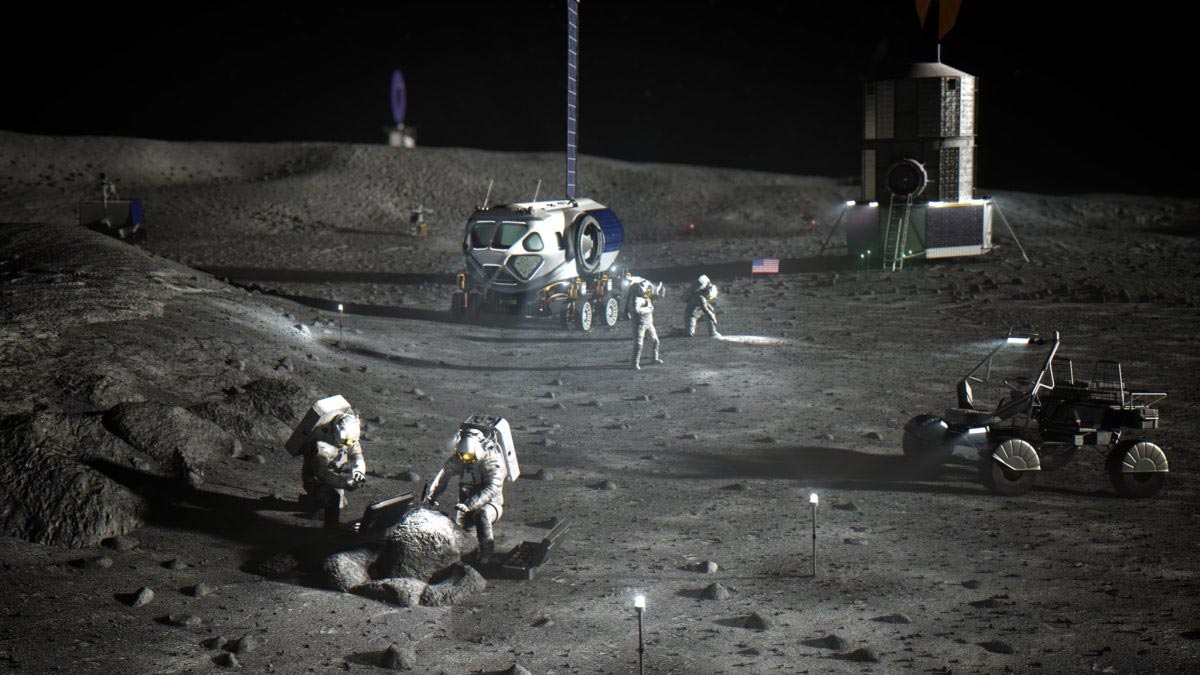
NASA’s Artemis program has sparked excitement around the world and catalyzed new interest in exploring the Moon as the agency prepares to land the first woman and next man on the lunar South Pole in 2024. After that, NASA and its growing list of global partners will establish sustainable exploration by the end of the decade.
NASA will build on the momentum of that human return mission in four years and plans to send crew to the Moon about once per year thereafter. To give astronauts a place to live and work on the Moon, the agency’s Artemis Base Camp concept includes a modern lunar cabin, a rover, and even a mobile home. Early missions will include short surface stays, but as the base camp evolves, the goal is to allow crew to stay at the lunar surface for up to two months at a time.
“On each new trip, astronauts are going to have an increasing level of comfort with the capabilities to explore and study more of the Moon than ever before,” said Kathy Lueders, associate administrator for human spaceflight at NASA Headquarters in Washington. “With more demand for access to the Moon, we are developing the technologies to achieve an unprecedented human and robotic presence 240,000 miles from home. Our experience on the Moon this decade will prepare us for an even greater adventure in the universe – human exploration of Mars.”

Where to stay
Crew will return to the lunar surface for the first time this century beginning with the Artemis III mission. From lunar orbit, two astronauts will take the first new ride to the surface of the Moon, landing where no humans have ever been: the lunar South Pole. This is the ideal location for a future base camp given its potential access to ice and other mineral resources.
On the first few missions, the human landing system will double as lunar lodging, offering life support systems to support a short crew stay on the Moon. In the future, NASA envisions a fixed habitat at the Artemis Base Camp that can house up to four astronauts for a month-long stay.
Since 2016, NASA has worked with several companies on their habitation systems and designs, assessing internal layouts, environmental control and life support systems, and outer structure options, including rigid shells, expandable designs, and hybrid concepts. The agency is currently working with industry to refine ideas for a combination home and office in orbit, recently testing full-size prototypes.
What to wear
Even with minimal surface support in place on early missions, astronauts will embark on at least a week-long expedition on the Moon. Crew will work by day in their modern spacesuits – using new tools to collect samples and setting up a variety of experiments.
These next-generation spacesuits will provide increased mobility, modern communications, and a more robust life support system than its Apollo predecessors. With improved functionality and movement, crew can conduct more complex experiments and collect more unique geologic samples.
NASA is building the new suits for the initial lunar landing and will transition the design and manufacturing to Industry for follow-on production.
Traveling in style
NASA has proposed two lunar surface transportation systems: a lunar terrain vehicle (LTV) and a mobile home and office referred to as a habitable mobility platform.
The LTV will be an unpressurized, or open-top vehicle, that astronauts can drive in their spacesuits for more than 12 miles (19 kilometers) from a camp site. Earlier this year, NASA asked American companies to send ideas to develop an LTV that handles the rough surface of the Moon as well as push the boundaries of power generation and energy storage. The agency is evaluating those responses and hopes to leverage innovations in commercial all-terrain vehicles, military rovers, and more. Such a vehicle may also be autonomous and capable of driving on pre-programmed paths or could be operated remotely from Earth to conduct additional science and exploration activities.
In addition to the LTV, a pressurized rover will greatly expand lunar surface exploration capabilities to the next level. Pressurization means that astronauts can be in the vehicle in their regular clothing as opposed to wearing their spacesuits inside too. This will provide more comfort to work as they cross the lunar terrain in their mobile habitat and explore large areas. When they’re ready to go outside to collect samples or set up experiments, they would need to put their spacesuits on again.
NASA is in the early idea stage for a pressurized rover – formulating concepts and evaluating potential science and exploration rover missions around the South Pole.
What to do
Breakthrough discoveries from the Lunar Reconnaissance Orbiter and Lunar CRater Observation and Sensing Satellite have shown the Moon is rich with resources, such as ice and greater than average access to light, which could support Artemis explorers and provide new opportunities for scientific discoveries and commercial enterprising activities. The unexplored south polar region provides unique opportunities to unlock scientific secrets about the history and evolution of the Earth and Moon, as well as our solar system.
Harvesting lunar resources could lead to safer, more efficient operations with less dependence on supplies delivered from Earth. NASA plans to send the Volatiles Investigating Polar Exploration Rover (VIPER) to the lunar South Pole before crew. Arriving via a commercial Moon delivery, mobile robot will get a close-up view of the distribution and concentration of ice that could eventually be harvested to support human exploration farther into the solar system. We will learn how to spend more time on the lunar surface as well as prepare to future trips to Mars by conducting life science research and learning to mitigate hazards associated with space exploration.
What to know
The Sun hovers over the lunar South Pole horizon continuously throughout the day and year, providing a near-constant source of energy for solar power opportunities. There is no single location, however, that avoids periods of darkness. This means NASA must plan for early Artemis systems to survive the extremely cold environment without power, to build in the capability to store power for up to eight days.
For longer-term work trips to the Artemis Base Camp, NASA’s Lunar Surface Innovation Initiative is working with the U.S. Departments of Energy and Defense to develop a nuclear fission surface power unit that can continuously provide 10 kW of power – the average annual power consumption of a home here on Earth. This small power plant will be able to power and recharge the other basic elements of the Artemis Base Camp and allow greater flexibility for mission planning by easing the requirement for continuous access to sunlight in a distinct location during a specific timeframe.
What to pack
While NASA will need to bring or send ahead all the supplies it needs for early Artemis missions, the agency wants to know what others would pack for their trips to the Moon. It’s not too late to submit photos of your #NASAMoonKit online.
This decade, the Artemis program will lay the foundation for a sustained long-term presence on the lunar surface. As our lunar presence grows with the help of commercial and international partners, someday the Moon could be the ultimate destination for all to explore.
Never miss a breakthrough: Join the SciTechDaily newsletter.
Follow us on Google and Google News.
16 Comments
Not thinking big enough. They can land, unload, and return, multiple unmanned SpaceX StarShips. Each one could deliver approximately 100 tons of payload per trip. That’s almost equivalent to the capacity of a US Air Force C-5M Super Galaxy cargo aircraft with each load. They could drop-off four to five story inflatable domes that could house 30 to 50 astronauts comfortably, and a couple of pressurized Tesla Semis with a range of over 500 miles per charge. With that kind of capability just around the corner, why are they wasting their time landing with a 3-4 person mini-camper? Go big!
Cost.
Return on Investment.
Before going big,
there has to be a study to see,
if the investment is feasible.
Do we have the capability and technology now to extract water from the moon?
We have to have a rescue plan in place,
with another launch ready to go when needed,
probably stationed in earth orbit or in Luna orbit.
So that means another station in orbit a liason to the moon and back.
Once everything is in place maybe in 10 to 20 years from now,
then we can start colonizing the moon and start exploring within our solar system.
Building way station in between.
It’ll be 100 years before we can travel freely within our system,
and another 100 years when we have the ability to travel faster than light travel.
This is really stupid i hate this artical
That isn’t really true at all you just don’t like to read
shut up
Just stop talking please
THIS IS A INTERESTING ARTICLE!
true
Talk to meh if your on no real email needed just @ symbol.
I suppose woke NASA is planning on over 50 bathrooms at the Artemis facility in order to address all the genders of humans who will populate it. Anything less will be bigoted and racist, according to doctrine.
now me personally i wouldnt take that level of disrespect
38K^ 18::.
i will put my genetics in your blood
surenoK::.
yes
Hi