
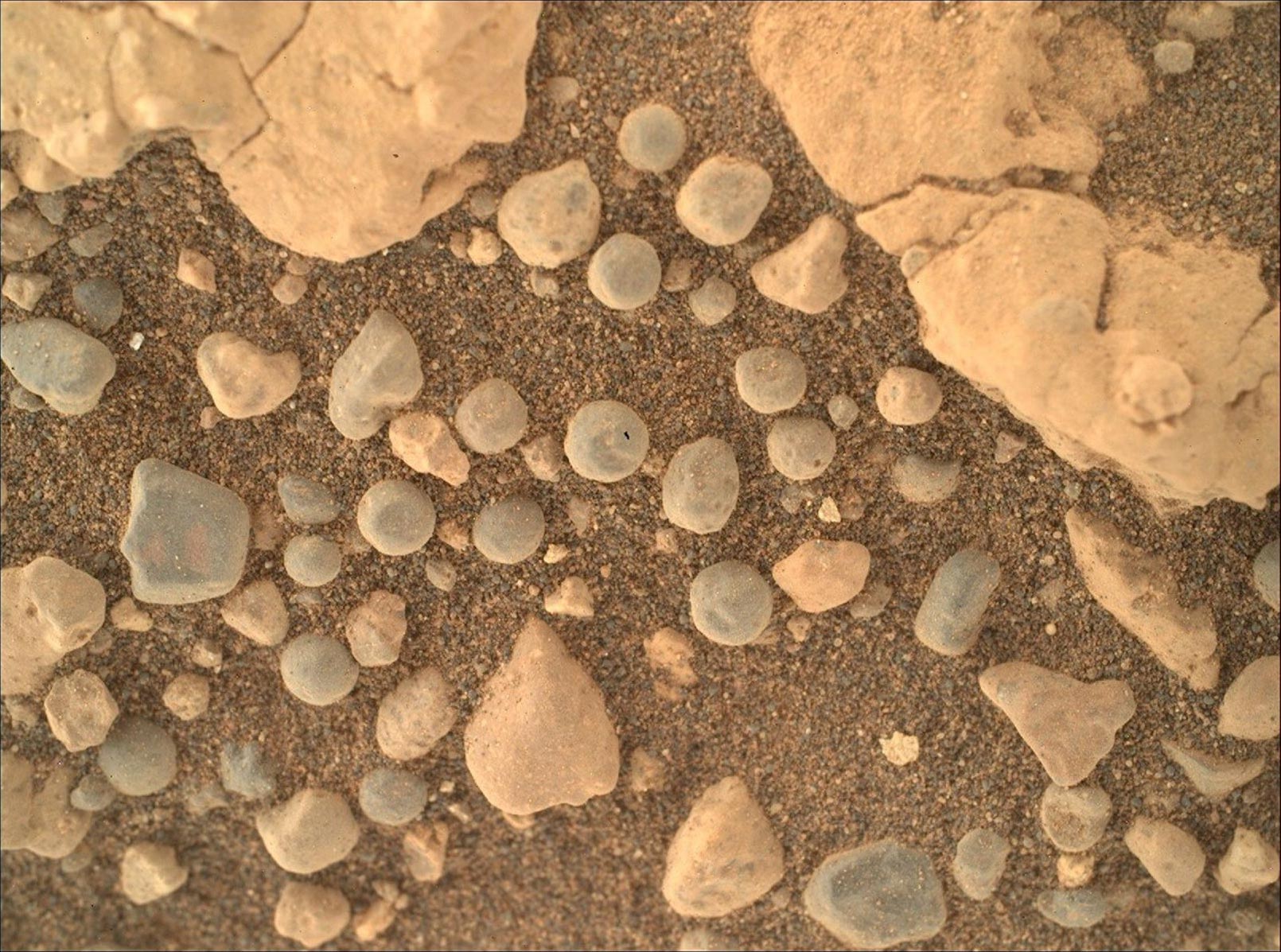
While Americans enjoyed fireworks on July 4th, NASA’s Perseverance rover was investigating tiny, perfectly round spherules on Mars that might hold secrets to the planet’s fiery past.
Unlike the hematite “blueberries” discovered years ago, these new spherules have a volcanic or impact origin, possibly formed during dramatic meteoroid strikes or ancient eruptions. Their unique composition offers scientists a chance to understand Mars’ dynamic history—whether shaped by fire from within or violent blows from the cosmos.
Mysterious Martian Spheres
Spotting nearly flawless spheres on the Martian surface is a rare occurrence for a rover. More than twenty years ago, NASA’s Opportunity rover made headlines after finding hematite-rich spherules (nicknamed “blueberries”) near its landing site in Meridiani Planum. Now, the Perseverance rover has come across a similar surprise: small spherical formations, some embedded in bedrock and others scattered loosely across an area informally known as “Witch Hazel Hill.”
In an earlier update, the team highlighted Perseverance’s close-up study of a spherule-bearing rock formation at a site called “Hare Bay,” where a core sample was later collected. After adding the “Bell Island” core to its collection, the science team turned its attention to the loose spherules in the surrounding terrain, which seem to have weathered out of nearby rock layers.

Perseverance Gets Up Close
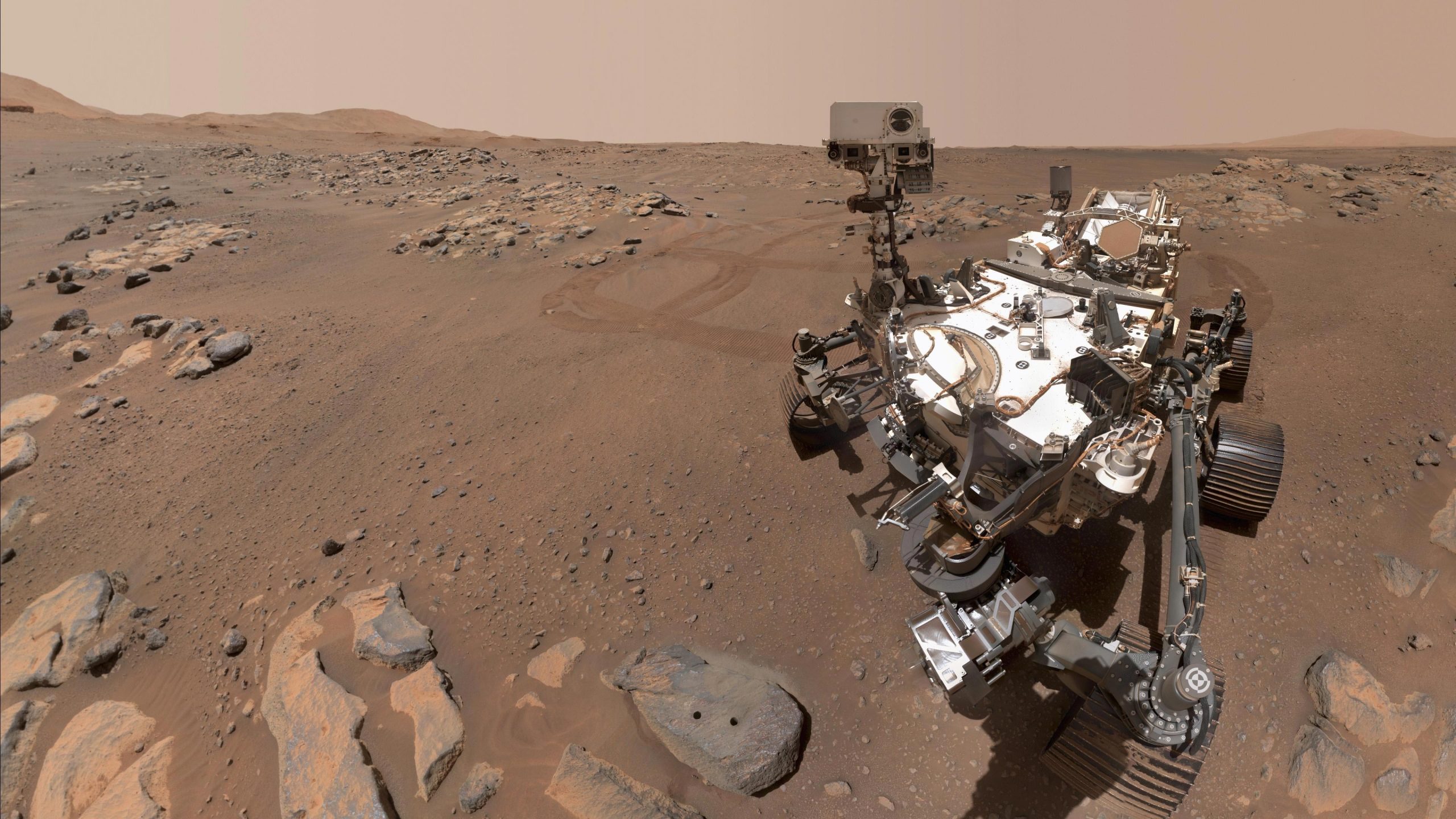
While many in the United States were enjoying the Fourth of July with hot dogs and fireworks, Perseverance spent Sol 1555 investigating soil rich in spherules at a target called “Rowsell Hill.” Using instruments on its robotic arm, the rover closely examined the site. SHERLOC’s Autofocus and Context Imager and the WATSON camera captured detailed, high-resolution images (shown at the top of the page), and PIXL analyzed the chemical elements within both the spherules and the surrounding material.
A Tale of Two Spherules
Despite their superficial similarity to Opportunity’s “blueberries,” the spherules at “Rowsell Hill” have a very different composition and likely origin. In Meridiani Planum, the spherules were composed of the mineral hematite and were interpreted to have formed in groundwater-saturated sediments in Mars’ distant past.
By comparison, the spherules in “Rowsell Hill” have a basaltic composition and likely formed during a meteoroid impact or volcanic eruption. When a meteoroid crashes into the surface of Mars, it can melt rock and send molten droplets spraying into the air. Those droplets can then rapidly cool, solidifying into spherules that rain down on the surrounding area. Alternatively, the spherules may have formed from molten lava during a volcanic eruption.
Unlocking Ancient Martian Energies
With these new data in hand, the Perseverance science team continues to search for answers about where these spherules came from. If they formed during an ancient impact, they may be able to tell us about the composition of the meteoroid and the importance of impact cratering in early Mars’s history. If they instead formed during a volcanic eruption, they could preserve clues about past volcanism in the region around Jezero crater. Either way, these spherules are a remnant of an energetic and dynamic period in Mars’ history!
Written by Andrew Shumway, Postdoctoral Researcher at the University of Washington
Never miss a breakthrough: Join the SciTechDaily newsletter.
Follow us on Google and Google News.
5 Comments
The features represent botryoidal formation, consistent with rapid cooling.
On Earth, most commonly formed by crystal formation from solution:
“Minerals take on a botryoidal habit when they form in an environment containing many nuclei, specks of sand, dust, or other particulate matter to serve as sources of crystal nucleation. Acicular or fibrous crystals grow outward from these “seeds” at the same or very similar rate, resulting in radial crystal growth. As these spheres grow, they can run into or overlap with others that are nearby, fusing together to form a botryoidal cluster. Since botryoidal growths are formed from many smaller crystals, botryoidal habit is usually independent of the specific crystal structure associated with any given mineral. This is how the habit can be observed in a variety of minerals that otherwise display distinct euhedral forms.”
The early conclusion that hematite (Fe2O3) forms in water is incorrect. Hematite is an iron oxide that contains no water. It is derived from the dehydration of hydrous iron oxides like goethite or ferrihydrite. Thus hematite on Mars simply tells us that there were other minerals before they were altered by diagenesis to hematite. Few have doubted that Mars was wet anyhow. So it doesn’t really matter.
Maybe there is a disagreement in how to word it. The main formation model seems to be one of “”diagenetic” processes, i.e., processes that change sediments by water-rock interactions.” [Wikipedia]
You should be more careful using the word “perfect.”