
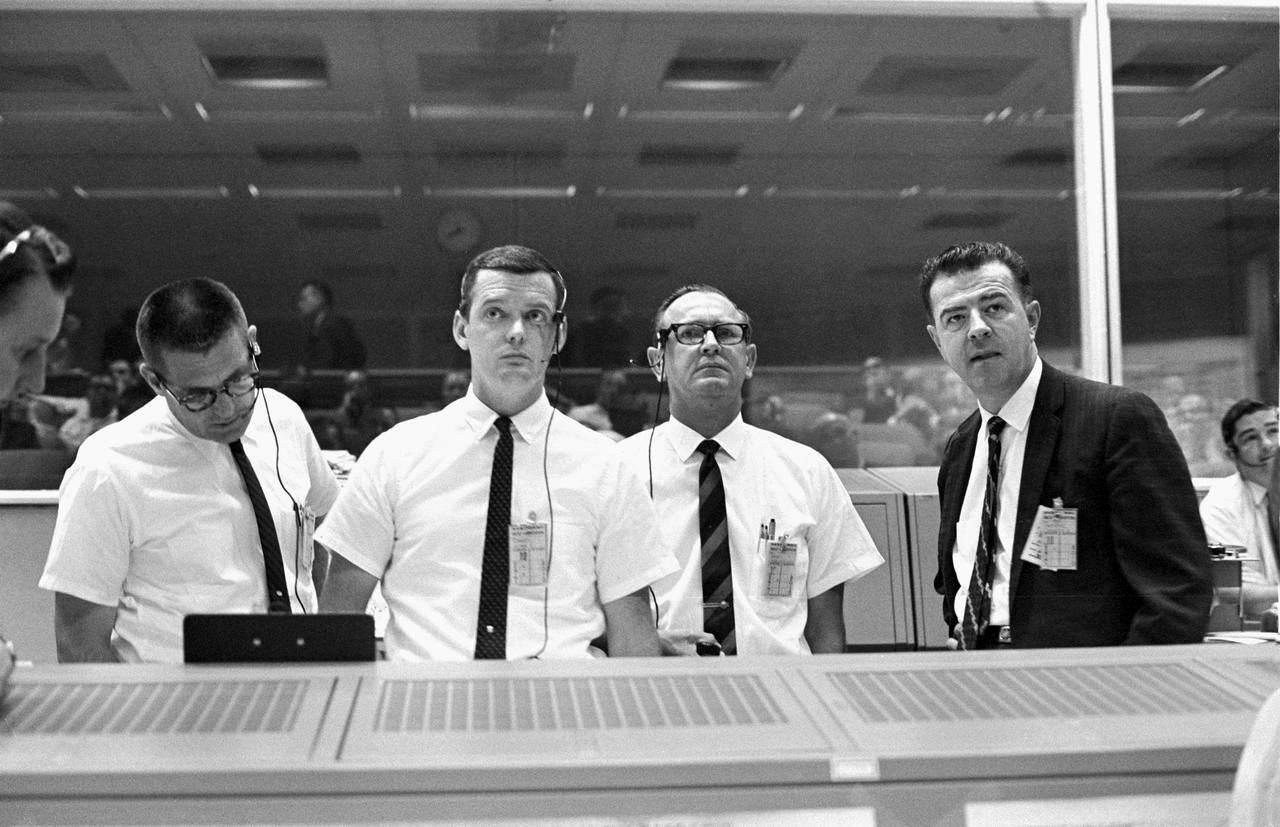
Legendary NASA Flight Director Glynn Lunney, 84, died Friday, March 19, 2021.
Lunney was a flight director for the Apollo 11 Moon landing mission, and was lead flight director for Apollo 7, the first crewed Apollo flight, and Apollo 10, the dress rehearsal for the first Moon landing, in NASA’s Mission Control Center in Houston. He led the mission control team credited with key actions that made it possible to save three Apollo 13 astronauts aboard a spacecraft disabled on the way to the Moon.
Throughout his career, he was a key leader of NASA human spaceflight operations, beginning as a member of the original Space Task Group at NASA’s Langley Research Center established shortly after NASA was formed to manage America’s efforts to put humans into space. After moving to Houston, the task group eventually became the Manned Spacecraft Center, now NASA’s Lyndon B. Johnson Space Center.
“Glynn was the right person for the right time in history. His unique leadership and remarkably quick intellect were critical to the success of some of the most iconic accomplishments in human space flight,” said Johnson Director Mark Geyer. “Although he retired from the agency many years ago, he is forever a member of the NASA family. While he was one of the most famous NASA alumni, he was also one of the most humble people I have ever worked with. He was very supportive of the NASA team and was so gracious in the way he shared his wisdom with us.”
Using the call sign “Black Flight,” he was selected in the Class of 1963 with John Hodge and Gene Kranz, and became NASA’s fourth flight director. Flight directors are responsible for leading teams of flight controllers, research and engineering experts, and support personnel around the world, and making real-time decisions critical to keeping NASA astronauts and missions safe and successful in space.
Lunney worked on the Mercury, Gemini, Apollo, Skylab, and Space Shuttle programs. He retired from NASA in 1985 as manager of the Space Shuttle Program, but continued to lead human spaceflight activities in private industry with Rockwell International and, later, United Space Alliance until his retirement in 1995.
At NASA, he also was a flight director for Apollo missions Apollo-Saturn-201, 4, 7, 8, 11, 13, 14, and 15. He served as lead flight director for Gemini missions 10 and 12, and was a flight director for Gemini missions 9 and 11.
He took on a leadership role in the planning and negotiations that led to the Apollo-Soyuz Test Project (ASTP) which culminated in the docking of an American Apollo and a Russian Soyuz spacecraft July 17, 1975. The effort led the way for today’s cooperative international efforts on the International Space Station.
One of the most notable events in his career came April 13, 1970, after an oxygen tank in the Apollo 13 service module exploded on the way to the Moon. His team reacted quickly and effectively to prepare the astronauts and their spacecraft to complete a safe-return trajectory around the Moon and return home safely. Under Lunney’s direction, the team innovated and worked with the astronauts to deliberately shut down the command module systems so that the lunar module could be used as a lifeboat for the crew during the journey home to Earth. His team’s work was widely credited with keeping the crew alive and safe while longer-term plans were developed for a successful reentry and splashdown.
Lunney received the Presidential Medal of Freedom as part of the Apollo 13 Mission Operations Team.
In Lunney’s own words from his NASA oral history:
“I felt that the Black Team shift immediately after the explosion and for the next 14 hours was the best piece of operations work I ever did or could hope to do. It posed a continuous demand for the best decisions often without hard data and mostly on the basis of judgment, in the face of the most severe in-flight emergency faced thus far in manned space flight. There might have been a ‘better’ solution, but it still is not apparent what it would be. Perhaps, we could have been a little quicker at times but we were consciously deliberate.”
He was born November 27, 1936, in Old Forge, Lackawanna County, Pennsylvania.
Never miss a breakthrough: Join the SciTechDaily newsletter.
Follow us on Google and Google News.