
NASA unveiled four patriotic-colored images of the cosmos to celebrate America’s 250th birthday, revealing everything from an exploded star to a galaxy cluster shaped by dark matter.
NASA is marking the 250th anniversary of the United States with a striking new collection of space images that showcase the beauty and power of the universe. Created using observations from the Chandra X-ray Observatory, the four images have been rendered in red, white, and blue to honor the occasion.
Cassiopeia A Reveals the Aftermath of a Stellar Explosion
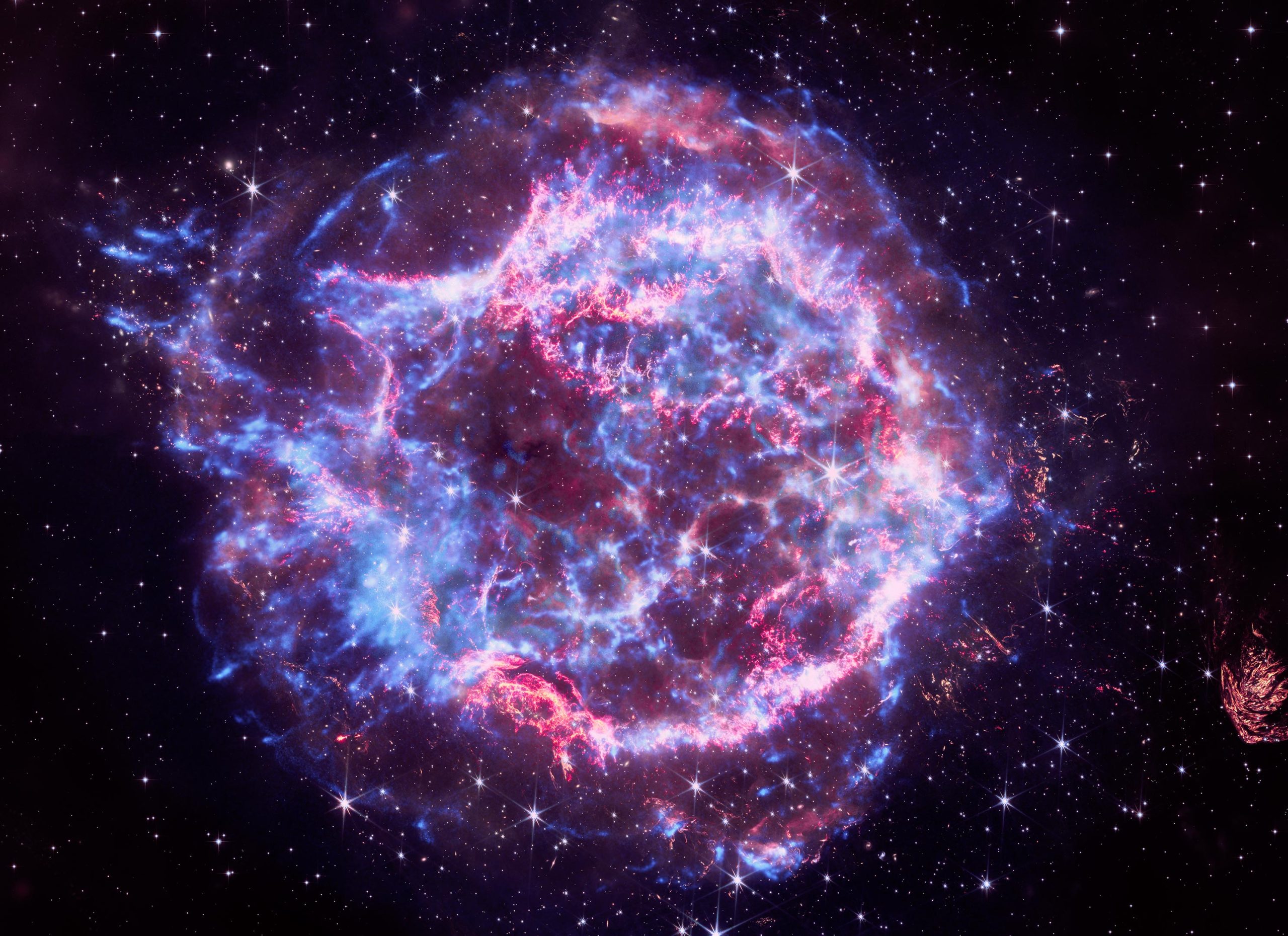
The first image (top of page) features Cassiopeia A, the remains of a star that exploded in a supernova. It combines X-ray observations from Chandra (shown in blue and purple) with infrared data from NASA’s James Webb Space Telescope (displayed in red and white).
Chandra’s X-ray observations reveal the powerful blast wave from the explosion along with elements scattered throughout the debris, including iron, calcium, and oxygen. Webb’s infrared view highlights the expanding shell of material left behind and the clouds of cosmic dust spread across the remnant.
NGC 3603 Shows a Stellar Nursery in the Milky Way
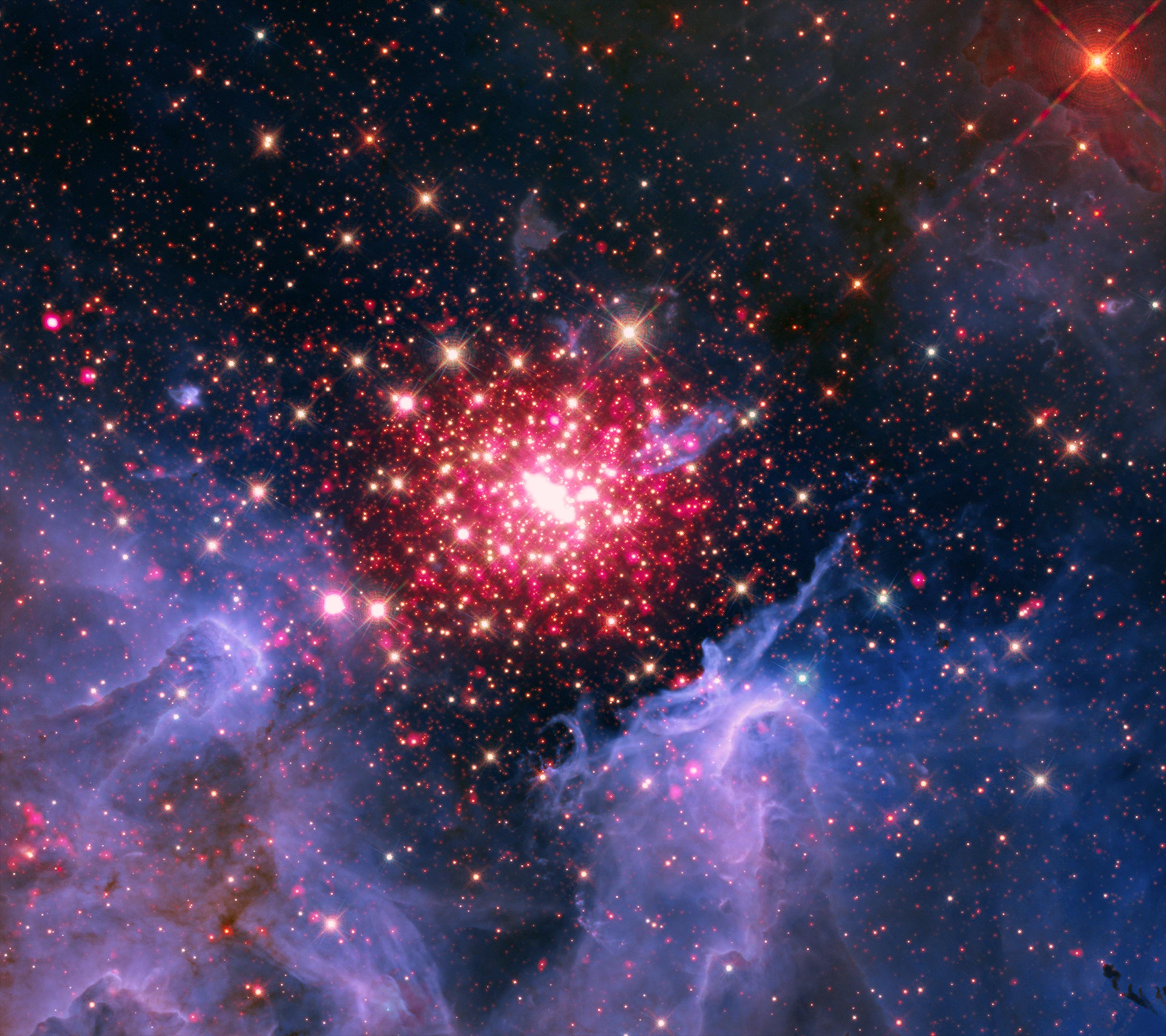
The next image (above) highlights NGC 3603, a nebula in the Milky Way that contains one of the galaxy’s largest clusters of young stars.
In this composite image, Chandra’s X-ray data (red and white) reveals diffuse emission near the center as well as numerous point-like X-ray sources scattered across the region. Data from NASA’s Hubble Space Telescope, captured in optical, infrared, and ultraviolet light (red-orange, green, blue, and yellow), shows stars packed into the center along with dust and gas concentrated toward the bottom. Together, the combined observations create a striking red, white, and blue view, with the X-rays highlighting the brilliant glow of newly formed stars.
Messier 94 Highlights an Active Starburst Ring
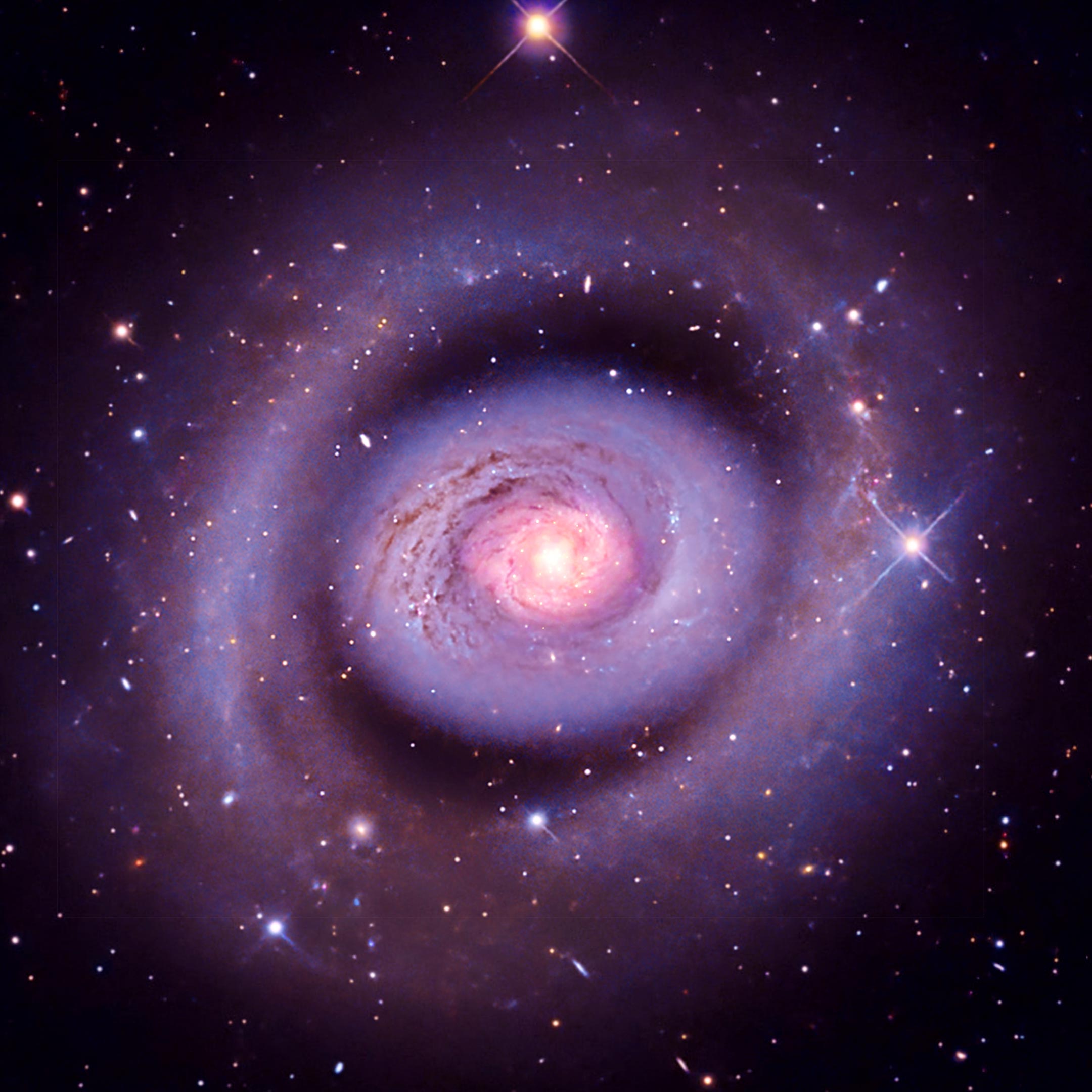
The next image (above) presents a fresh view of the spiral galaxy NGC 4736, better known as Messier 94.
The image blends Chandra X-rays at multiple wavelengths (red, orange, and blue) with visible light observations captured by astrophotographers using ground-based telescopes (red, green, and blue). Messier 94 is known for its bright inner ring, called a starburst ring, where new stars are actively forming. Scientists think this burst of star formation may be fueled by gas flowing inward through the galaxy’s distinctive oval-shaped structure.
Galaxy Cluster Offers Evidence of Dark Matter
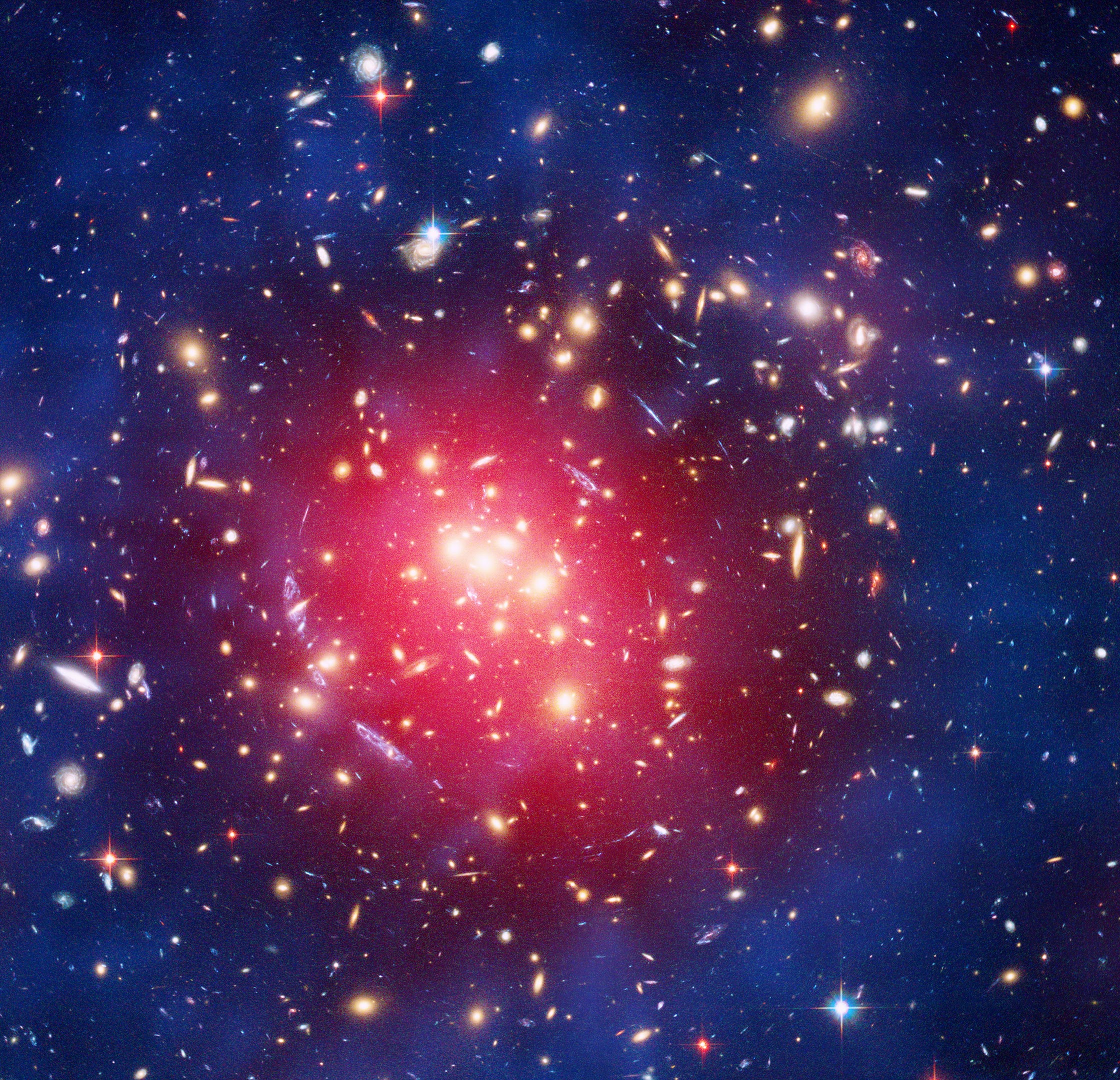
The final image (above) in NASA’s patriotic collection features ZwCl 0024+1652, a distant galaxy cluster that has helped astronomers uncover evidence for dark matter.
Specially processed Hubble data (blue) reveals the effects of dark matter within the cluster, while another Hubble image shows the cluster’s individual galaxies in yellow and white. Chandra’s X-ray observations (red) reveal a vast reservoir of superheated gas filling the cluster. That hot gas contains far more mass than all of the cluster’s galaxies combined, providing another dramatic glimpse into one of the universe’s largest structures.
Never miss a breakthrough: Join the SciTechDaily newsletter.
Follow us on Google and Google News.
1 Comment
B Memo 2607_060639,070405_ Source 1. Reinterpretation【()】
Source 1.
https://scitechdaily.com/nasa-reveals-four-cosmic-masterpieces-for-americas-250th-birthday/
1. NASA Reveals Four Cosmic Masterpieces for America’s 250th Birthday
_X-ray images taken by NASA’s Chandra X-ray Observatory and infrared images taken by NASA’s James Webb Space Telescope appear together on Cassiopeia A. Chandra’s X-ray observations reveal the explosion waves that destroyed the star and elements such as iron, calcium, and oxygen contained in the debris. Webb’s infrared data also shows the shell of matter expanding due to the explosion and cosmic dust spread throughout the debris.
_NASA has released four cosmic images adorned with patriotic colors to commemorate America’s 250th birthday, showcasing a variety of landscapes ranging from exploded stars to galaxy clusters formed by dark matter.
NASA has released a stunning new collection of space images showcasing the beauty and wonders of the universe to commemorate the 250th anniversary of the United States. Created using observational data from the Chandra X-ray Observatory, these four images are rendered in red, white, and blue to honor the anniversary.
1-1. Cassiopeia A Reveals the Aftermath of a Stellar Explosion.
The first image (top of the page) shows the remnants of Cassiopeia A, the star left behind after a supernova explosion. This image is a composite of X-ray observations from the Chandra X-ray Telescope (blue and purple) and infrared data from NASA’s James Webb Space Telescope (red and white).
(The Chandra X-ray observations reveal elements such as iron, calcium, and oxygen scattered throughout the remnants, along with the powerful shock waves from the explosion.) The Webb Space Telescope’s infrared observations show the expanding shell of the material remaining after the explosion and the clouds of cosmic dust spread across the remnants.
2.
_(NGC 3603 shows a massive and brilliant star-forming factory located in the Carina spiral arm of our galaxy.) This image combines infrared and ultraviolet data observed by NASA’s Hubble Space Telescope with high-energy X-ray data from the Chandra X-ray Telescope.
ㅡㅡㅡㅡㅡㅡㅡ
a2.【() Shows the elements (iron, calcium, oxygen, etc.) of the remnants of Cassiopeia A, a star remaining after a supernova explosion.
1.)NGC 3603 shows a massive and brilliant star-forming factory located in the Carina spiral arm of our galaxy.
^^^If the remnants from the supernova explosion are not scattered within msbase but belong to qpeoms,
2.) A reasonable analogy aligns with the logic that ‘qpeoms.element units of remnant elements (iron, oxygen, gold, silver, copper, etc.) accumulate to form nkstars.’ Hmm. 0706_0638.1656.
^^^^^Here, qpeoms are the elemental units of ordinary matter,
>>>>>It is believed that what was previously thought to be quantum units will play a different role.
3.) The fact that msbase decays and scatters into ordinary elements is similar to the expectation that the unit in which msbase.banc decomposes into qpeoms will be an element. There does not seem to be a need to go all the way to the quantum field unit. Hmm. 0706_1708.
^^^^^ Then, if msoss decays, what element would it be? Since it wouldn’t be an ordinary element… an element of dark matter? Haha. Well, I’m not sure. 1710.
】
_While the Hubble Telescope observes towering pillars of cold dust and glowing gas layers where new stars are born, Chandra’s X-ray data penetrates through this hazy dust. X-rays reveal a glittering appearance at the center of the star cluster, densely packed with powerful stars and young, massive stars breathing their first breath in space while emitting intense radiation energy.
_This NGC 3603 shows a star-forming region within the Milky Way.
2-1.
_The following image (top) shows NGC 3603, a nebula located in our galaxy. This nebula contains one of the largest clusters of young stars in the galaxy.
_In this composite image, X-ray data from the Chandra Space Telescope (red and white) shows diffuse emission near the center and numerous point-shaped X-ray sources scattered throughout the region. Data captured by NASA’s Hubble Space Telescope in visible, infrared, and ultraviolet (red-orange, green, blue, yellow) light shows that stars are densely packed in the center, while dust and gas are concentrated at the bottom. Combining these two observational data creates an impressive image of red, white, and blue hues, with the X-rays highlighting the bright light of newly formed stars.
This image shows Messier 94 (NGC 4736), or the M94 galaxy. Along with X-ray images of various wavelengths captured by the Chandra Space Telescope, it includes visible light images taken by ground-based telescopes by astrophotographers Brian Brennan and Rémy Lacas.
M94 is a spiral galaxy with a bright ring-shaped structure at its center, where new stars are actively being formed. This is called a starburst ring, and it is believed to be powered by gas emitted from a unique bar-shaped elliptical structure. Additionally, M94 possesses a ring-shaped structure composed of several spiral arms on its outer edge.
3.
Messier 94 displays an active star-shaped ring structure.
This image is a composite of X-rays observed at various wavelengths (red, orange, and blue) by the Chandra X-ray Space Telescope and visible light (red, green, and blue) captured by astrophotographers using ground-based telescopes. Messier 94 is famous for its bright inner ring, known as the Starburst Ring, where new stars are actively being formed. Scientists believe that this star-forming activity is facilitated by gas flowing inward through the galaxy’s unique elliptical structure.
This image shows ZwCl 0024+1652, a massive, distant galaxy cluster bound by gravity.
X-ray data obtained from NASA’s Chandra X-ray Observatory reveals massive, luminous, superheated clouds of gas spread throughout the galaxy cluster.
This gas cloud possesses far more mass than all the galaxies within the cluster combined. Additionally, optical data obtained from the Hubble Space Telescope captures individual galaxies floating within the cluster. Astronomers analyzed (how the immense gravity of a galaxy cluster bends the light of celestial bodies behind it) and mapped a massive invisible ring of dark matter using specially processed Hubble data.
ㅡㅡㅡㅡㅡㅡㅡ
a1.【() The appearance of a massive galaxy cluster bound by gravity is msbase.power. Hmm. 2607060_0626.
3-1.
_(Evidence of dark matter was discovered in a galaxy cluster).
The final image (above) in NASA’s patriotic photo collection shows ZwCl 0024+1652, a distant galaxy cluster that helped astronomers discover evidence of dark matter.
^^^^^Since the galaxy cluster msbase.power corresponds to a scale of nearly msoss, dark matter is discovered. Hmm.0629.
】
_Specially processed Hubble data (blue) shows the influence of dark matter within the galaxy cluster, and another Hubble image displays the individual galaxies that make up the cluster in yellow and white.
_(Chandra X-ray observations (red) show a massive reservoir of superheated gas filling the galaxy cluster. This hot gas has a mass far greater than the combined mass of all the galaxies within the cluster?) (One of the largest structures in the universe?) allows us to get a vivid glimpse of it.
ㅡㅡㅡㅡㅡ
a2.【() The superheated gas reservoir(? ) seems to be the state of qpeoms.elements(*) in the center of msbase.power. Heh. 0707_0342.
1.)^^^^^I never imagined such a sight before, but now, as if speeding through the surrounding scenery like a flight in a dream, that image is rendered in high-definition simulation on the cloud layer in the center of msbase that has turned qpeoms.ele_redcolor. Heh._0345, 47.
>>>>>The even more surprising fact is that the mass of this red cloud of the galaxy cluster power is greater than the combined mass of all the galaxies existing within the cluster?
I didn’t anticipate this picture before, but come to think of it, it makes perfect sense if the center of the power is the domain of all ele.qpms(*). Heh. 260707_0454.
>>>The problem is that the entire power looks like a somewhat discordant block to be the magicsum state of a single galaxy cluster. If you look at that appearance from the perspective of the whole, is it power.qpeoms(*)? Hmm. I’m not so sure! _0358.
^^^^^This is a form that has transformed into a larger framework of side.qpms(*). Just as cmb is nothing more than an element in side_qpms… Aw. 260707_0403.
2.) Then why does this phenomenon appear in the galaxy cluster mspower?
The first conjecture, 1., seems to be because the variables of power can be amplified not only to msbase, but also to
>>>qpeoms.elements. Just as the prime factorization of some massive numbers forms a polynomial… Aw. _0411.
3.)
^^^^ The second conjecture, 2., might be because dark matter msoss is sometimes mixed in with mspower… Aw. 360707_0413.
^^^^ The third conjecture, 3., is that the spacetime that bent light is due to the high-mass gravity of dark matter msoss.nk. Hmm. _0419.
】