
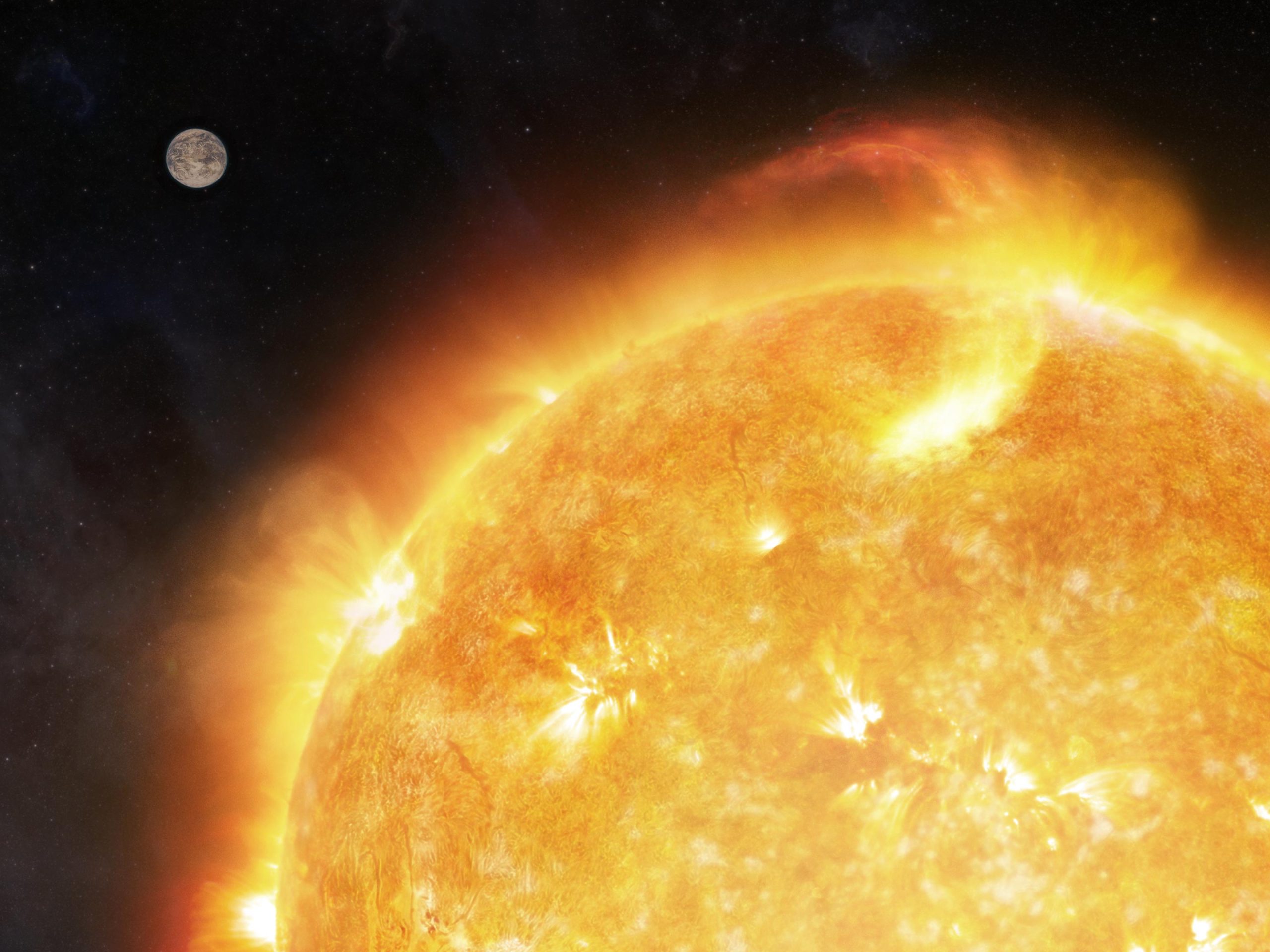
Wolf 359, a red dwarf star just 7.8 light-years away, could host planets, but extreme X-ray and ultraviolet radiation make habitability difficult.
Only planets far from the star, with thick greenhouse-gas atmospheres, stand a chance of sustaining life. Frequent X-ray flares add to the challenge, likely stripping atmospheres from planets in the habitable zone before life can take hold.
Extreme Space Weather and Exoplanet Survival
Planets orbiting other stars may face extreme space weather, according to a new study using data from NASA’s Chandra X-ray Observatory and the European Space Agency’s XMM-Newton. The research examined how X-ray radiation affects potential exoplanets around the most common type of stars in the universe.
Astronomers found that for a planet to have a chance of supporting life, it would need a thick greenhouse gas atmosphere, like Earth’s, and be positioned far enough from its host star to avoid harmful radiation.
Meet Wolf 359: A Nearby Red Dwarf
One of the stars studied, Wolf 359, is a red dwarf with about one-tenth the mass of the Sun. Red dwarfs are the most abundant stars in the universe and can burn for billions of years, theoretically allowing plenty of time for life to develop. At just 7.8 light-years away, Wolf 359 is also one of the closest stars to our solar system.
“Wolf 359 can help us unlock the secrets around stars and habitability,” said Scott Wolk of the Center for Astrophysics | Harvard & Smithsonian (CfA), who led the study. “It’s so close and it belongs to such an important class of stars — it’s a great combination.”
The Search for Exoplanets Around Wolf 359
Because red dwarfs are the most prevalent types of stars, astronomers have looked hard to find exoplanets around them. Astronomers have found some evidence for two planets in orbit around Wolf 359 using optical telescopes, but those conclusions have been challenged by other scientists.
“While we don’t have proof of planets around Wolf 359 yet, it seems very possible that it hosts multiple planets,” Wolk added. “This makes it an excellent test bed to look at what planets would experience around this kind of star.”
Wolk and his colleagues used Chandra and XMM to study the amounts of steady X-rays and extreme ultraviolet (UV) radiation — the most energetic type of UV radiation — that Wolf 359 would unleash on the possible planets around it.

Survival Requires More Than Distance
They found that Wolf 359 is producing enough damaging radiation that only a planet with greenhouse gases like carbon dioxide in its atmosphere — and located at a relatively large distance from the star — would likely be able to sustain life.
“Just being far enough away from the star’s harmful radiation wouldn’t be enough to make it habitable,” said co-author Vinay Kashyap, also of CfA. “A planet around Wolf 359 would also need to be blanketed in greenhouse gases like Earth is.”
Defining the Habitable Zone
To study the effects of energetic radiation on the habitability of the planet candidates, the team considered the star’s habitable zone — the region around a star where liquid water could exist on a planet’s surface.
The outer limit of the habitable zone for Wolf 359 is about 15% of the distance between Earth and the Sun, because the red dwarf is much less bright than the Sun. Neither of the planet candidates for this system is located in Wolf 359’s habitable zone, with one too close to the star and the other too far out.
This video shows a young, low-mass, relatively cool star called a red dwarf like Wolf 359. Because it is young, the star is very active and can flare several times a day. These flares are very hot and can include ejections of mass equivalent to that of a small moon. Around the star, we see a planet with roughly the same mass as Earth. Since the star is cool, the planet needs to be very close to its host star — only between 2.5 million and 5 million miles — in order to potentially maintain a temperature on its surface that would allow for liquid water. By comparison, the Earth orbits the Sun at a distance of about 93 million miles.
The Harsh Reality of Inner Orbit Planets
“If the inner planet is there, the X-ray and extreme UV radiation it is subjected to would destroy the atmosphere of this planet in only about a million years,” said co-author Ignazio Pillitteri of CfA and the National Institute for Astrophysics in Palermo, Italy.
The team also considered the effects of radiation on as-yet undetected planets within the habitable zone. They concluded that a planet like the Earth in the middle of the habitable zone should be able to sustain an atmosphere for almost two billion years, while one near the outer edge could last indefinitely, helped by the warming effects of greenhouse gases.
X-Ray Flares: A Lethal Obstacle for Life
Another big danger for planets orbiting stars like Wolf 359 is from X-ray flares, or occasional bright bursts of X-rays, on top of the steady, everyday output from the star. Combining observations made with Chandra and XMM-Newton resulted in the discovery of 18 X-ray flares from Wolf 359 over 3.5 days.
A Harsh Universe for Life as We Know It
Extrapolating from these observed flares, the team expects that much more powerful and damaging flares would occur over longer periods of time. The combined effects of the steady X-ray and UV radiation and the flares mean that any planet located in the habitable zone is unlikely to have a significant atmosphere long enough for multicellular life, as we know it on Earth, to form and survive. The exception is the habitable zone’s outer edge if the planet has a significant greenhouse effect.
These findings were presented at the 245th meeting of the American Astronomical Society in National Harbor, Maryland, and are being prepared for publication in a scientific journal.
NASA’s Marshall Space Flight Center in Huntsville, Alabama, oversees the Chandra X-ray Observatory program. The Smithsonian Astrophysical Observatory’s Chandra X-ray Center manages scientific operations from Cambridge, Massachusetts, and flight operations from Burlington, Massachusetts.
Never miss a breakthrough: Join the SciTechDaily newsletter.
Follow us on Google and Google News.
2 Comments
Yet another article where we observe scientists applying their presuppositions to the existence of environments where we and life as we know it cannot physically thrive. Haven’t we discovered enough species of animals and bacteria at extreme environments on our own planet to realize that life is resilient and possible anywhere? You would think when they explored the Mariana Trench and found the abundant biodiversity down there as well as the living communities around volcanic vents and under Antarctica’s ice
(Smh hit send before I was done… 🙄🤦♀️) that perhaps scientists would stop with the notion that life in the universe is bound by the laws that we observe and experience in our infinitessimally small corner of the universe. But no…😒 Why not just…. discover without applying our own understand as a model for trying to quantify everything? A single planet rotating around a single star, even if ours was the only planet in our solar system, isn’t even CLOSE enough of a ratio to begin logically applying what we know to the vast expanse that is the universe we live in…..😮💨