

- Astronomers have announced evidence for a possible planet in another galaxy.
- This “exoplanet” would be much farther away than any of the thousands of others scientists have found in our Milky Way Galaxy in recent years.
- This planet candidate was identified with NASA’s Chandra X-ray Observatory that detected a temporary dimming in X-rays in a binary system.
- Researchers interpret this dimming as a planet passing in front of an X-ray source around a neutron star or black hole orbiting a companion star.
Astronomers have found evidence for a possible planet candidate in the M51 (“Whirlpool”) galaxy, potentially representing what would be the first planet seen to transit a star outside of the Milky Way. Researchers used NASA’s Chandra X-ray Observatory to detect the dimming of X-rays from an “X-ray binary”, a system where a Sun-like star is in orbit around a neutron star or black hole. The authors interpret this dimming as being a planet passing in front of the neutron star or black hole.
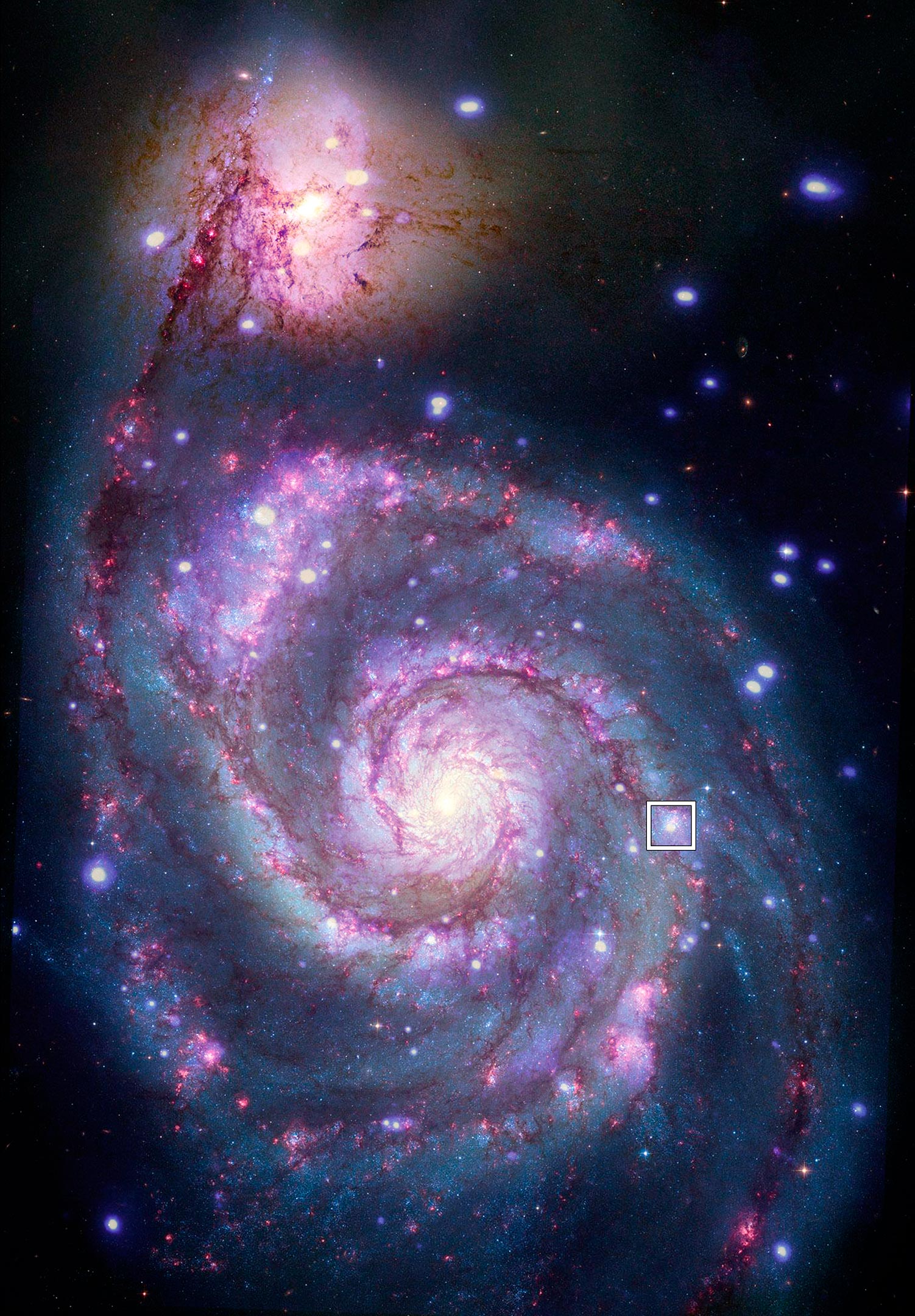
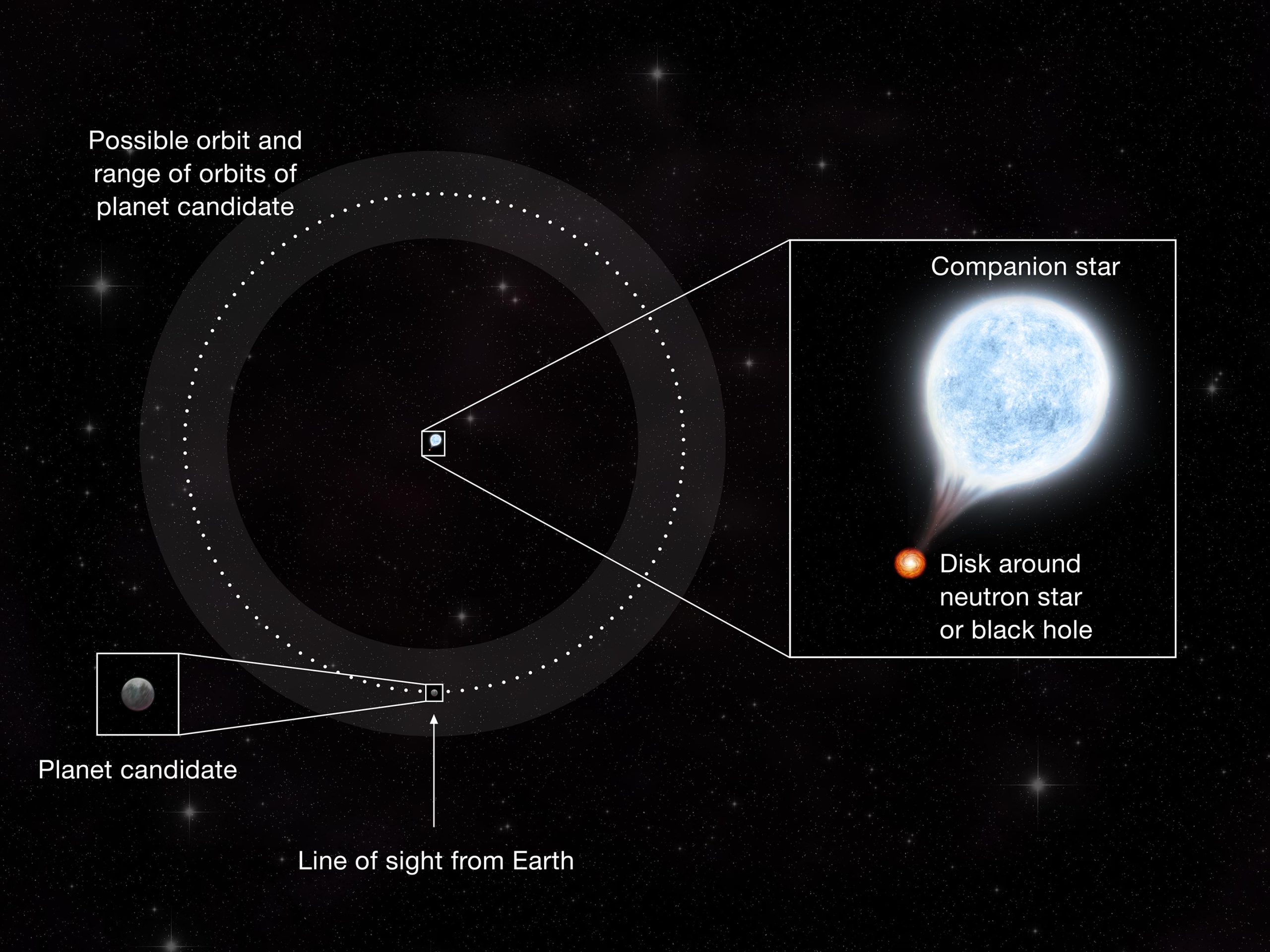
The left panel of this graphic shows M51 in X-rays from Chandra (purple and blue) and optical light from NASA’s Hubble Space Telescope (red, green, and blue). A box marks the location of the possible planet candidate, an X-ray binary known as M51-ULS-1. An artist’s illustration in the right panel depicts the X-ray binary and possible planet. Material from the companion star (white and blue in illustration) is pulled onto the neutron star or black hole, forming a disk around the dense object (illustrated as red and orange). The material near the dense object becomes superheated, causing it to glow in X-ray light (white). The planet is shown beginning to pass in front of this source of X-rays.
Looking for the dimming of a star’s light as something passes in front of it is called the transit technique. For years, scientists have discovered exoplanets using transits with optical light telescopes, which detect the range of light humans can see with their eyes and more. This includes both ground-based telescopes and space-based ones like NASA’s Kepler mission. These optical light transit detections require very high levels of sensitivity because the planet is much smaller than the star it passes in front of, and, therefore, only a tiny fraction of the light is blocked.

The scenario of a transit in an X-ray binary is different. Because a potential planet is close in size to the X-ray source around the neutron star or black hole, a transiting planet passing along Earth’s line of sight could temporarily block most or all of the X-rays. This makes it possible to spot transits at greater distances — including beyond the Milky Way — than current optical light studies using transits. A graphic (above) shows how X-rays from M51-ULS-1 temporarily decrease to zero during the Chandra observations.
While this is a tantalizing study, the case of an exoplanet in M51 is not ironclad. One challenge is that the planet candidate’s large orbit in M51-ULS-1 means it would not cross in front of its binary partner again for about 70 years, thwarting any attempts for a confirming observation for decades. There is also the possibility that the dimming of X-rays is due to a passing cloud of gas near the M51-ULS-1, though the researchers think the data strongly favor the planet’s explanation.
Reference: “A possible planet candidate in an external galaxy detected through X-ray transit” by Rosanne Di Stefano, Julia Berndtsson, Ryan Urquhart, Roberto Soria, Vinay L. Kashyap, Theron W. Carmichael and Nia Imara, 25 October 2021, Nature Astronomy.
DOI: 10.1038/s41550-021-01495-w
PDF
The paper describing these results appears in the latest issue of Nature Astronomy. The authors are Rosanne DiStefano (CfA), Julia Berndtsson (Princeton), Ryan Urquhart (Michigan State University), Roberto Soria (University of the Chinese Science Academy), Vinay Kashap (CfA), Theron Carmichael (CfA), and Nia Imara (now at the University of California at Santa Cruz). NASA’s Marshall Space Flight Center manages the Chandra program. The Smithsonian Astrophysical Observatory’s Chandra X-ray Center controls science from Cambridge Massachusetts and flight operations from Burlington, Massachusetts.
Never miss a breakthrough: Join the SciTechDaily newsletter.
Follow us on Google and Google News.
5 Comments
A perfect mechancal aspect is presented in the in binary X-ray star M-51-ULS-1 with a rotating exoplant blocks total radiation to zero for some time instants in the galaxy M-51.Here the concerned star can be considered having zero net gravity effect with tunneling all magnetic effect previously acconting all gravity to the next star/black hole in binary stars system.So no hamper to relativity occures as for observation.Tanks to the authors for fine citement.
A perfect mechancal aspect is presented in the in binary X-ray star M-51-ULS-1 with a rotating exoplant blocks total radiation to zero for some time instants in the galaxy M-51.Here the concerned star can be considered having zero net gravity effect with tunneling all magnetic effect previously acconting all gravity to the next star/black hole in binary stars system.So no hamper to relativity occures as for observation.Tanks to the authors for fine citement.
As the laws òf physìcs are homogeneous or fixed for all the galaxies and syarscòntained by them.
Keeping the relativity proper for the present system of binary stars and an exopĺanet,we easily get a solùtion using Newtonian mechanics.
As an aspect the amount of X-ray must be equal to energy of rotation of the planet binary stars system,where centre of gravity is attributed net,to the massive star.
His was kinda obvious, why wouldn’t there be planets in other galaxy’s
Extragalactic planets? Never thought we might find one this early on in the history of astronomy, but I guess that could be wrong.
I recall a story about a gravitational-lensing incident reportedly suggesting a small planet in some other galaxy years ago, but it was a one-off thing.