
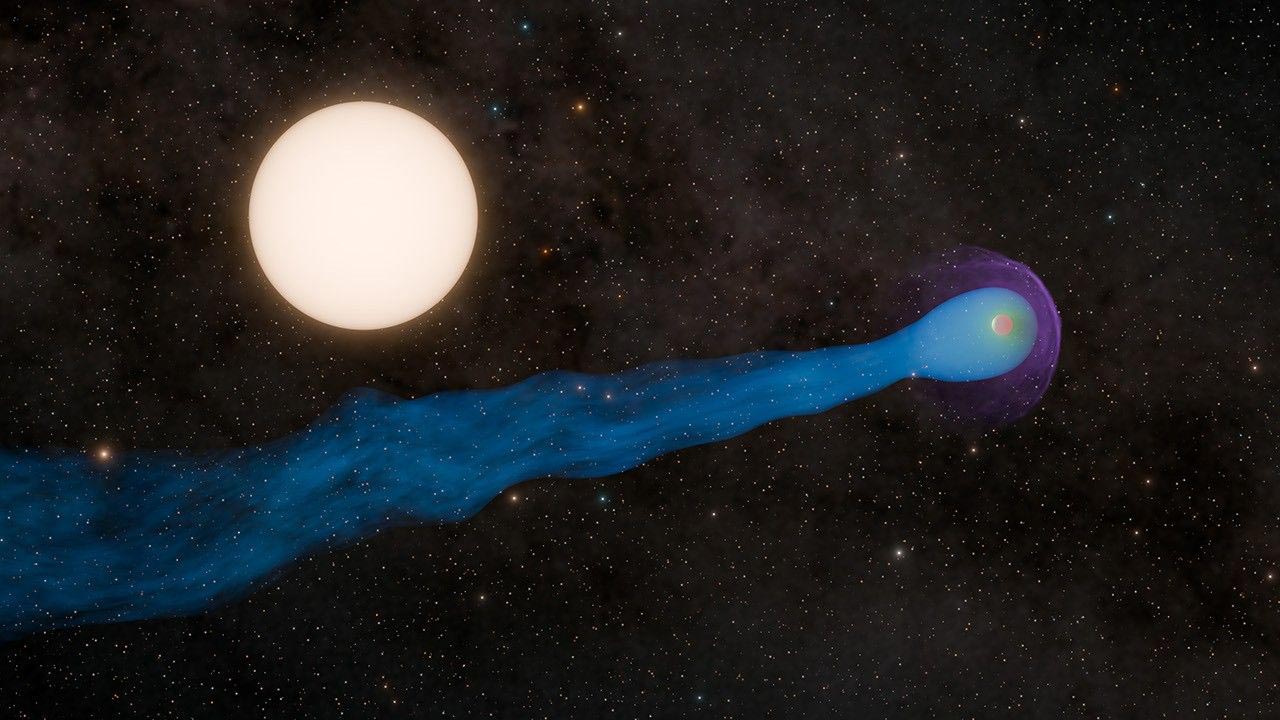
Astronomers have discovered that the exoplanet WASP-69 b has a comet-like tail, which extends more than 350,000 miles due to the influence of stellar wind from its host star.
This phenomenon occurs as the planet loses its atmosphere slowly over time, shaped by the stellar wind into a distinctive tail that can change with variations in the stellar wind.
Discovery of WASP-69 b’s Unique Tail
Scientists at the University of California, Los Angeles have discovered that the exoplanet WASP-69 b has a has a “tail” — a long stream of gas trailing behind it as it moves through space.
This unusual feature occurs because WASP-69 b is gradually losing its atmosphere. Light gases like hydrogen and helium escape from the planet’s outer atmosphere over time. However, these gases don’t disperse evenly in all directions. Instead, powerful stellar winds from the planet’s host star push the escaping gas into a tail-like formation.
Dynamics of Hot Jupiters
WASP-69 b is classified as a “hot Jupiter,” a type of gas giant that orbits extremely close to its star, making its outer atmosphere intensely hot. The star’s radiation heats the planet’s atmosphere, causing a process called photoevaporation. This process energizes lightweight gases, like hydrogen and helium, allowing them to escape into space. Over time, the star effectively strips gas from the planet’s outer layers.
Something called the stellar wind plays a key role in shaping the escaping gas. As the gas drifts away, the stellar wind stretches it into a long, comet-like tail, making WASP-69 b a truly extraordinary sight in the cosmos.
Stellar Wind’s Role in Tail Formation
The stellar wind is a continuous stream of charged particles that flow outwards into space from a star’s outer atmosphere, or corona. On Earth, the Sun’s stellar wind interacts with our planet’s magnetic field which can create beautiful auroras like the Northern Lights.
On WASP-69 b, the stellar wind coming from its host star actually shapes the gas escaping from the planet’s outer atmosphere. So, instead of gas just escaping evenly around the planet, “strong stellar winds can sculpt that outflow in tails that trail behind the planet,” said lead author Dakotah Tyler, an astrophysicist at the University of California, Los Angeles, likening this gaseous tail to a comet’s tail.
Because this tail is created by the stellar wind, however, that means it’s subject to change.
“If the stellar wind were to taper down, then you could imagine that the planet is still losing some of its atmosphere, but it just isn’t getting shaped into the tail,” Tyler said, adding that, without the stellar wind, that gas escaping on all sides of the planet would be spherical and symmetrical. “But if you crank up the stellar wind, that atmosphere then gets sculpted into a tail.”
Tyler likened the process to a windsock blowing in the breeze, with the sock forming a more structured shape when the wind picks up and it fills with air.
Observable Changes in Exoplanetary Tails
The tail that Tyler and his research team observed on WASP-69 b extended more than 7.5 times the radius of the planet, or over 350,000 miles. But it’s possible that the tail is even longer. The team had to end observations with the telescope before the tail’s signal disappeared, so this measurement is a lower limit on the tail’s true length at the time.
However, keep in mind that because the tail is influenced by the stellar wind, changes in the stellar wind could change the tail’s size and shape over time. Additionally changes in the stellar wind influence the tail’s size and shape, but since the tail is visible when illuminated by starlight, changes in stellar activity can also affect tail observations.
Implications for Exoplanet and Stellar Studies
Exoplanet tails are still a bit mysterious, especially because they are subject to change. The study of exoplanet tails could help scientists to better understand how these tails form as well as the ever-changing relationship between the stellar and planetary atmospheres. Additionally, because these exoplanetary tails are shaped by stellar activity, they could serve as indicators of stellar behavior over time. This could be helpful for scientists as they seek to learn more about the stellar winds of stars other than the star we know the most about, our very own Sun.
Long-Term Atmospheric Loss
WASP-69 b is losing a lot of gas — about 200,000 tons per second. But it’s losing this gaseous atmosphere very slowly — so slowly in fact that there is no danger of the planet being totally stripped or disappearing. In general, every billion years, the planet is losing an amount of material that equals the mass of planet Earth.
The solar system that WASP-69 b inhabits is about 7 billion years old, so even though the rate of atmosphere loss will vary over time, you might estimate that this planet has lost the equivalent of seven Earths (in mass) of gas over that period.
A team of scientists led by Dakotah Tyler of the University of California, Los Angeles published a paper in January 2024 on their discovery in the journal, The Astrophysical Journal.
For more on this discovery, see This Exoplanet Has Been Hiding a Big Secret: A 350,000-Mile-Long Tail.
Reference: “WASP-69b’s Escaping Envelope Is Confined to a Tail Extending at Least 7 Rp” by Dakotah Tyler, Erik A. Petigura, Antonija Oklopčić and Trevor J. David, 9 January 2024, The Astrophysical Journal.
DOI: 10.3847/1538-4357/ad11d0
The observations described in this paper were made by Keck/NIRSPEC (NIRSPEC is a spectrograph designed for Keck II).
Never miss a breakthrough: Join the SciTechDaily newsletter.
Follow us on Google and Google News.
1 Comment
WASP-69 b is a comet-planet!