
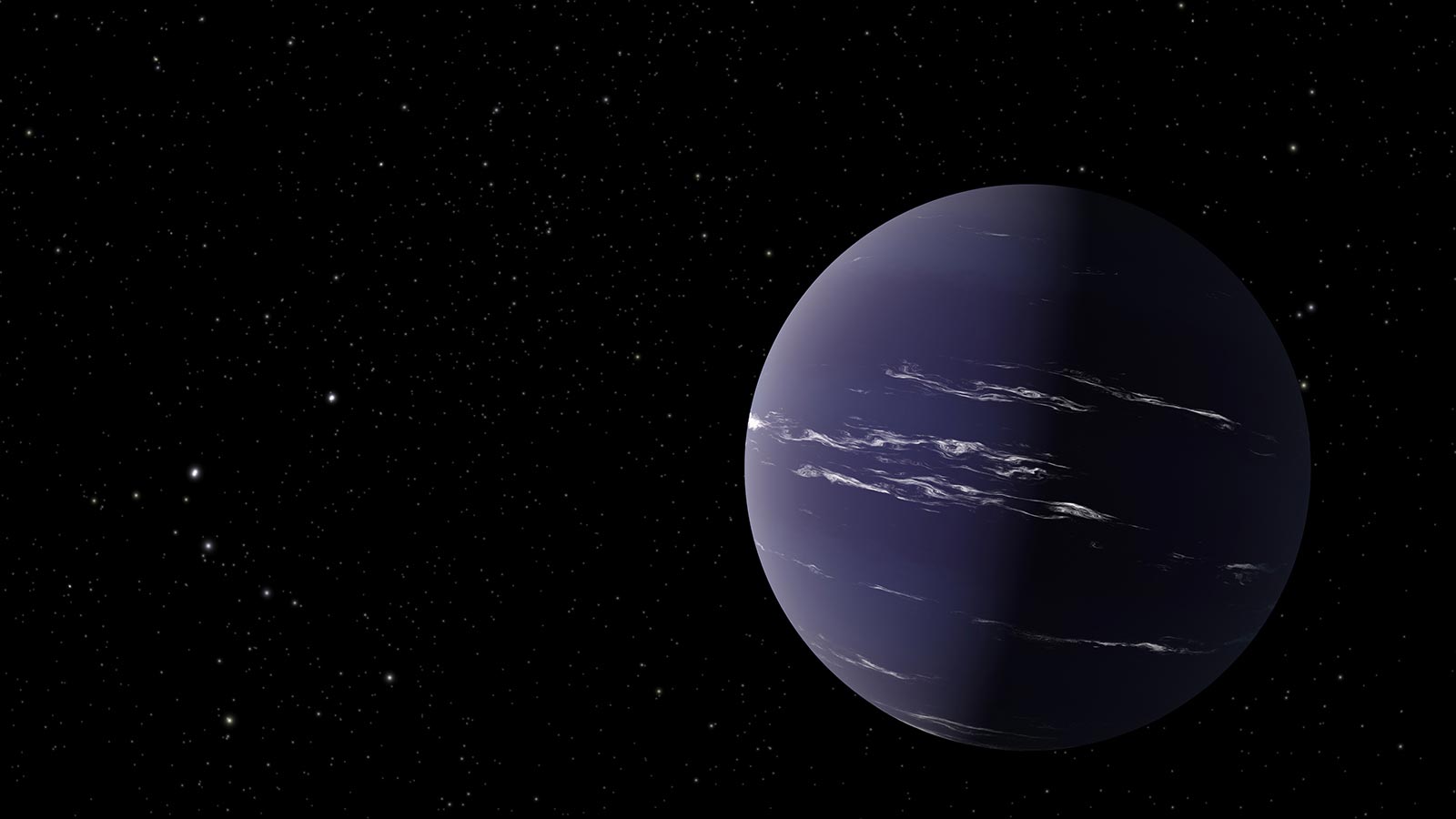
The planet: TOI-1231 b
The discovery: A planet some 90 light-years away from Earth is oddly reminiscent of our own Neptune – that is, a gaseous world with a potentially rich atmosphere, ripe for study. The planet is more than 3 ½ times as big around as Earth and warm by Earthly standards at 134 degrees Fahrenheit (57 Celsius). But astronomers say it is one of the “coolest,” comparatively small planets known to date, and in a prime position for the components of its atmosphere to be teased apart by space telescopes.
Key facts: TOI-1231 b orbits a red-dwarf star – smaller but longer lived than our own Sun – with a year, once around the star, that is 24 days long. But the planet stays relatively cool despite its close orbit because its star also is on the cooler side. Though not habitable due to its size, the planet could offer scientists one of their first chances to capture a “bar-code” type reading of the atmosphere of a temperate, Neptune-sized exoplanet – a planet orbiting another star. This will allow comparisons with similar worlds elsewhere in the galaxy, bringing potentially deep insights into the composition and formation of exoplanets and planetary systems, including our own.
Details: A new era in the study of exoplanets is just beginning, as we move from simply detecting these planets, and counting them up, to zeroing in on individual worlds to analyze their atmospheres. With a technique called transmission spectroscopy, scientists should be able to use the Hubble Space Telescope – and soon the far more sensitive James Webb Space Telescope – to capture starlight shining through the atmosphere of TOI-1231 b. Molecules in this planet’s atmosphere will absorb slices of light from this spectrum, leaving dark lines that can be read like a barcode, revealing which gases are present.
The planet’s red dwarf star, though small, is quite bright in the infrared part of the light spectrum, or light beyond the red end of the spectrum that can’t be seen with the naked eye. It is, however, ideal for investigation by Hubble and Webb. Also helpful: From our perspective on Earth, TOI-1231 b crosses the face of its star, which allowed its detection in the first place by NASA’s Transiting Exoplanet Survey Satellite (TESS). And that crossing, called a “transit,” takes nearly 3 ½ hours – plenty of time to capture and analyze starlight shining through the planet’s atmosphere.
Fun facts: We might see evidence of clouds (perhaps even made of water) in this planet’s atmosphere. And because this star-and-planet system is moving at a high velocity away from Earth, hydrogen atoms escaping from the planet’s atmosphere might be readily detected. In other words, the planet could turn out to have a tail.
In general, such atoms are almost impossible to detect even when using space-based facilities; their presence is masked both by the outer wisps of Earth’s atmosphere and by interstellar gas. But the TOI-1231 system is moving so quickly that escaping hydrogen atoms are shifted out of phase with the blocking material, where they could be detected by telescopes like Hubble.
The discoverers: Using data from TESS, a large, international team of astronomers led by Dr. Jennifer Burt, an exoplanet researcher at NASA’s Jet Propulsion Laboratory in Southern California, and Professor Diana Dragomir, an exoplanet researcher at the University of New Mexico, announced the discovery of TOI-1231 b in a new paper. The discovery was entered into NASA’s Exoplanet Archive on June 3.
For more on this discovery, read New Neptune-Sized Exoplanet Discovered With a Substantial Atmosphere Ripe for Study.
Reference: “TOI-1231 b: A Temperate, Neptune-Sized Planet Transiting the Nearby M3 Dwarf NLTT 24399” by Jennifer A. Burt, Diana Dragomir, Paul Mollière, Allison Youngblood, Antonio García Muñoz, John McCann, Laura Kreidberg, Chelsea X. Huang, Karen A. Collins, Jason D. Eastman, Lyu Abe, Jose M. Almenara, Ian J. M. Crossfield, Carl Ziegler, Joseph E. Rodriguez, Eric E. Mamajek, Keivan G. Stassun, Samuel P. Halverson, Steven Jr. Villanueva, R. Paul Butler, Sharon Xuesong Wang, Richard P. Schwarz, George R. Ricker, Roland Vanderspek, David W. Latham, S. Seager, Joshua N. Winn, Jon M. Jenkins, Abdelkrim Agabi, Xavier Bonfils, David Ciardi, Marion Cointepas, Jeffrey D. Crane, Nicolas Crouzet, Georgina Dransfield, Fabo Feng, Elise Furlan, Tristan Guillot, Arvind F. Gupta, Steve B. Howell, Eric L. N. Jensen, Nicholas Law, Andrew W. Mann, Wenceslas Marie-Sainte, Rachel A. Matson, Elisabeth C. Matthews, Djamel Mékarnia, Joshua Pepper, Nic Scott, Stephen A. Shectman, Joshua E. Schlieder, François-Xavier Schmider, Daniel J. Stevens, Johanna K. Teske, Amaury H.M.J. Triaud, David Charbonneau, Zachory K. Berta-Thompson, Christopher J. Burke, Tansu Daylan, Thomas Barclay, Bill Wohler and C. E. Brasseurs, 3 August 2021, The Astronomical Journal.
DOI: 10.3847/1538-3881/ac0432
arXiv: 2105.08077
Never miss a breakthrough: Join the SciTechDaily newsletter.
Follow us on Google and Google News.
5 Comments
Too much English with deep words keep it real for everyone one to understand
There is a planet out there, 90 light years away, rotating in 24 days around its sun with heaps of water and some clouds.Can’t get there yet,although it is visible with a special telescope. More interesting than the Tokyo Olympic Games.
Oooooh! Beautiful!
Yes, perfect, let’s spend billions of dollars studying planets that are so far away we couldn’t possibly get to them, while we ruin our chances of a future here on Earth by our greed and our short sightedness.
Just another day waiting in the YMCA lobby