
Close Menu
    Facebook X (Twitter) Instagram
    SciTechDaily
    • Biology
    • Chemistry
    • Earth
    • Health
    • Physics
    • Science
    • Space
    • Technology
    Facebook X (Twitter) Pinterest YouTube RSS
    SciTechDaily
    Home»Space»Chandra Views an Eclipsing Exoplanet for First Time
    Space

    Chandra Views an Eclipsing Exoplanet for First Time

    By J.D. Harrington, NASAJuly 30, 2013No Comments5 Mins Read
    Facebook Twitter Pinterest Telegram LinkedIn WhatsApp Email Reddit
    Share
    Facebook Twitter LinkedIn Pinterest Telegram Email Reddit
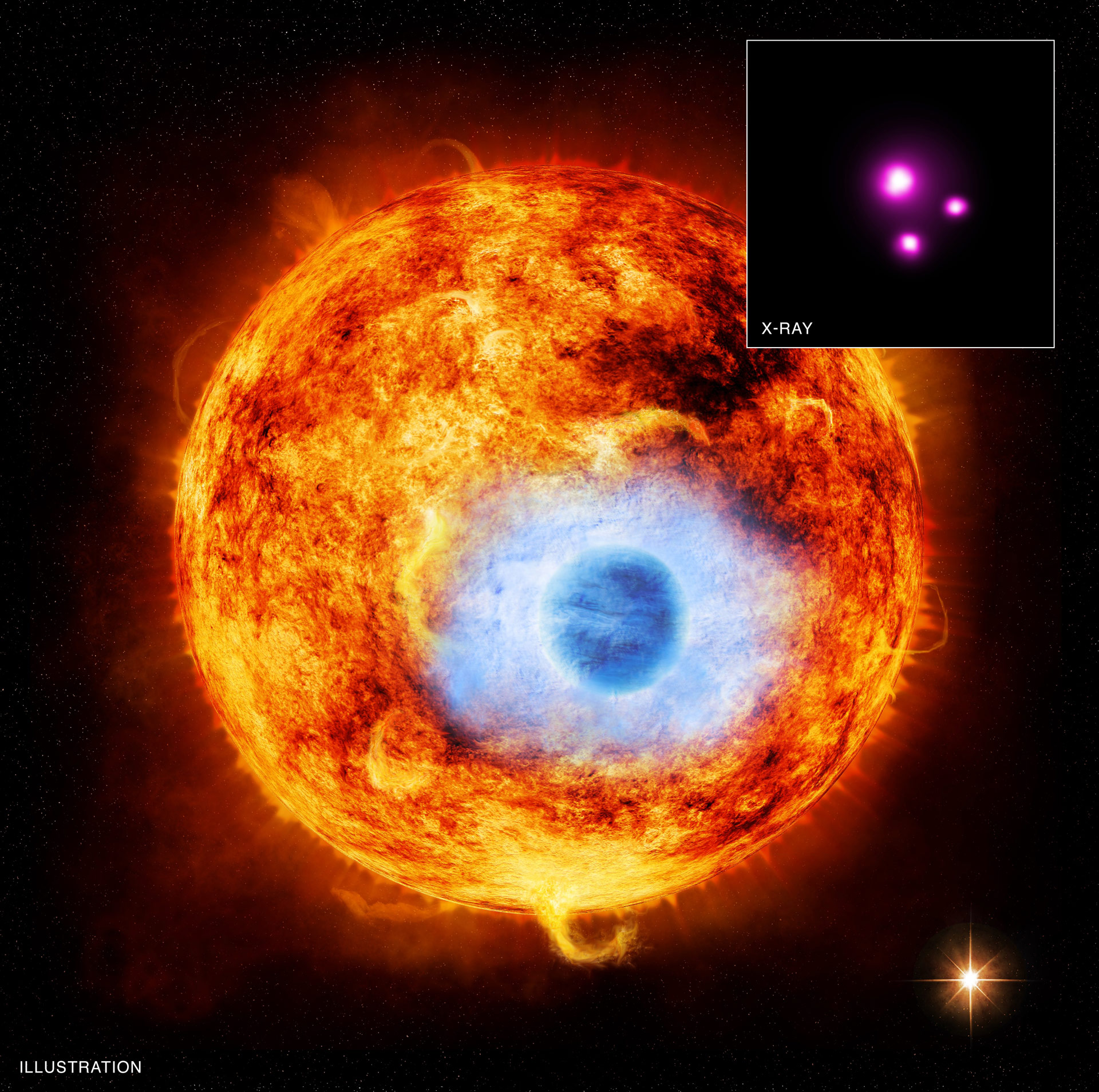
    Exoplanet HD 189733b
    This graphic depicts HD 189733b, the first exoplanet caught passing in front of its parent star in X-rays. The main figure is an artist’s impression showing the HD 189733 system, containing a Sun-like star orbited by HD 189733b, an exoplanet about the size of Jupiter. This “hot Jupiter” is over 30 times closer to its star than Earth is to the Sun and goes around the star once every 2.2 days, as determined from previous observations. Also in the illustration is a faint red companion star, which was detected for the first time in X-rays with these observations. This star orbits the main star about once every 3,200 years. The inset contains the Chandra image of HD 189733. The source in the middle is the main star and the source in the lower right is the faint companion star. The source at the bottom of the image is a background object not contained in the HD 189733 system. Credit: X-ray: NASA/CXC/SAO/K. Poppenhaeger et al; Illustration: NASA/CXC/M. Weiss

    Data from NASA’s Chandra X-ray Observatory and the European Space Agency’s XMM Newton Observatory has revealed the first exoplanet caught passing in front of its parent star in X-rays.

    For the first time since exoplanets, or planets around stars other than the sun, were discovered almost 20 years ago, X-ray observations have detected an exoplanet passing in front of its parent star.

    An advantageous alignment of a planet and its parent star in the system HD 189733, which is 63 light-years from Earth, enabled NASA’s Chandra X-ray Observatory and the European Space Agency’s XMM Newton Observatory to observe a dip in X-ray intensity as the planet transited the star.

    “Thousands of planet candidates have been seen to transit in only optical light,” said Katja Poppenhaeger of Harvard-Smithsonian Center for Astrophysics (CfA) in Cambridge, Massachusetts, who led a new study published in The Astrophysical Journal. “Finally being able to study one in X-rays is important because it reveals new information about the properties of an exoplanet.”

    The team used Chandra to observe six transits and data from XMM Newton observations of one.

    The planet, known as HD 189733b, is a hot Jupiter, meaning it is similar in size to Jupiter in our solar system but in a very close orbit around its star. HD 189733b is more than 30 times closer to its star than Earth is to the sun. It orbits the star once every 2.2 days.

    HD 189733b is the closest hot Jupiter to Earth, which makes it a prime target for astronomers who want to learn more about this type of exoplanet and the atmosphere around it. They have used NASA’s Kepler space telescope to study it at optical wavelengths, and NASA’s Hubble Space Telescope to confirm it is blue in color as a result of the preferential scattering of blue light by silicate particles in its atmosphere.

    The study with Chandra and XMM Newton has revealed clues to the size of the planet’s atmosphere. The spacecraft saw light decreasing during the transits. The decrease in X-ray light was three times greater than the corresponding decrease in optical light.

    “The X-ray data suggest there are extended layers of the planet’s atmosphere that are transparent to optical light but opaque to X-rays,” said co-author Jurgen Schmitt of Hamburger Sternwarte in Hamburg, Germany. “However, we need more data to confirm this idea.”

    The researchers also are learning about how the planet and the star can affect one another.

    Astronomers have known for about a decade that ultraviolet and X-ray radiation from the main star in HD 189733 are evaporating the atmosphere of HD 189733b over time. The authors estimate it is losing 100 million to 600 million kilograms (220 million to 1,300 million pounds) of mass per second. HD 189733b’s atmosphere appears to be thinning 25 percent to 65 percent faster than it would be if the planet’s atmosphere were smaller.

    “The extended atmosphere of this planet makes it a bigger target for high-energy radiation from its star, so more evaporation occurs,” said co-author Scott Wolk, also of CfA.

    The main star in HD 189733 also has a faint red companion, detected for the first time in X-rays with Chandra. The stars likely formed at the same time, but the main star appears to be 3 billion to 3 1/2 billion years younger than its companion star because it rotates faster, displays higher levels of magnetic activity, and is about 30 times brighter in X-rays than its companion.

    “This star is not acting its age, and having a big planet as a companion may be the explanation,” said Poppenhaeger. “It’s possible this hot Jupiter is keeping the star’s rotation and magnetic activity high because of tidal forces, making it behave in some ways like a much younger star.”

    Reference: “Transit Observations of the Hot Jupiter HD 189733b at X-Ray Wavelengths” by K. Poppenhaeger, J. H. M. M. Schmitt and S. J. Wolk, 25 July 2013, The Astrophysical Journal.
    DOI: 10.1088/0004-637X/773/1/62
    arXiv:1306.2311


    Never miss a breakthrough: Join the SciTechDaily newsletter.
    Follow us on Google and Google News.

    Astronomy Chandra X-ray Observatory Exoplanet NASA Planetary Science XMM-Newton
    Share. Facebook Twitter Pinterest LinkedIn Email Reddit

    Related Articles

    Chandra Observations Show Solar Storms Trigger Jupiter’s ‘Northern Lights’

    NASA’s Kepler Mission Delivers New Data

    The Wild Weather of Hot Jupiters

    Project 1640 Reveals Precise Composition Information About Four HR 8799 Planets

    Kepler Mission Discovers Two New Planetary Systems With ‘Habitable Zone’ Planets

    New Study Revives Doubted Exoplanet Fomalhaut b

    Volunteer Scientists Aid in Discovery of Four-Star Planet PH1

    “Habitable Zone” Might Help Extreme Life Forms Survive on Exoplanets

    In McNeil’s Nebula, Protostar V1647 Ori Flaunts its X-ray Spots

    Leave A Reply Cancel Reply

    • Facebook
    • Twitter
    • Pinterest
    • YouTube

    Don't Miss a Discovery

    Subscribe for the Latest in Science & Tech!

    Trending News

    Millions Take These IBS Drugs, But a New Study Finds Serious Risks

    Scientists Unlock Hidden Secrets of 2,300-Year-Old Mummies Using Cutting-Edge CT Scanner

    Bread Might Be Making You Gain Weight Even Without Eating More Calories

    Scientists Discover Massive Magma Reservoir Beneath Tuscany

    Europe’s Most Active Volcano Just Got Stranger – Here’s Why Scientists Are Rethinking It

    Alzheimer’s Symptoms May Start Outside the Brain, Study Finds

    Millions Take This Popular Supplement – Scientists Discover a Concerning Link to Heart Failure

    The Universe Is Expanding Too Fast and Scientists Can’t Explain Why

    Follow SciTechDaily
    • Facebook
    • Twitter
    • YouTube
    • Pinterest
    • Newsletter
    • RSS
    SciTech News
    • Biology News
    • Chemistry News
    • Earth News
    • Health News
    • Physics News
    • Science News
    • Space News
    • Technology News
    Recent Posts
    • Doctors Surprised by the Power of a Simple Drug Against Colon Cancer
    • Why Popular Diabetes Drugs Like Ozempic Don’t Work for Everyone: The “Genetic Glitch”
    • Scientists Create Improved Insulin Cells That Reverse Diabetes in Mice
    • Scientists Stunned After Finding Plant Thought Extinct for 60 Years
    • A Common Diabetes Drug May Hold the Key to Stopping HIV From Coming Back
    Copyright © 1998 - 2026 SciTechDaily. All Rights Reserved.
    • Science News
    • About
    • Contact
    • Editorial Board
    • Privacy Policy
    • Terms of Use

    Type above and press Enter to search. Press Esc to cancel.