
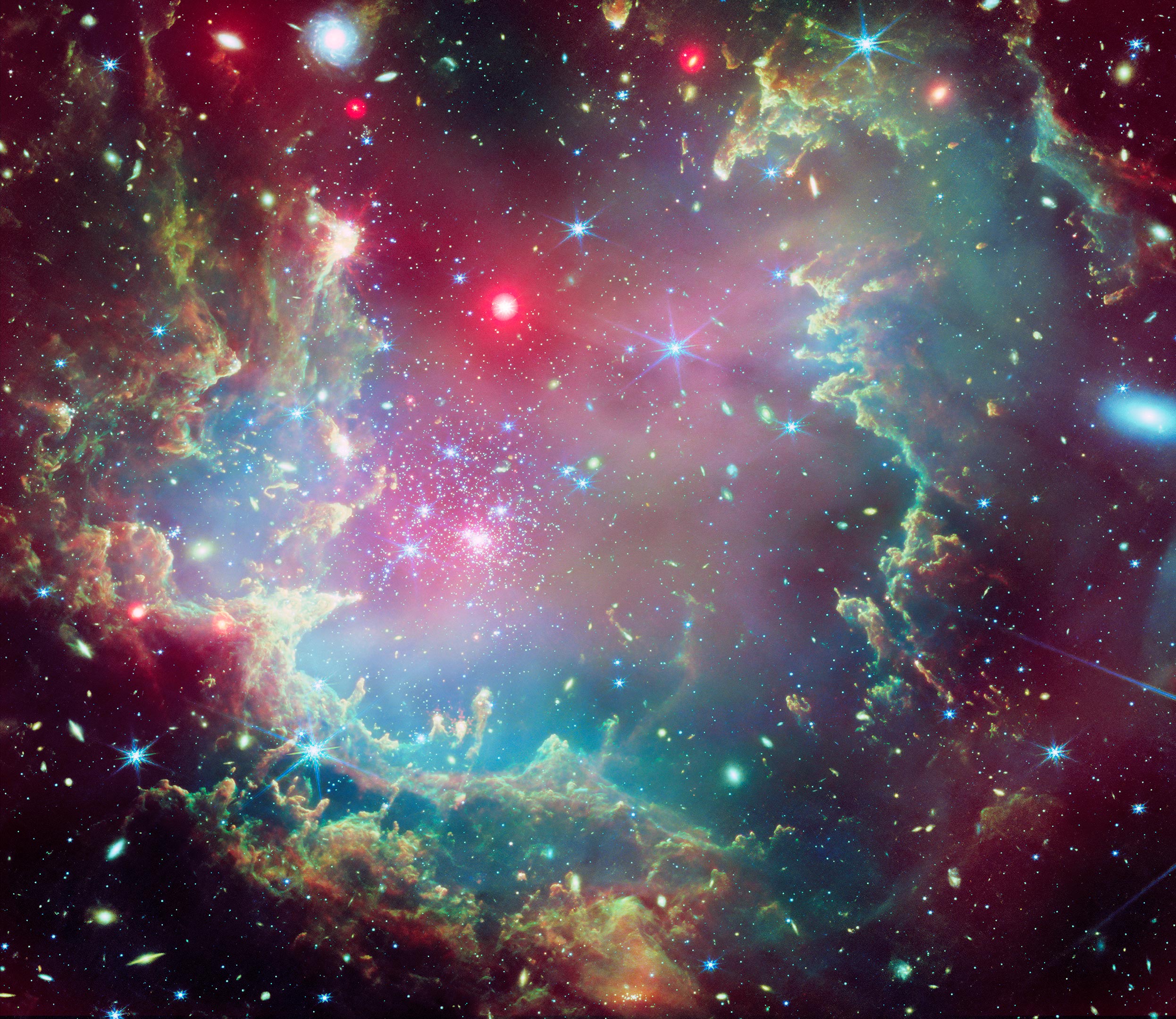
- A new image resembling a Christmas wreath captures young stars lighting up dense, dark clouds of dust.
- The image features NGC 602, a star cluster in the Small Magellanic Cloud, a nearby galaxy to the Milky Way.
- This composite combines X-ray data from Chandra (shown in red) and infrared data from the James Webb Space Telescope (depicted in orange, yellow, green, and blue).
- Chandra’s X-rays highlight the powerful stellar winds from massive young stars scattered across the cluster.
Wreaths have long symbolized the cycle of life, death, and rebirth, making it especially fitting that astronomers study the stellar lifecycle in a place resembling a giant holiday wreath.
This place is the star cluster NGC 602, located on the outskirts of the Small Magellanic Cloud, a neighboring galaxy to the Milky Way about 200,000 light-years away. The stars in NGC 602 contain fewer heavy elements than the Sun and most stars in the Milky Way. This environment mirrors the conditions of the universe billions of years ago, providing a glimpse into the early days of star formation.
This new image combines data from NASA’s Chandra X-ray Observatory with a previously released image from NASA’s James Webb Space Telescope. The dark ring-like outline of the wreath seen in Webb data (represented as orange, yellow, green, and blue) is made up of dense clouds of filled dust.
Meanwhile, X-rays from Chandra (red) show young, massive stars that are illuminating the wreath, sending high-energy light into interstellar space. These X-rays are powered by winds flowing from the young, massive stars that are sprinkled throughout the cluster. The extended cloud in the Chandra data likely comes from the overlapping X-ray glow of thousands of young, low-mass stars in the cluster.
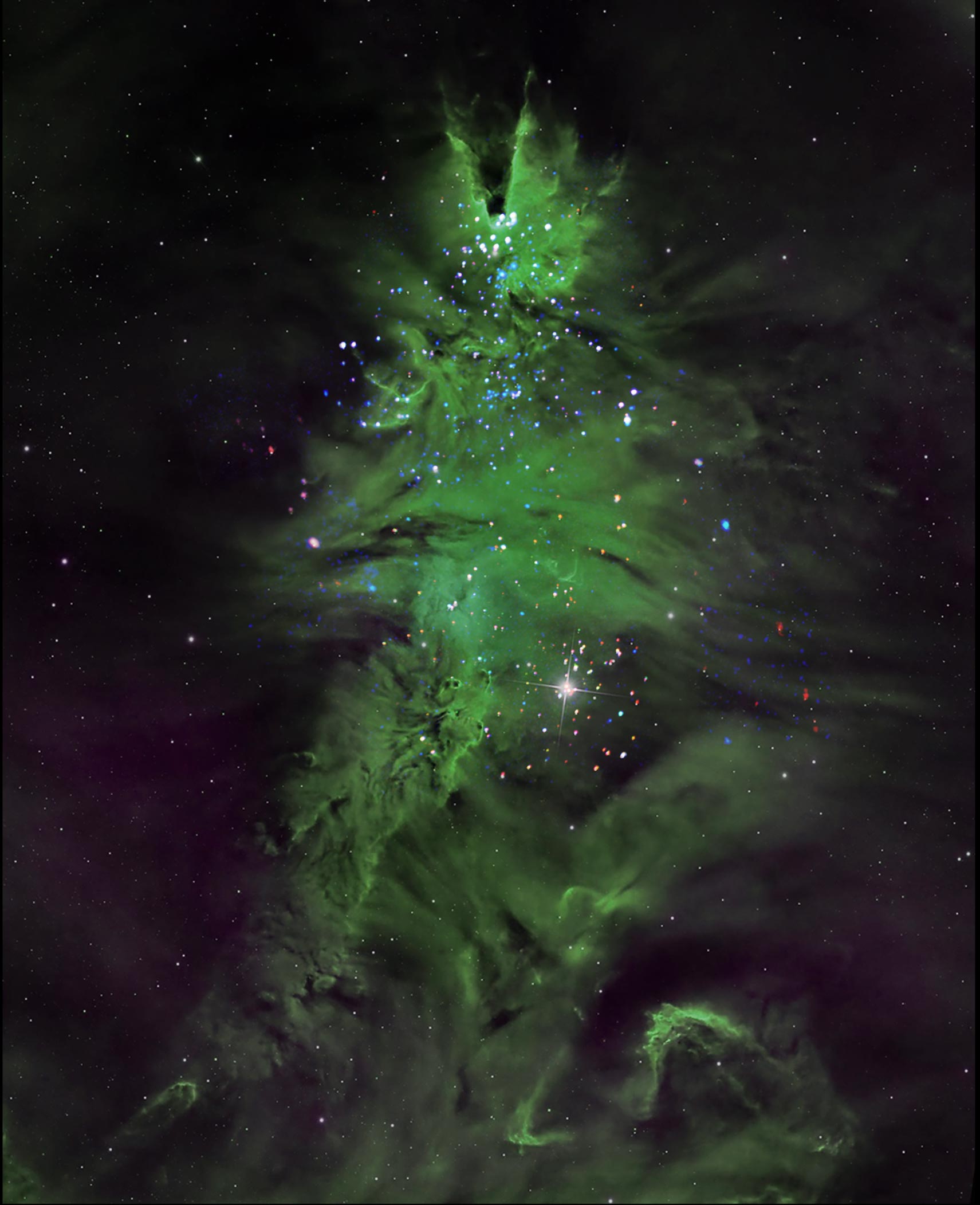
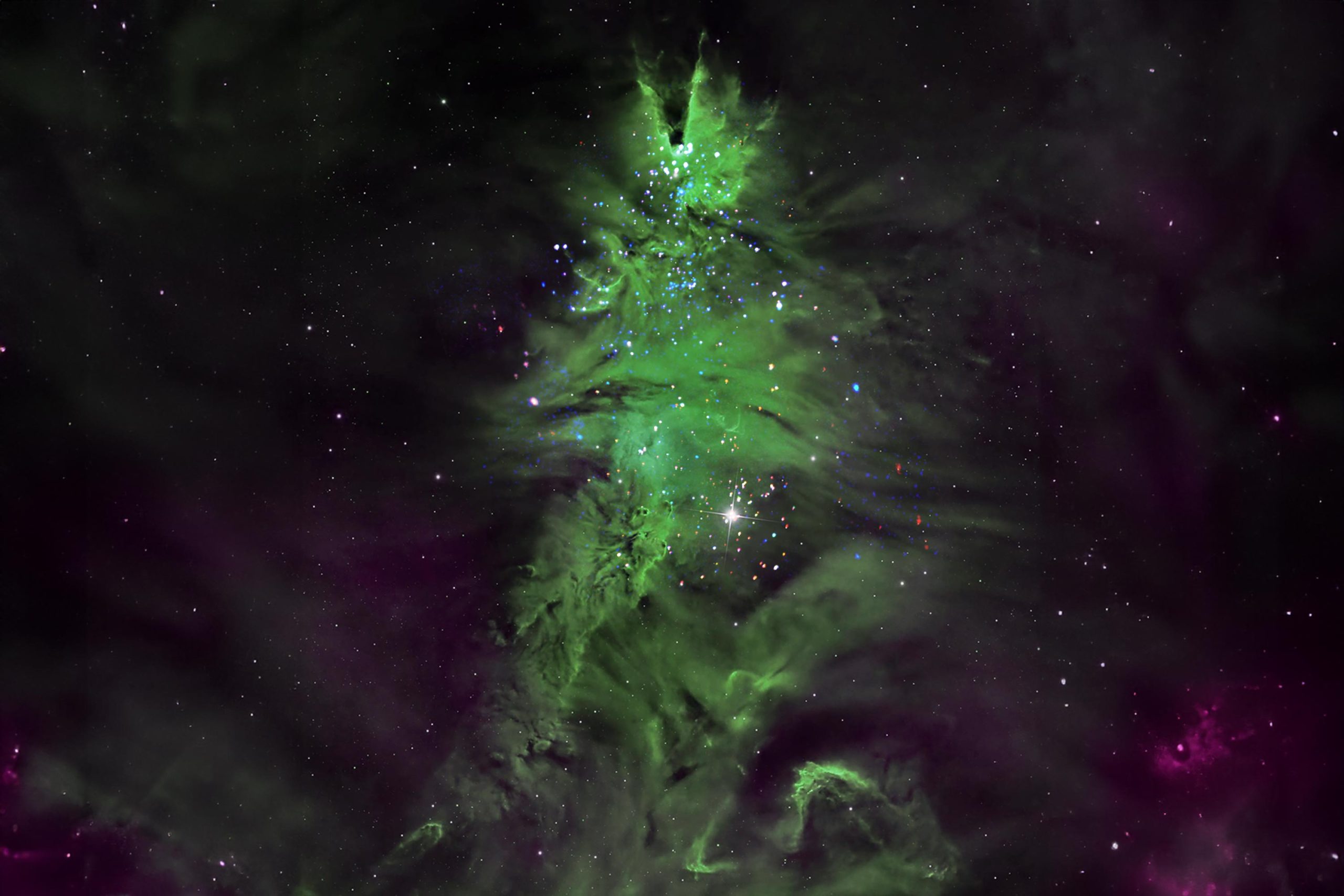
In addition to this cosmic wreath, a new version of the “Christmas tree cluster” is also now available. Like NGC 602, NGC 2264 is a cluster of young stars between one and five million years old. (For comparison, the Sun is a middle-aged star about 5 billion years old — about 1,000 times older.) In this image of NGC 2264, which is much closer than NGC 602 at a distance of about 2,500 light-years from Earth, Chandra data (red, green, and blue) has been combined with optical data (green and white) captured by astrophotographer Michael Clow from his telescope in Arizona in November 2024.
NASA’s Marshall Space Flight Center in Huntsville, Alabama, manages the Chandra program. The Smithsonian Astrophysical Observatory’s Chandra X-ray Center controls science operations from Cambridge, Massachusetts, and flight operations from Burlington, Massachusetts.
Never miss a breakthrough: Join the SciTechDaily newsletter.
Follow us on Google and Google News.
7 Comments
Looks more like the grinch to me.
It looks like cosmic… 🥦🚬
Love it
Are there posters of this?
Surely, there is the Almighty God somewhere. None of these exist by chance. He made them all.
None of this is real, folks. We can’t look at the moon up close, there nooooo way we can see light years in the distance, let alone hundreds of millions of miles. And all the fake colors added to these places, seriously 😂.
THAT!!! IS CRONUS THE GOD OF TIME. He came to Earth receiving cosmic issue from the TREES as a cosmic tree issue what we would call a tree FROG that he then later PIERCED the TEMPANIC MEMBRANE of causing there to be the inner ear. The OOZE from his ear they called ZEUS like OOZE to pronounce it is aka FROG KING aka BIG BUD I believe we may have big bird through it. There are many with Grecian ancestry whom this is the COSMIC great grand daddy of. So with that being said aka The COSMIC GREAT GRAND DADDY of all those with the inner ear. They used to say JOSH is CRONUS AND saying CRONUS IS CRO-MAGNONS A.stronomical S.cience S.ociety. f.y I. Thats what I heard.