
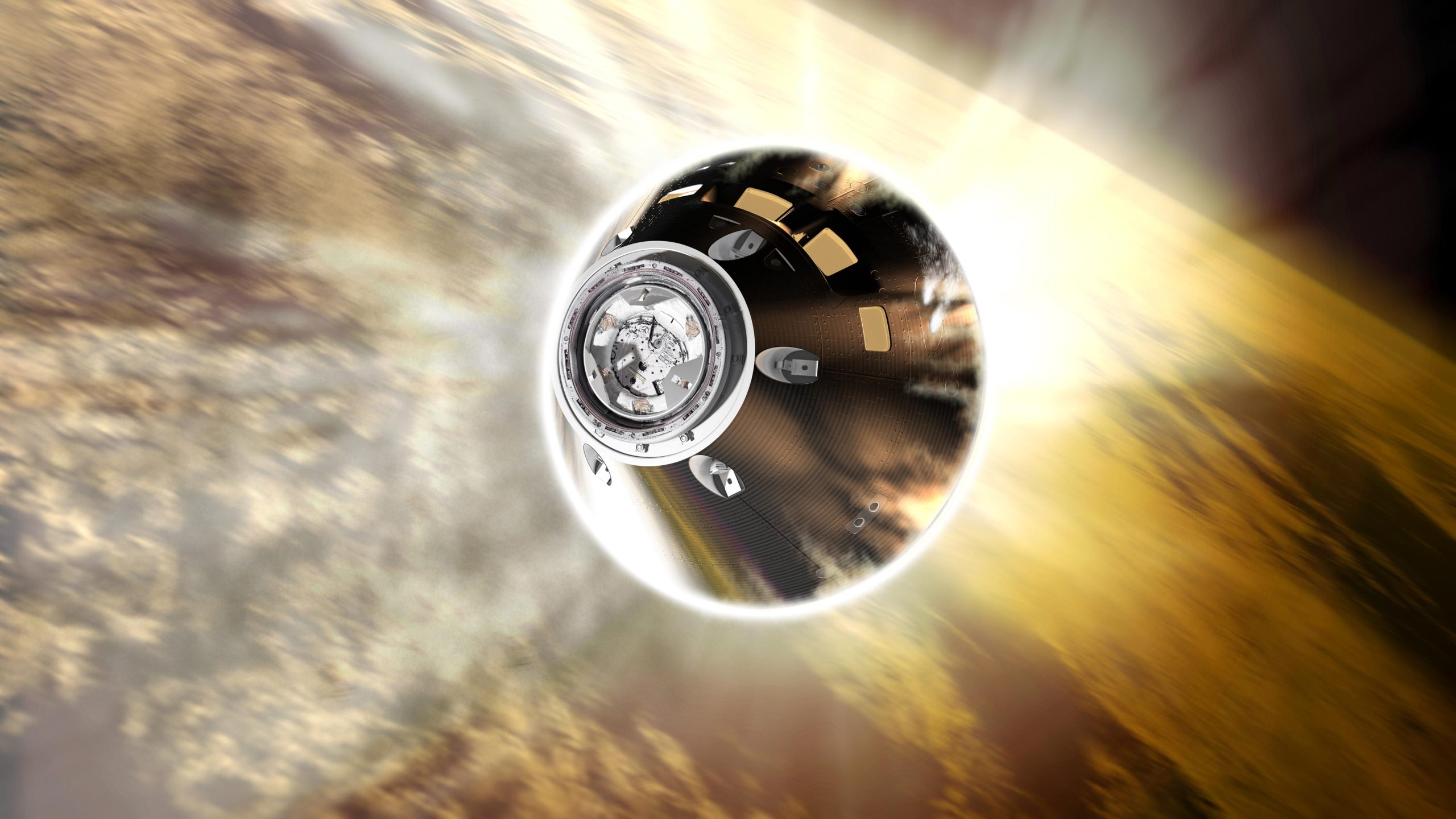
NASA’s investigation into the Artemis I Orion spacecraft’s heat shield issue revealed that trapped gases within the Avcoat material led to pressure buildup and char loss during reentry.
Extensive testing, both pre-flight and post-flight, and simulation at NASA facilities have helped refine the heat shield’s design to prevent future issues, ensuring crew safety for subsequent Artemis missions.
NASA Identifies Cause of Heat Shield Damage on Artemis I
After extensive analysis and testing, NASA has identified the technical cause of the unexpected char loss observed on the Artemis I Orion spacecraft’s heat shield.
Engineers determined that during Orion’s return from its uncrewed mission around the Moon, gases generated within the heat shield’s ablative material, known as Avcoat, were unable to vent and dissipate as intended. This led to a buildup of internal pressure, causing cracks and the shedding of charred material in several areas.
“Our early Artemis flights are a test campaign, and the Artemis I test flight gave us an opportunity to check out our systems in the deep space environment before adding crew on future missions,” explained Amit Kshatriya, deputy associate administrator, Moon to Mars Program Office, NASA Headquarters in Washington. “The heat shield investigation helped ensure we fully understand the cause and nature of the issue, as well as the risk we are asking our crews to take when they venture to the Moon.”
Extensive Testing Reveals Underlying Issues
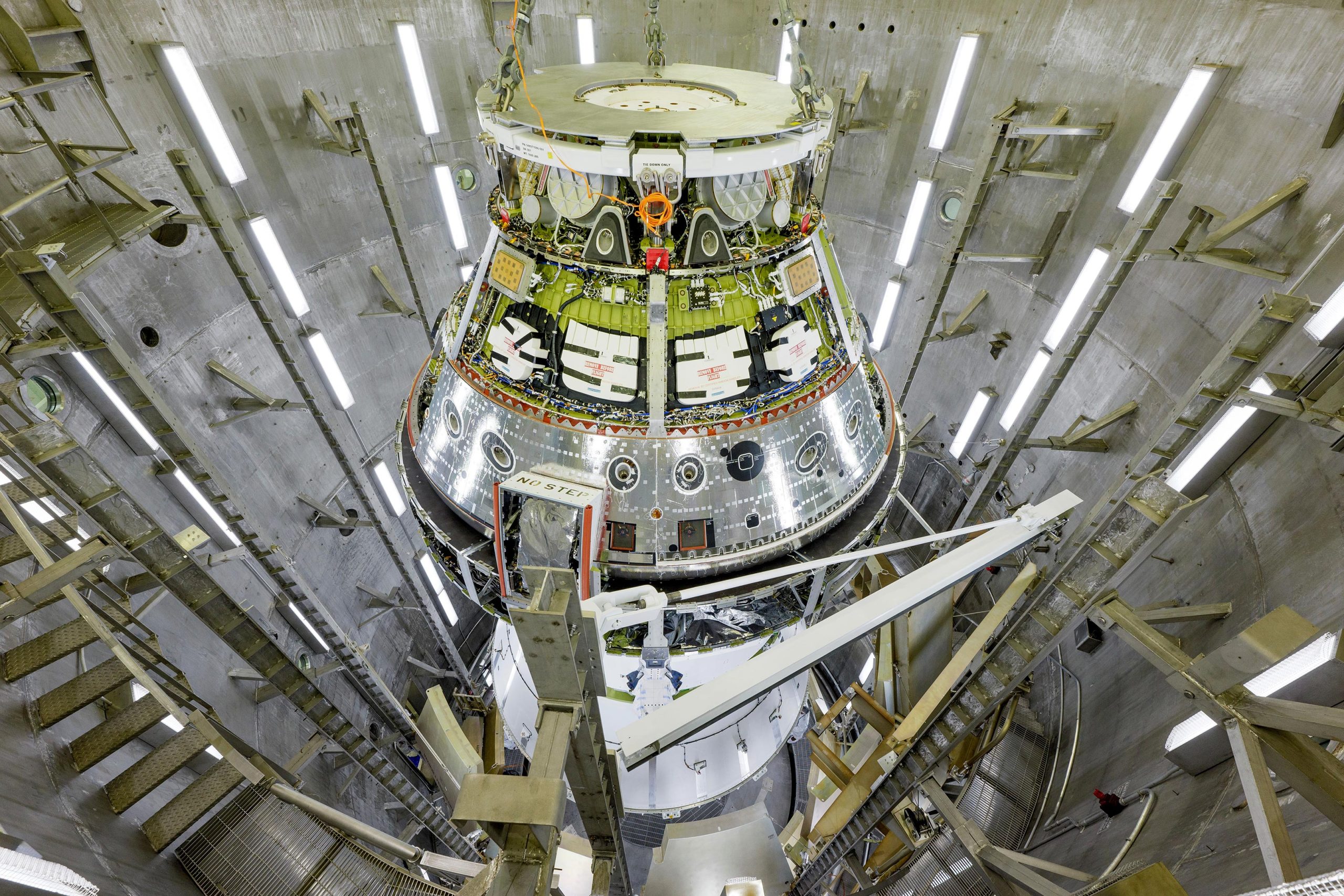
Teams took a methodical approach to understanding and identifying the root cause of the char loss issue, including detailed sampling of the Artemis I heat shield, review of imagery and data from sensors on the spacecraft, and comprehensive ground testing and analysis.
During Artemis I, engineers used the skip guidance entry technique to return Orion to Earth. This technique provides more flexibility by extending the range Orion can fly after the point of reentry to a landing spot in the Pacific Ocean. Using this maneuver, Orion dipped into the upper part of Earth’s atmosphere and used atmospheric drag to slow down. Orion then used the aerodynamic lift of the capsule to skip back out of the atmosphere, then reenter for final descent under parachutes to splashdown.
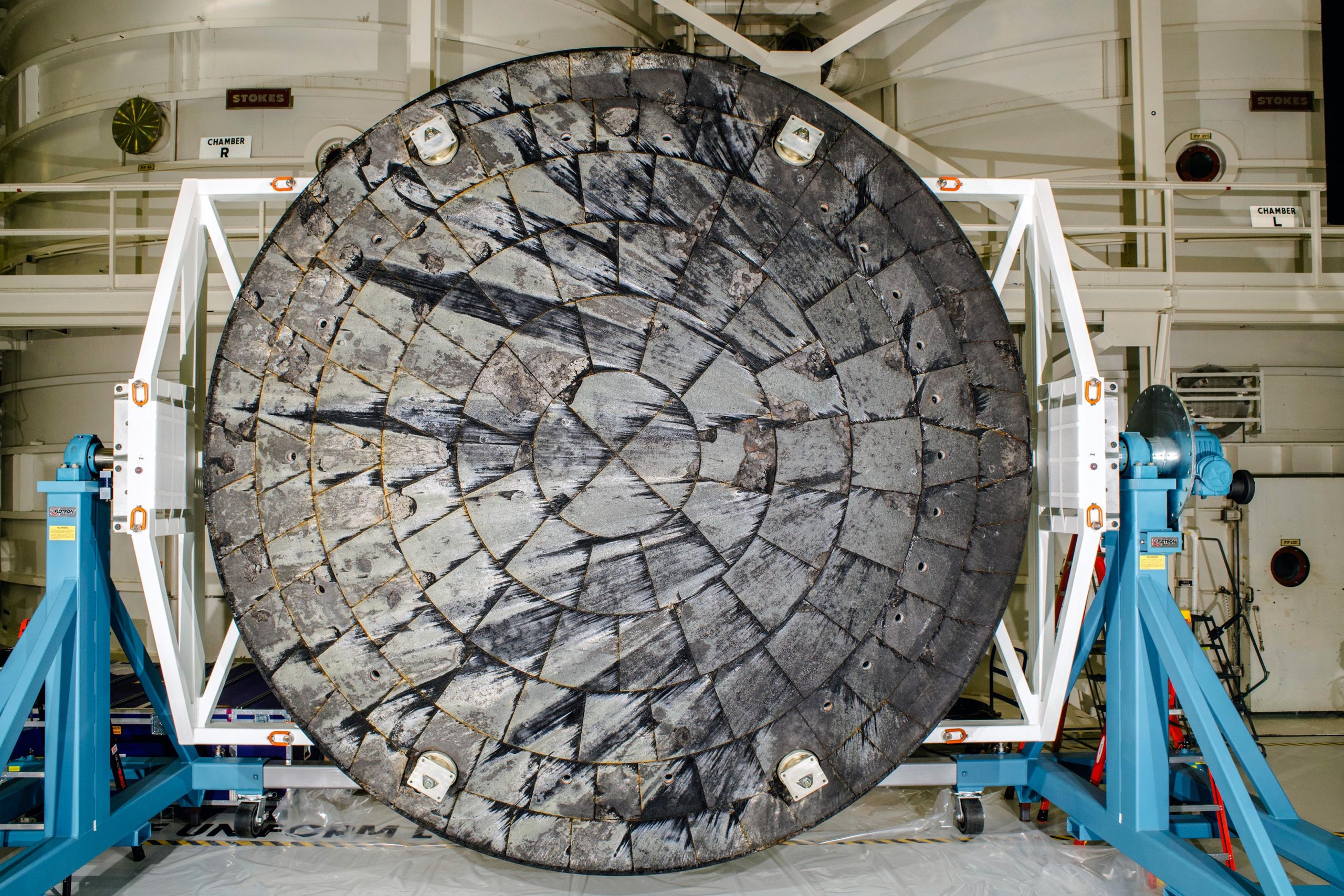
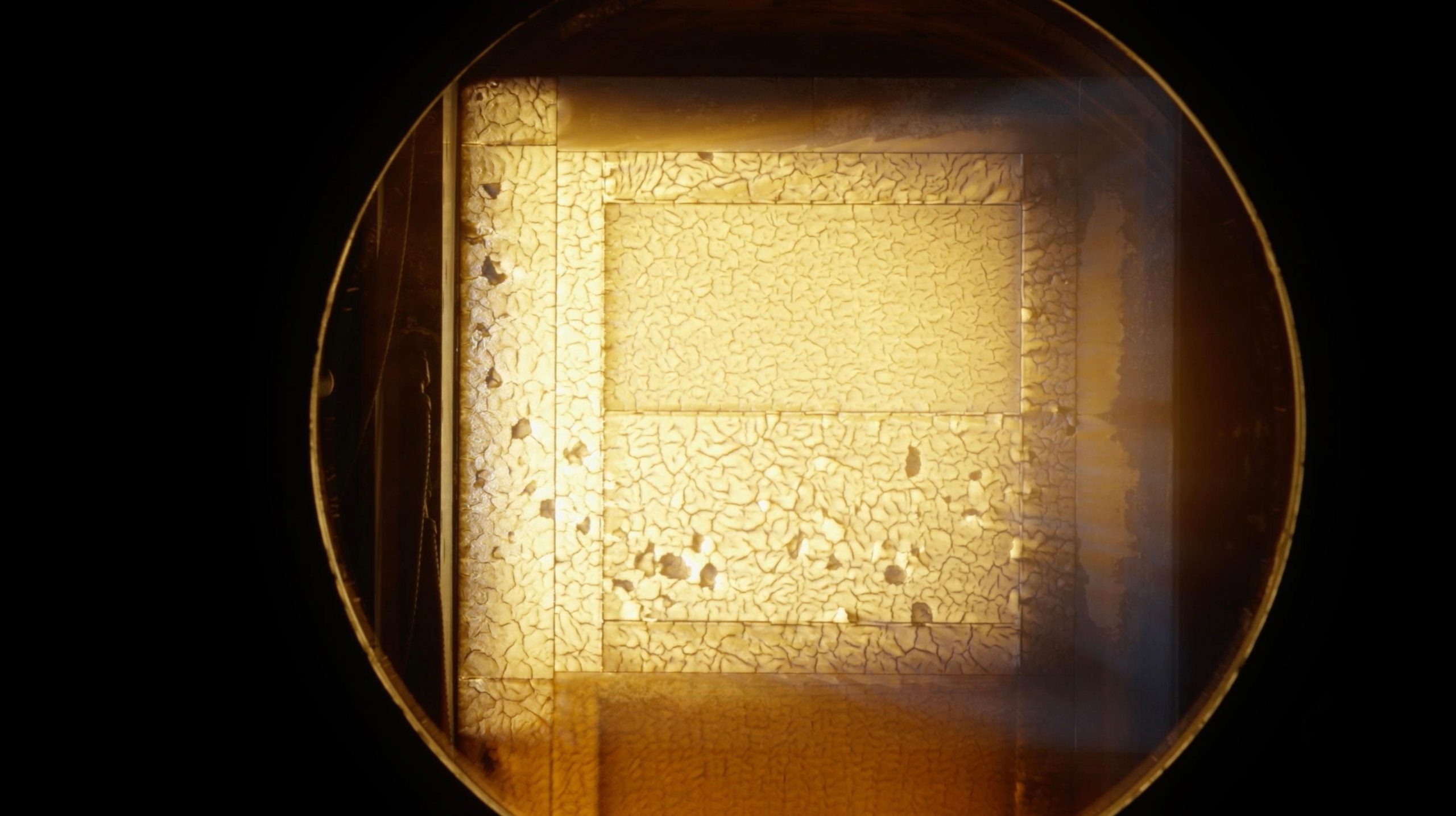
Using Avcoat material response data from Artemis I, the investigation team was able to replicate the Artemis I entry trajectory environment — a key part of understanding the cause of the issue — inside the arc jet facilities at NASA’s Ames Research Center in California. They observed that during the period between dips into the atmosphere, heating rates decreased, and thermal energy accumulated inside the heat shield’s Avcoat material. This led to the accumulation of gases that are part of the expected ablation process. Because the Avcoat did not have “permeability,” internal pressure built up, and led to cracking and uneven shedding of the outer layer.
Teams performed extensive ground testing to replicate the skip phenomenon before Artemis I. However, they tested at much higher heating rates than the spacecraft experienced in flight. The high heating rates tested on the ground allowed the permeable char to form and ablate as expected, releasing the gas pressure. The less severe heating seen during the actual Artemis I reentry slowed down the process of char formation, while still creating gases in the char layer. Gas pressure built up to the point of cracking the Avcoat and releasing parts of the charred layer. Recent enhancements to the arc jet facility have enabled a more accurate reproduction of the Artemis I measured flight environments, so that this cracking behavior could be demonstrated in ground testing.
Enhanced Safety Measures for Future Missions
While Artemis I was uncrewed, flight data showed that had the crew been aboard, they would have been safe. The temperature data from the crew module systems inside the cabin were also well within limits and holding steady in the mid-70s Fahrenheit. The thermal performance of the heat shield exceeded expectations.
Engineers understand both the material phenomenon and the environment the materials interact with during entry. By changing the material or the environment, they can predict how the spacecraft will respond. NASA teams unanimously agreed the agency can develop acceptable flight rationale that will keep the crew safe using the current Artemis II heat shield with operational changes to the entry.
Thorough Investigation and Testing Efforts
Soon after NASA engineers discovered the condition on the Artemis I heat shield, the agency began an extensive investigation process, which included a multi-disciplinary team of experts in thermal protection systems, aerothermodynamics, thermal testing and analysis, stress analysis, material test and analysis, and many other related technical areas. NASA’s Engineering and Safety Center was also engaged to provide technical expertise including nondestructive evaluation, thermal and structural analysis, fault tree analysis, and other testing support.
“We took our heat shield investigation process extremely seriously with crew safety as the driving force behind the investigation,” said Howard Hu, manager, Orion Program, NASA’s Johnson Space Center in Houston. “The process was extensive. We gave the team the time needed to investigate every possible cause, and they worked tirelessly to ensure we understood the phenomenon and the necessary steps to mitigate this issue for future missions.”
The Artemis I heat shield was heavily instrumented for flight with pressure sensors, strain gauges, and thermocouples at varying ablative material depths. Data from these instruments augmented the analysis of physical samples, allowing the team to validate computer models, create environmental reconstructions, provide internal temperature profiles, and give insight into the timing of the char loss.
Approximately 200 Avcoat samples were removed from the Artemis I heat shield at NASA’s Marshall Space Flight Center in Alabama for analysis and inspection. The team performed a non-destructive evaluation to “see” inside the heat shield.
Improved Heat Shield Design for Future Flights
One of the most important findings from examining these samples was that local areas of permeable Avcoat, which had been identified prior to the flight, did not experience cracking or char loss. Since these areas were permeable at the start of the entry, the gases produced by ablation were able to adequately vent, eliminating the pressure build-up, cracking, and char loss.
Engineers performed eight separate post-flight thermal test campaigns to support the root cause analysis, completing 121 individual tests. These tests took place in facilities with unique capabilities across the country, including the Aerodynamic Heating Facility at the Arc-Jet Complex at Ames to test convective heating profiles with various test gases; the Laser Hardened Materials Evaluation Laboratory at Wright‐Patterson Air Force Base in Ohio to test radiative heating profiles and provide real-time radiography; as well as the Interaction Heating Facility at Ames to test combined convective and radiative heating profiles in the air at full-block scale.
Aerothermal experts also completed two hypersonic wind tunnel test campaigns at NASA’s Langley Research Center in Virginia and CUBRC aerodynamic test facilities in Buffalo, New York, to test a variety of char loss configurations and enhance and validate analytical models. Permeability testing was also performed at Kratos in Alabama, the University of Kentucky, and Ames to help further characterize the Avcoat’s elemental volume and porosity. The Advanced Light Source test facility, a U.S. Department of Energy scientific user facility at Lawrence Berkeley National Laboratory, was also used by engineers to examine the heating behavior of the Avcoat at a microstructure level.
In the spring of 2024, NASA stood up an independent review team to conduct an extensive review of the agency’s investigation process, findings, and results. The independent review was led by Paul Hill, a former NASA leader who served as the lead space shuttle flight director for Return to Flight after the Columbia accident, led NASA’s Mission Operations Directorate, and is a current member of the agency’s Aerospace Safety Advisory Panel. The review occurred over a three-month period to assess the heat shield’s post-flight condition, entry environment data, ablator thermal response, and NASA’s investigation progress. The review team agreed with NASA’s findings on the technical cause of the physical behavior of the heat shield.
Heat Shield Advancements
Knowing that permeability of Avcoat is a key parameter to avoid or minimize char loss, NASA has the right information to assure crew safety and improve performance of future Artemis heat shields. Throughout its history, NASA has learned from each of its flights and incorporated improvements into hardware and operations.
The data gathered throughout the Artemis I test flight has provided engineers with invaluable information to inform future designs and refinements. Lunar return flight performance data and a robust ground test qualification program improved after the Artemis I flight experience are supporting production enhancements for Orion’s heat shield.
Future heat shields for Orion’s return from Artemis lunar landing missions are being produced to achieve uniformity and consistent permeability. The qualification program is currently being completed along with the production of more permeable Avcoat blocks at NASA’s Michoud Assembly Facility in New Orleans.
Never miss a breakthrough: Join the SciTechDaily newsletter.
Follow us on Google and Google News.
4 Comments
Is the asymmetric char pattern the result of the skipping maneuver? Off hand, it looks like the ablation shield is not being used to maximum effect.
What no one mentions, is that the heat shield for Artemis 1 was significantly different from Apollo and the Orion OFT-1 mission. Prior to Artemis 1, the heat shield was constructed by filling a honeycomb structure with Avcoat (including Orion OFT-1). Artemis-2 introduced Avcoat tiles, which didn’t work so well. Skip trajectories have been evaluated by the Orion aeroheating community for years. Maybe Avcoat in the honeycomb structure would had had the same problems. The switch to Avcoat tiles seems the culprit to me, not the skip trajectory.
When will you let real engineers talk instead of poligineers. Just say: we f__’d up pretty bad, did not have nearly the proper margins, could not understand what we had well enough to simulate it, have to rely on “let’s try it” instead of margins. I will bet the “pert” milestones and budget was right on though. WE did it with slide rules. You guys just don’t do it at all. GREAT lower level people. Astonishingly bad upper management. I did 62 straight years of engineering … as my credentials.
Apollo had a heat shield that could handle the 24000 mph re entry speeds without a skip re-entry. This was made 55 years ago and proved successful (100%) with 8 @ 3 man crews returning safely. Are we allowed to ask why they are still inventing a heat shield? or will be insulted and called a flat earther or something?