
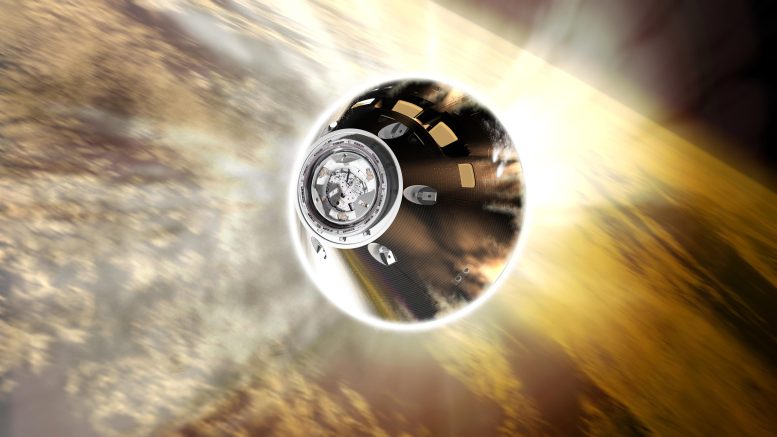
As NASA’s Artemis I mission to the Moon draws to a close, the Orion spacecraft is on its way back to Earth, with the planned splashdown on Sunday, December 11, fast approaching. When Orion is nearing its return to Earth, it will attempt the first skip entry for a human spacecraft. This maneuver is designed to pinpoint its landing spot in the Pacific Ocean.
During this skip entry, Orion will dip into the upper part of Earth’s atmosphere and use that atmosphere, along with the lift of the capsule, to skip back out of the atmosphere, then reenter for final descent under parachutes and splashdown. It’s a little like skipping a rock across the water in a river or lake.
“The skip entry will help Orion land closer to the coast of the United States, where recovery crews will be waiting to bring the spacecraft back to land,” said Chris Madsen, Orion guidance, navigation and control subsystem manager. “When we fly crew in Orion beginning with Artemis II, landing accuracy will really help make sure we can retrieve the crew quickly and reduces the number of resources we will need to have stationed in the Pacific Ocean to assist in recovery.”
Ever skip stones across a pond? Imagine doing it with a spacecraft. When the Lockheed Martin-built Orion spacecraft returns to Earth at the end of the Artemis I mission, it will attempt a never-been-done guidance and control maneuver called a skip-entry. This maneuver allows for a precise landing location for safer crew recovery efforts.
During Apollo, the spacecraft entered the Earth’s atmosphere directly and could then travel up to 1,725 miles (1,500 nautical miles / 2,880 km) beyond that location before splashing down. This limited range required U.S. Navy ships to be stationed in multiple, remote ocean locations. By using a skip entry, Orion can fly up to 5,524 miles (4,800 nautical miles / 8,890 km) beyond the point of entry, allowing the spacecraft to touch down with more precision. The skip entry ultimately enables the spacecraft to accurately and consistently land at the same landing site regardless of when and where it comes back from the Moon.
“We extend the range by skipping back up out of the atmosphere where there is little to no drag on the capsule. With little or no drag, we extend the range we fly,” said Madsen. “We use our capsule lift to target how high we skip, and thus how far we skip.”
Although the concept of the skip entry has been around since the Apollo era, it wasn’t used because Apollo lacked the necessary navigational technology, computing power, and accuracy.
“We took a lot of that Apollo knowledge and put it into the Orion design with the goal of making a more reliable and safer vehicle at lower cost,” said Madsen. “These are some of the things we’re doing that are different and provide more capability than Apollo.”
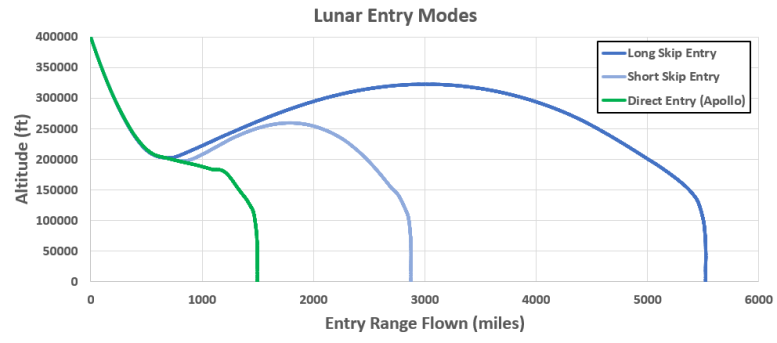
The skip entry also will allow astronauts to experience lower g-forces during Earth entry from Moon missions. Instead of a single event of high acceleration, there will be two events of a lower acceleration of about four g’s each. The skip entry will reduce the acceleration load for the astronauts so they have a safer, smoother ride.
Splitting up the acceleration events also splits up the heating, no small matter for a spacecraft that will endure approximately 5,000 degrees Fahrenheit (2,800 degrees Celsius) upon reentry, half as hot as the surface of the Sun. The heat the spacecraft will experience upon reentry will be split over two events causing a lower heat rate at both occurrences and ultimately making it a safer ride for the astronauts.
During Artemis missions, Orion will splashdown approximately 50 miles (43 nautical miles / 80 km) off the coast of San Diego, California, where rescue teams are close and can quickly recover the spacecraft. This quick recovery will make it safer for the astronauts. It will also be more cost-efficient than Apollo by eliminating the need for the Navy to deploy ships widely across the target ocean.
As an essential part of NASA’s Artemis program, the Orion spacecraft will fly on NASA’s first integrated test of its deep space exploration systems during Artemis I. The Space Launch System rocket will launch an uncrewed Orion on a mission to travel 40,000 miles beyond the Moon and then return to Earth.
Never miss a breakthrough: Join the SciTechDaily newsletter.
Follow us on Google and Google News.
16 Comments
This was literally done on the Apollo missions ha ha
And why would you believe so?
I see what you did there. When you said “This was literally done on the Apollo missions”, you were really saying “This literally wasn’t done on the Apollo missions as the Apollo craft didn’t have the capability to leave the atmosphere again”.
I love this radical new usage of the word ‘literally’ and the ‘ha ha’ is a very nice touch in the absence of a facility to add a dozen ‘crying with laughter’ emojis
The Apollo capsule used a similar method, although didn’t leave the atmosphere during the “skip”. This helped with both heat management and landing accuracy and it’s why Apollo didn’t use a direct reentry.
Can’t help but remember the Challenger
My memory might be defective, but I’m pretty sure that Challenger was lost during ascent to orbit and not during re-entry.
What’s the difference between this and aerobraking?
Columbia broke up on reentry after being damaged at launch by foam.
The idea of “flying” a spacecraft by using roll around a displaced center of mass was actually pioneering on the Gemini flights. Apollo took it to the next level described in the graph, but Orion is far and away next level.
The title is wrong.
If uncrewed mission of human-rated spacecraft is considered, then first fully successfull skip-entry of such spacecraft was performed by Zond-7 (from the Soyuz 7K-L1 series) in August 1969.
Please, correct the title.
It’s a shame females will not be able to share the same responsibility as their male counterparts because Female astronauts have fewer opportunities in space than men because of strict lifetime radiation exposure restrictions, A six-month mission on the International Space Station exposes astronauts to 40 times the average yearly dose of background radiation that a person would receive living on Earth,
A six-month mission on the International Space Station exposes astronauts to 40 times yearly dose of background radiation that a person would receive on Earth,
While the level of risk allowed for women becouse they have a lower threshold for space radiation exposure than men,
“Depending on when you fly a space mission, a female will fly only 45 to 50 percent of the missions that a male can fly,”
And what happened to putting the best candidates in space like we did in the ’60s when we had a head-to-head competition to determine who had the best ability for which Mission instead of trying to fill political agendas to put a person of color and a female on the moon!
RE: Mark Boyer’s comment and his use of the perpetually misused fad word “literally,” 99% of the comments I’ve ever read that use this now meaningless term used it incorrectly.
This “first skip” business has really annoyed me. First of all, Zond. Second of all, Apollo did skip as long as you consider a short skip in the atmosphere (“lofting”) as qualifying. So the issue here is definitional. Apparently, because Artemis does a bigger and longer skip (although not above 400K feet) it qualfies as a skip and Apollo does not.
I’m 38 years old and don’t believe anyone has ever gone to “outer space”. It’s obvious that you all believe nixon used a landline to congratulate Armstrong and the other “heros” back in ’69 but it’s all so silly and stupid. Stop lying.. just stop. Your kids will discover your lies and will hold it against you. Cellular phones don’t require satellites, communication takes place largely through wires and ground based towers. That is why cell phones have dead spots in ravines instead of always having signal. The challenger disaster happened at launch and all of us children got to watch it live because all of our teachers had spent weeks preparing us to see the first woman teach have her opportunity to shine. Her rocket exploded and that was when I knew deep inside that I was being brainwashed with propaganda. Change my mind
Right, the Challenger exploded shortly after take-off. It was the Columbia that burnt up during re-entry some two years previous.
I saw one Apollo capsule at the Smithsonian. Then I saw a photo of the Orion capsule after re-entry. It was burned out like a huge charcoal piece. I’m worried for astronauts on next missions. That reentry was fast but too hot for any human crew inside.
Thanks for the information on Artemis missions. Please check the speed and heat for next re-entry. The Orion capsule looked too burned out after recovery by the Navy team. Wishing you a safe success for next Artemis missions, my salute to all the marvelous space team. Thanks