
Sagittarius B’s turbulent dust lanes may trigger star birth in the galactic center.
Looking at the ionized carbon emission from Sagittarius B provides critical information about star formation in our own galaxy and beyond.
Sagittarius, or Sgr B, a cloud of gas and dust near the center of the Milky Way is one of the brightest sources in the Central Molecular Zone – a massive, dense area of gas in the center of our galaxy, home to very high star formation rates and turbulent molecular gas clouds. At less than 27,000 light-years away, Sgr B is a relatively close neighbor, making it a useful region to study, both as a proxy for understanding other galaxies throughout the universe and also for understanding our own galactic center.
In particular, observing the concentration of ionized carbon in a molecular cloud like Sgr B is a powerful method for probing the properties of the system, including its level of star formation.
SOFIA’s upGREAT Maps the Heart of Sgr B
Using SOFIA’s upgraded German Receiver for Astronomy at Terahertz Frequencies, or upGREAT, a team of researchers imaged the ionized carbon characteristics of Sgr B. GREAT has ample spectral resolution to study Sgr B in detail at scales ranging from small clouds to star formation regions, allowing the scientists to understand the dynamics of gas within our galactic center. UpGREAT’s rapid imaging capabilities and detailed velocity resolution were crucial for enabling the study, which is part of a much larger scan of the area.
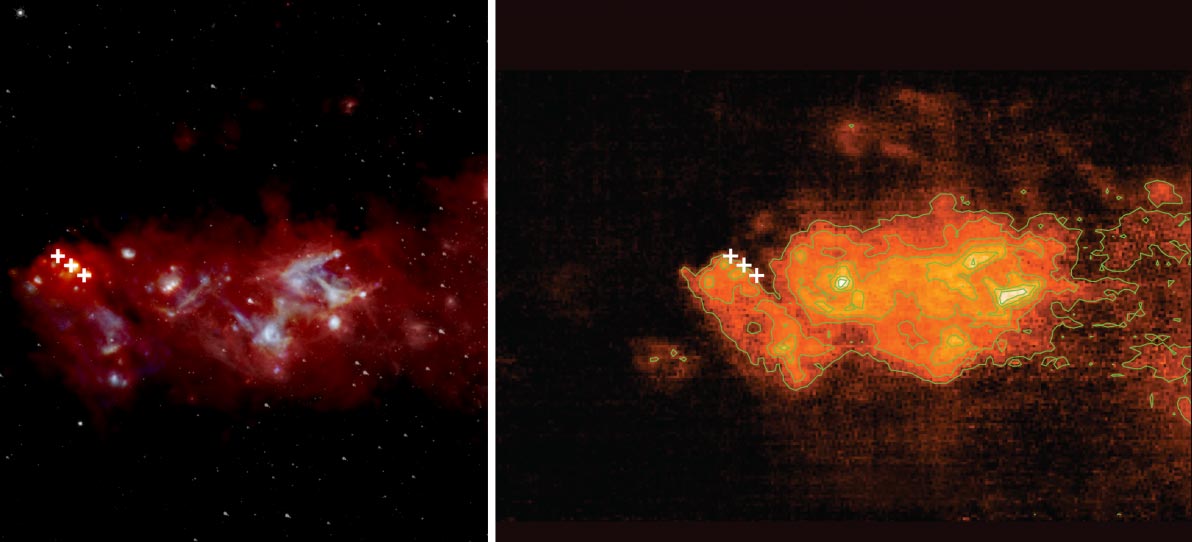
Among a number of findings, astronomers noted the steady carbon emission from Sgr B implies the entire region is physically connected, making it one continuous structure spanning about 34 by 15 parsecs, or about 111 by 49 light-years. It is spatially complex, comprised of arcs and ridges undergoing large-scale, turbulent motion.
By comparing the brightness of different emission lines, the group obtained an estimate of the ratio of ionized carbon emission coming from regions dominated by ionized hydrogen compared to emission from photodissociation regions, which are created by far-UV photons from massive stars.
Unexpected Carbon Gaps in Star-Forming Cores
Notably, the three star-forming cores of Sagittarius B2, within Sgr B, exhibit no ionized carbon emission, which is atypical of extreme star forming regions. They appear to be within a dark, narrow lane of dust which appears to be slightly physically distanced and in front of the rest of the region – though they remain, for the most part, dynamically related. This may answer the debate about the origin of star formation in Sgr B — dark dust lanes have been associated with cloud-cloud collisions and are a common sign of a shock-induced star formation trigger. This possibility is also consistent with the fact that multiple star formation stages coexist within Sgr B, as a recent burst of star formation within Sgr B indicates some sort of trigger has likely occurred.
“The nuclear regions of galaxies are fascinating places, and our relatively nearby galactic center lets us explore its gas clouds, stars, and black hole in far more detail than we can get in any other galaxy,” said Andrew Harris, astronomer at the University of Maryland and lead author on the paper. “The SOFIA results we found in our US-German project join those made at wavelengths across the electromagnetic spectrum made from telescopes all over the world and in space, allowing us to better understand not only our galaxy but others as well.”
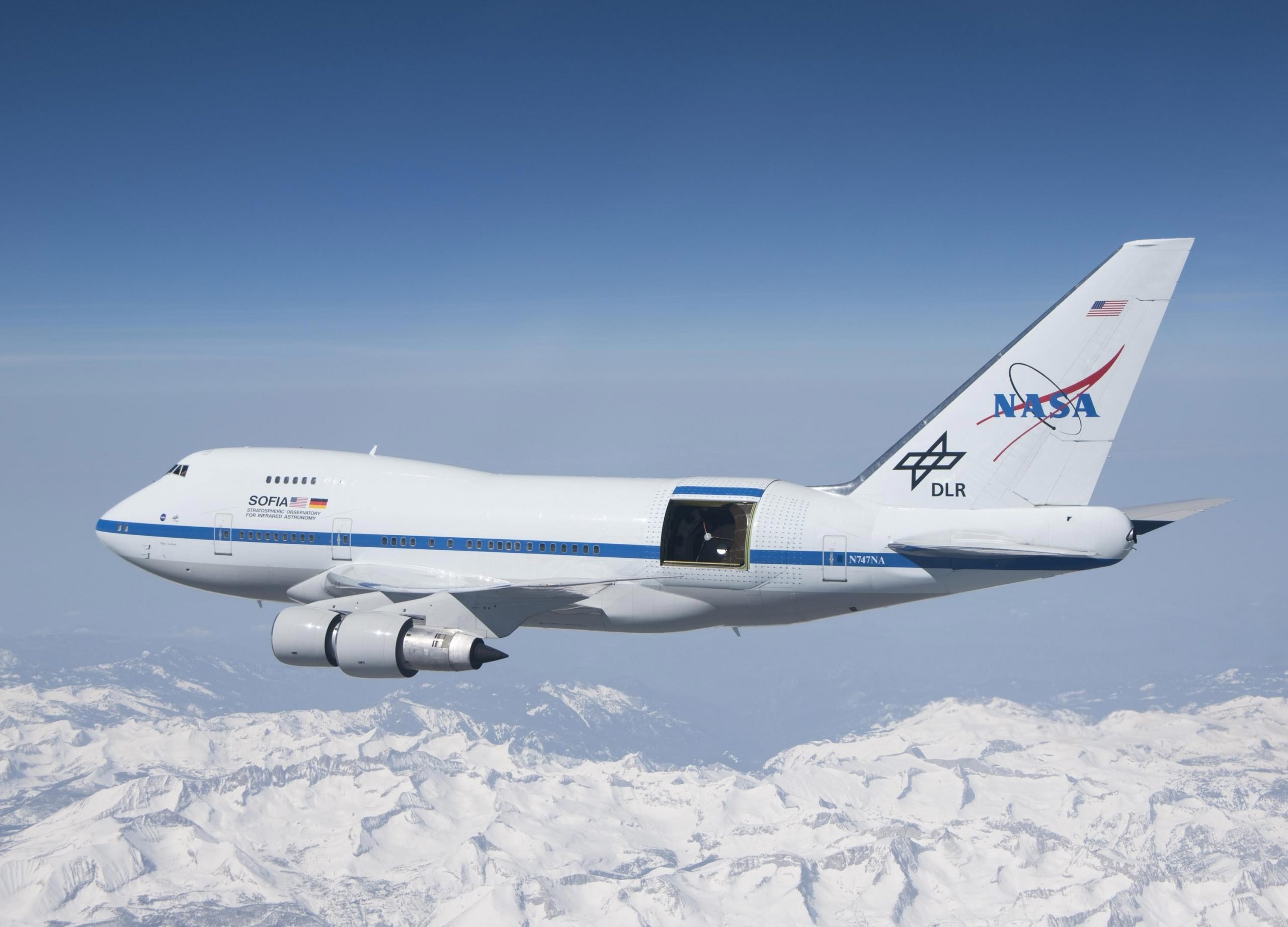
SOFIA is a joint project of NASA and the German Space Agency at DLR. DLR provides the telescope, scheduled aircraft maintenance, and other support for the mission. NASA’s Ames Research Center in California’s Silicon Valley manages the SOFIA program, science, and mission operations in cooperation with the Universities Space Research Association, headquartered in Columbia, Maryland, and the German SOFIA Institute at the University of Stuttgart. The aircraft is maintained and operated by NASA’s Armstrong Flight Research Center Building 703, in Palmdale, California.
Never miss a breakthrough: Join the SciTechDaily newsletter.
Follow us on Google and Google News.
1 Comment
This is closer to the truth. Stars are born in the center of the galaxy, but not from dust and gas, but are synthesized in the quark center of the galaxy, which was once mistakenly called a black hole.
https://www.youtube.com/watch?v=tFUM3vAlaGc