
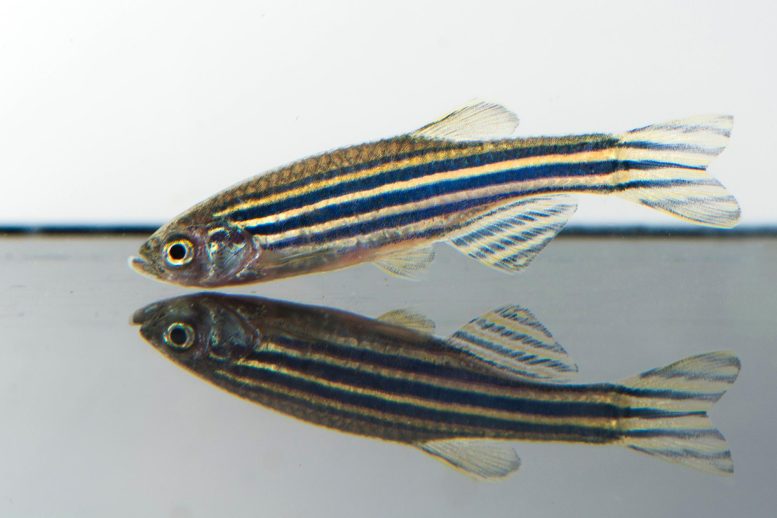
Scientists from the RIKEN Center for Brain Science (CBS) and collaborators in Japan have discovered particular neurons in the brain that monitor whether predictions made by fish actually come true. By making use of a new virtual reality-outfitted aquarium where brain imaging of zebrafish can be done as they learn and navigate through virtual reality cues, researchers found neurons that allow efficient risk avoidance and create a “hazard map” in the brain that allows for escape to safety.
Predicting the future is an integral part of decision-making for fish and humans alike. When real situations do not match expectations, the brain generates “prediction errors,” which let us know that our expectations were off. Expectations are formed by internal models of the environment, and just like people, the new study found that fish have such models in their brains. The researchers monitored prediction-error associated brain activity in real-time as zebrafish learned to avoid danger in their tank. They found that the fish tried to keep the prediction error low to efficiently avoid danger. Because risk avoidance is an evolutionarily conserved behavior, these results shed light on important brain circuits that are shared across all vertebrates, including humans.
Schematic of the setup. Tail movements made by the fish were analyzed in real-time and the scene projected the fish was adjusted accordingly to make them feel like they were swimming. Manipulating the virtual reality allowed researchers to record brain activity related to prediction error — when reality doesn’t match what is predicted or expected.
Zebrafish are small and transparent, which makes it easy to record the activity of the whole brain. In the experiment, the fish saw a choice between red or blue virtual reality zones as they virtually swam and learned to associate the colors of the virtual zones with danger or safety. The researchers were particularly interested in a front part of the brain called the telencephalon, which corresponds to the cerebral cortex and other structures in mammals, and which contributes to decision-making. As zebrafish learned to avoid danger in virtual reality, the time-lapse change in their brain activity was recorded, leading to the discovery of neurons that represent the prediction error.
Neurons That Encode Behavioral Rules, Not Just Colors
Distinct active populations of neurons emerged as fish started to learn that choosing the virtual route through blue surroundings led to danger and choosing the red route meant safety. Later, an experimental reversal of the association, in which red became dangerous instead of blue, led to an inactivation of these neurons. This told the researchers that the neurons were likely coding a behavioral rule, not simply the color that the fish were seeing. In another change to the virtual reality space, the scenery was altered so that it did not change based on the tail movements of the fish. For example, trying to swim forwards by flipping the tail did not make the view recede as expected. These manipulations revealed a group of neurons that was activated only when actions the fish thought would allow them to reach safety did not have the expected result. “We think this population of neurons is encoding a prediction error in the brain, comparing the actual view of their surroundings with the predicted view that they have learned would get them to safety if they behaved in a certain way,” says lead author Makio Torigoe.
“Every animal has to make predictions for its future based on what it has learned before,” adds research team leader Hitoshi Okamoto. “Now we know how these predictions are compared to what animals actually encounter in the world, and which parts of the zebrafish brain drive the subsequent decision-making.”
Reference: “Zebrafish capable of generating future state prediction error show improved active avoidance behavior in virtual reality” by Makio Torigoe, Tanvir Islam, Hisaya Kakinuma, Chi Chung Alan Fung, Takuya Isomura, Hideaki Shimazaki, Tazu Aoki, Tomoki Fukai and Hitoshi Okamoto, 29 September 2021, Nature Communications.
DOI: 10.1038/s41467-021-26010-7
Never miss a breakthrough: Join the SciTechDaily newsletter.
Follow us on Google and Google News.
1 Comment
Exelent Experiment Day did som 17 with Gills tetraciclin