
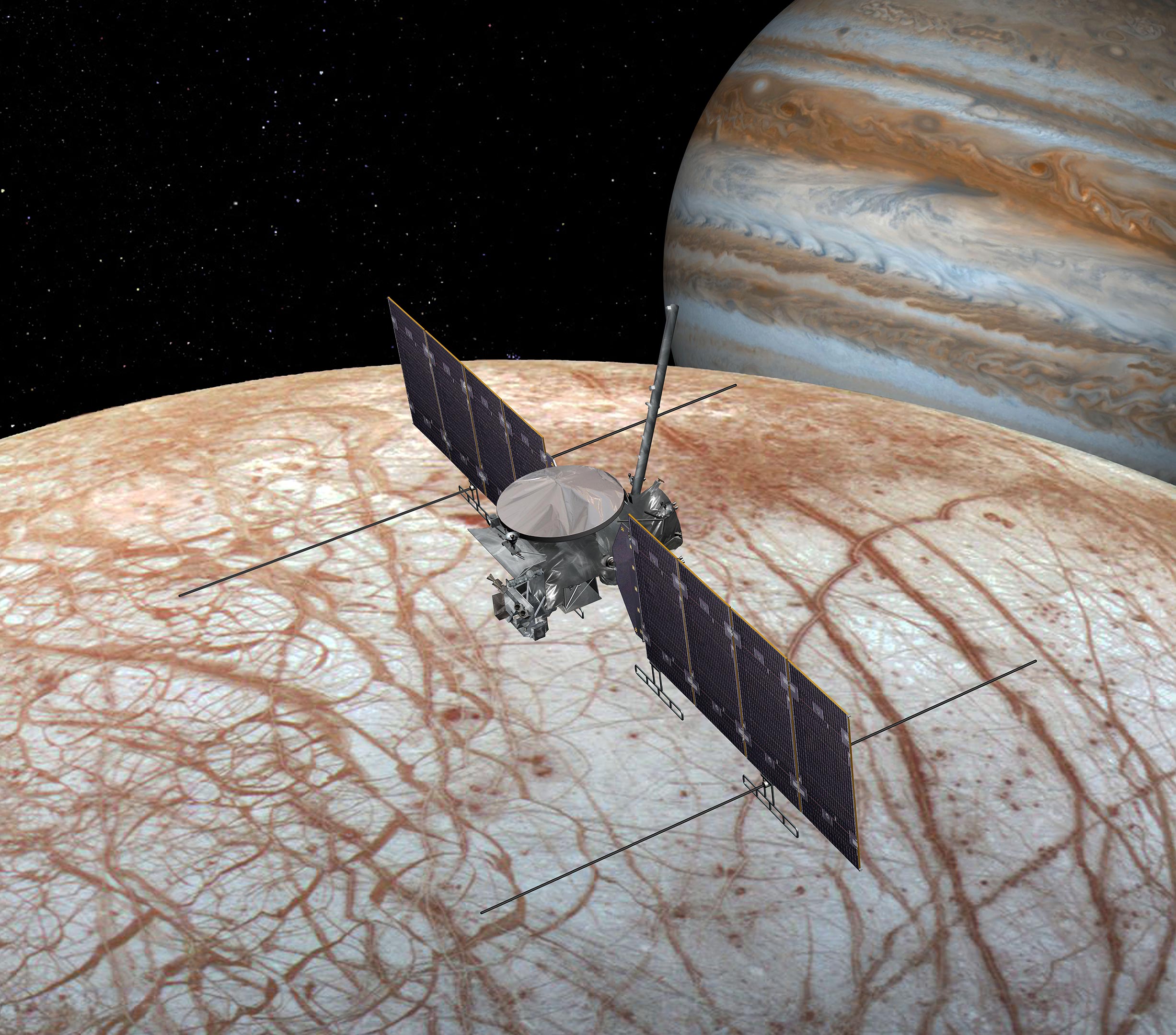
The science performed by the complex suite of instruments recently added to the Europa Clipper spacecraft will reveal whether Jupiter’s moon Europa has conditions that could support life.
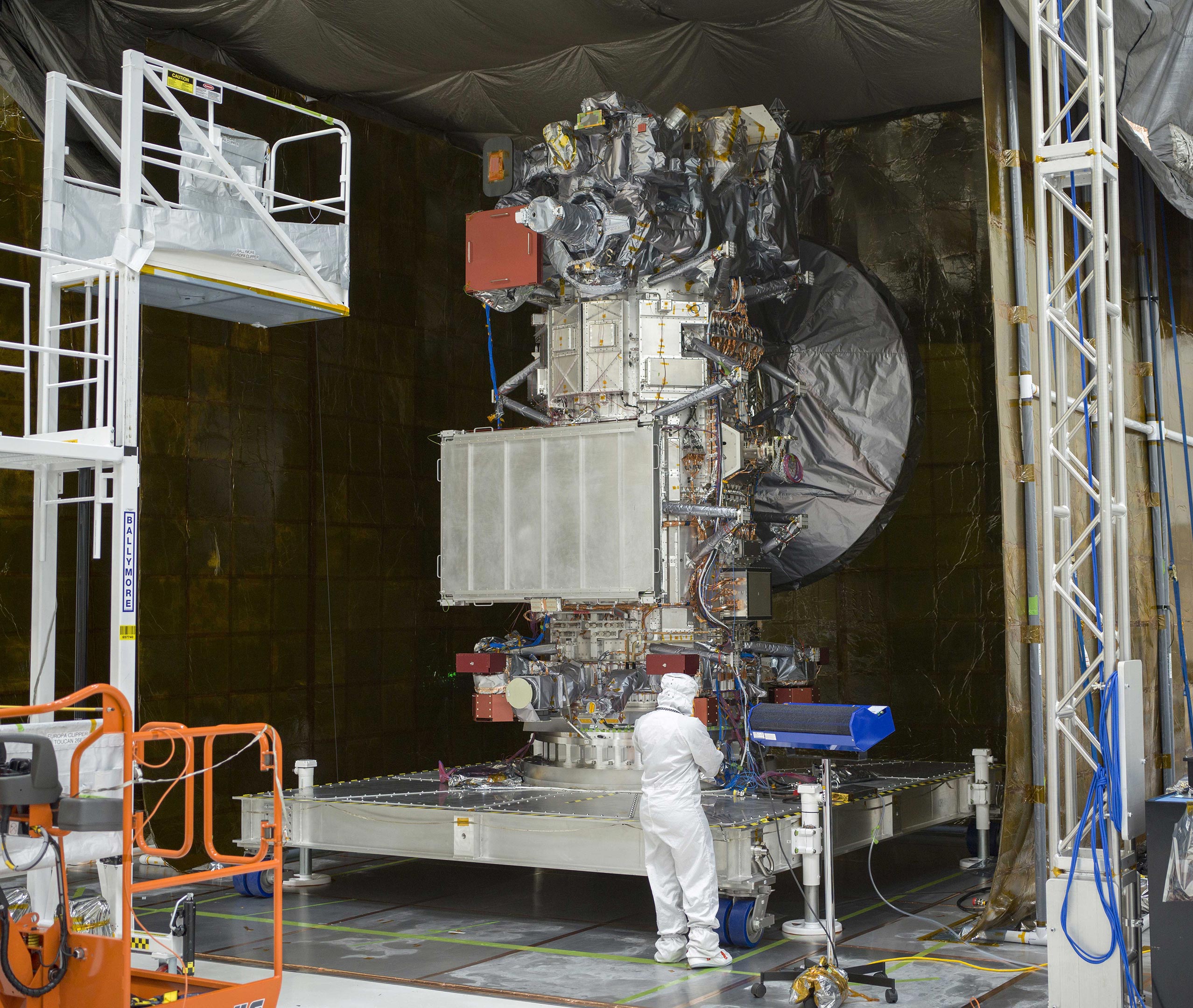
With less than nine months remaining in the countdown to launch, NASA’s Europa Clipper mission has passed a major milestone: Its science instruments have been added to the massive spacecraft, which is being assembled at the agency’s Jet Propulsion Laboratory in Southern California.
Set to launch from Kennedy Space Center in Florida in October, the spacecraft will head to Jupiter’s ice-encased moon Europa, where a salty ocean beneath the frozen surface may hold conditions suitable for life. Europa Clipper won’t be landing; rather, after arriving at the Jupiter system in 2030, the spacecraft will orbit Jupiter for four years, performing 49 flybys of Europa and using its powerful suite of nine science instruments to investigate the moon’s potential as a habitable environment.
Scientific Instruments and Investigation
“The instruments work together hand in hand to answer our most pressing questions about Europa,” said JPL’s Robert Pappalardo, the mission’s project scientist. “We will learn what makes Europa tick, from its core and rocky interior to its ocean and ice shell to its very thin atmosphere and the surrounding space environment.”
Credit: NASA/JPL-Caltech
The hallmark of Europa Clipper’s science investigation is how all of the instruments will work in sync while collecting data to accomplish the mission’s science objectives. During each flyby, the fully array of instruments will gather measurements and images that will be layered together to paint the full picture of Europa.
“The science is better if we obtain the observations at the same time,” Pappalardo said. “What we’re striving for is integration, so that at any point we are using all the instruments to study Europa at once and there is no need to have to trade off among them.”
In-depth Study of Europa’s Environment
By studying the environment around Europa, scientists will learn more about the moon’s interior. The spacecraft carries a magnetometer to measure the magnetic field around the moon. That data will be key to understanding the ocean, because the field is created, or induced, by the electrical conductivity of the ocean’s saltwater as Europa moves through Jupiter’s strong magnetic field. Working in tandem with the magnetometer is an instrument that will analyze the plasma (charged particles) around Europa, which can distort magnetic fields. Together, they’ll ensure the most accurate measurements possible.
What the mission discovers about Europa’s atmosphere will also lend insights into the moon’s surface and interior. While the atmosphere is faint, with only 100 billionth the pressure of Earth’s atmosphere, scientists expect that it holds a trove of clues about the moon. They have evidence from space- and ground-based telescopes that there may be plumes of water vapor venting from beneath the moon’s surface, and observations from past missions suggest that ice and dust particles are being ejected into space by micrometeorite impacts.
Three instruments will help investigate the atmosphere and its associated particles: A mass spectrometer will analyze gases, a surface dust analyzer will examine dust, and a spectrograph will collect ultraviolet light to search for plumes and identify how the properties of the dynamic atmosphere change over time.
Surface Exploration and Ice Shell Analysis
All the while, Europa Clipper’s cameras will be taking wide- and narrow-angle pictures of the surface, providing the first high-resolution global map of Europa. Stereoscopic, color images will reveal any changes in the surface from geologic activity. A separate imager that measures temperatures will help scientists identify warmer regions where water or recent ice deposits may be near the surface.
An imaging spectrometer will map the ices, salts, and organic molecules on the moon’s surface. The sophisticated set of imagers will also support the full instrument suite by collecting visuals that will provide context for the set of data collected.
Of course, scientists also need a better understanding of the ice shell itself. Estimated to be about 10 to 15 miles (15 to 25 kilometers) thick, this outer casing may be geologically active, which could result in the fracture patterns that are visible at the surface. Using the radar instrument, the mission will study the ice shell, including searching for water within and beneath it. (The instrument’s electronics are now aboard the spacecraft, while its antennas will be mounted to the spacecraft’s solar arrays at Kennedy later this year.)
Finally, there’s Europa’s interior structure. To learn more about it, scientists will measure the moon’s gravitational field at various points in its orbit around Jupiter. Observing how signals transmitted from the spacecraft are tugged on by Europa’s gravity can tell the team more about the moon’s interior. Scientists will use the spacecraft’s telecommunications equipment for this science investigation.
With all nine instruments and the telecommunications system aboard the spacecraft, the mission team has begun testing the complete spacecraft for the first time. Once Europa Clipper is fully tested, the team will ship the craft to Kennedy in preparation for launch on a SpaceX Falcon Heavy rocket.
Mission Overview and Goals
Europa Clipper’s main science goal is to determine whether there are places below Jupiter’s icy moon, Europa, that could support life. The mission’s three main science objectives are to determine the thickness of the moon’s icy shell and its surface interactions with the ocean below, to investigate its composition, and to characterize its geology. The mission’s detailed exploration of Europa will help scientists better understand the astrobiological potential for habitable worlds beyond our planet.
Never miss a breakthrough: Join the SciTechDaily newsletter.
Follow us on Google and Google News.