
Close Menu
    Facebook X (Twitter) Instagram
    SciTechDaily
    • Biology
    • Chemistry
    • Earth
    • Health
    • Physics
    • Science
    • Space
    • Technology
    Facebook X (Twitter) Pinterest YouTube RSS
    SciTechDaily
    Home»Space»NASA’s Cosmic Vision: Simulating Our Galaxy Through Gravitational Waves
    Space

    NASA’s Cosmic Vision: Simulating Our Galaxy Through Gravitational Waves

    By Francis Reddy, NASA’s Goddard Space Flight CenterSeptember 24, 20232 Comments4 Mins Read
    Facebook Twitter Pinterest Telegram LinkedIn WhatsApp Email Reddit
    Share
    Facebook Twitter LinkedIn Pinterest Telegram Email Reddit
    Gravitational Waves Galaxy Concept Art
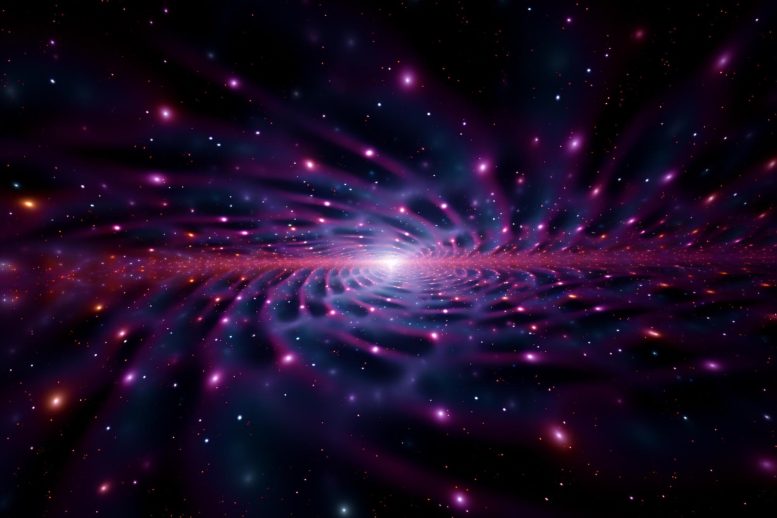
    Using simulated data, astronomers have depicted the sky through gravitational waves, revealing the need for space observatories to detect binary systems. Future projects like LISA aim to uncover thousands of these hard-to-detect systems, marking a paradigm shift in space observation. (Artist’s illustration — see video below for simulation.)

    A simulated all-sky gravitational wave view previews how LISA will detect thousands of ultra-compact binaries in the Milky Way.

    Astronomers using simulated data have produced a glimpse of the sky as it would appear in gravitational waves, cosmic ripples in space-time generated by orbiting objects. The image shows how space-based gravitational wave observatories expected to launch in the next decade will enhance our understanding of our galactic home.

    Since 2015, ground-based observatories have detected about a hundred events representing the mergers of systems that pair stellar-mass black holes, neutron stars, or both. The signals typically last less than a minute, have relatively high frequencies, can appear anywhere in the sky, and their sources lie far beyond our galaxy.


    Watch as gravitational waves from a simulated population of compact binary systems combine into a synthetic map of the entire sky. Such systems contain white dwarfs, neutron stars, or black holes in tight orbits. Maps like this using real data will be possible once space-based gravitational wave observatories become active in the next decade. Brighter spots indicate sources with stronger signals and lighter colors indicate those with higher frequencies. Larger colored patches show sources whose positions are less well known. The inset shows the frequency and strength of the gravitational signal, as well as the sensitivity limit for LISA (Laser Interferometer Space Antenna), an observatory now being designed by ESA (European Space Agency) in collaboration with NASA for launch in the 2030s. Credit: NASA’s Goddard Space Flight Center

    “Binary systems also fill the Milky Way, and we expect many of them to contain compact objects like white dwarfs, neutron stars, and black holes in tight orbits,” said Cecilia Chirenti, a researcher at the University of Maryland, College Park, and NASA’s Goddard Space Flight Center in Greenbelt, Maryland. “But we need a space observatory to ‘hear’ them because their gravitational waves hum at frequencies too low for ground-based detectors.”

    Astronomers call these systems UCBs (ultra-compact binaries), and they expect that future observatories like LISA (Laser Interferometer Space Antenna), which is led by ESA (European Space Agency) in collaboration with NASA, will detect tens of thousands of them. UCBs are typically difficult to spot – they are usually faint in visible light, and astronomers currently know of only a handful with orbital periods shorter than an hour. Discovering many new UCBs is one of LISA’s main objectives.
    LISA Pathfinder in Space
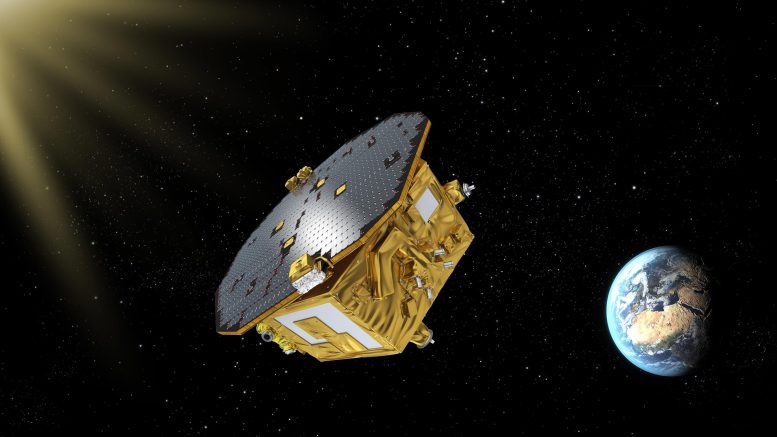
    Artist’s impression of LISA Pathfinder, ESA’s mission to test technology for future gravitational-wave observatories in space. LISA is a space-based gravitational wave observatory building on the success of LISA Pathfinder and LIGO. Credit: ESA–C.Carreau

    Using data simulating the expected distribution and gravitational wave signals of these systems, the team developed a way to combine the data into an all-sky view of the galaxy’s UCBs. A paper published in The Astronomical Journal describes the technique.

    “Our image is directly analogous to an all-sky view of the sky in a particular type of light, such as visible, infrared, or X-rays,” said Goddard astrophysicist Ira Thorpe. “The promise of gravitational waves is that we can observe the universe in a totally different way, and this image really brings that home. I hope one day I can see a version made with real LISA data on a poster or T-shirt.”

    Reference: “Imaging the Milky Way with Millihertz Gravitational Waves” by Kaitlyn Szekerczes, Scott Noble, Cecilia Chirenti and James Ira Thorpe, 15 June 2023, The Astronomical Journal.
    DOI: 10.3847/1538-3881/acd3f1/meta

    Never miss a breakthrough: Join the SciTechDaily newsletter.
    Follow us on Google and Google News.

    Astronomy Astrophysics Gravitational Waves NASA NASA Goddard Space Flight Center Popular
    Share. Facebook Twitter Pinterest LinkedIn Email Reddit

    Related Articles

    Cyclones in Space? See How Hubble Uncovered Extreme Weather on a Distant Planet

    Cosmic Cinema: NASA Unveils Stunning 14-Year Time-Lapse of the Gamma-Ray Sky

    NASA’s Webb Telescope Discovers Record-Breaking Miniature Brown Dwarf

    Hidden Wonders: Webb Space Telescope Detects Unexplained Structures in Heart of Milky Way

    Webb’s Window Into Cosmic Birth: Ice Pebble Drift Sparks Planetary Life

    Galactic Collision Captured in Stunning Detail: NASA’s Webb & Hubble Unite To Create Most Colorful View of Universe

    Cosmic Alchemy: Webb’s First Glimpse Into Heavy Element Creation

    Microlensing Magic: How NASA’s Roman Telescope Will Illuminate the Milky Way’s Mysteries

    Billions of Cosmic Objects: NASA’s Roman Space Telescope Prepares for Torrent of Future Data

    2 Comments

    1. Neeraja on September 26, 2023 1:11 am

      Light and sound Important for gravitational.
      Sound system means positive.
      My sense only.
      Light number of color combinations of enargy.

      Reply
    2. Ralph Johnson on September 26, 2023 6:30 am

      A fundamental piece of the universal puzzle.

      Reply
    Leave A Reply Cancel Reply

    • Facebook
    • Twitter
    • Pinterest
    • YouTube

    Don't Miss a Discovery

    Subscribe for the Latest in Science & Tech!

    Trending News

    Largest-Ever Study Finds Medicinal Cannabis Ineffective for Anxiety, Depression, PTSD

    250-Million-Year-Old Egg Solves One of Evolution’s Biggest Mysteries

    Living With Roommates Might Be Changing Your Gut Microbiome Without You Knowing

    Century-Old Cleaning Chemical Linked to 500% Increased Risk of Parkinson’s Disease

    What if Your Memories Never Happened? Physicists Take a New Look at the Boltzmann Brain Paradox

    One of the Universe’s Largest Stars May Be Getting Ready To Explode

    Scientists Discover Enzyme That Could Supercharge Ozempic-Like Weight Loss Drugs

    Popular Sweetener Linked to DNA Damage – “It’s Something You Should Not Be Eating”

    Follow SciTechDaily
    • Facebook
    • Twitter
    • YouTube
    • Pinterest
    • Newsletter
    • RSS
    SciTech News
    • Biology News
    • Chemistry News
    • Earth News
    • Health News
    • Physics News
    • Science News
    • Space News
    • Technology News
    Recent Posts
    • Challenging the Narrative: New Study Shows U.S. Life Expectancy Is Rising Across All States
    • Mystery Illness Kills 5 in Burundi As Doctors Scramble for Answers
    • Bone-Strengthening Discovery Could Reverse Osteoporosis
    • The Most Elusive Number in Physics Just Got Even More Mysterious
    • Scientists Uncover Hidden Trigger Behind Stem Cell Aging
    Copyright © 1998 - 2026 SciTechDaily. All Rights Reserved.
    • Science News
    • About
    • Contact
    • Editorial Board
    • Privacy Policy
    • Terms of Use

    Type above and press Enter to search. Press Esc to cancel.