
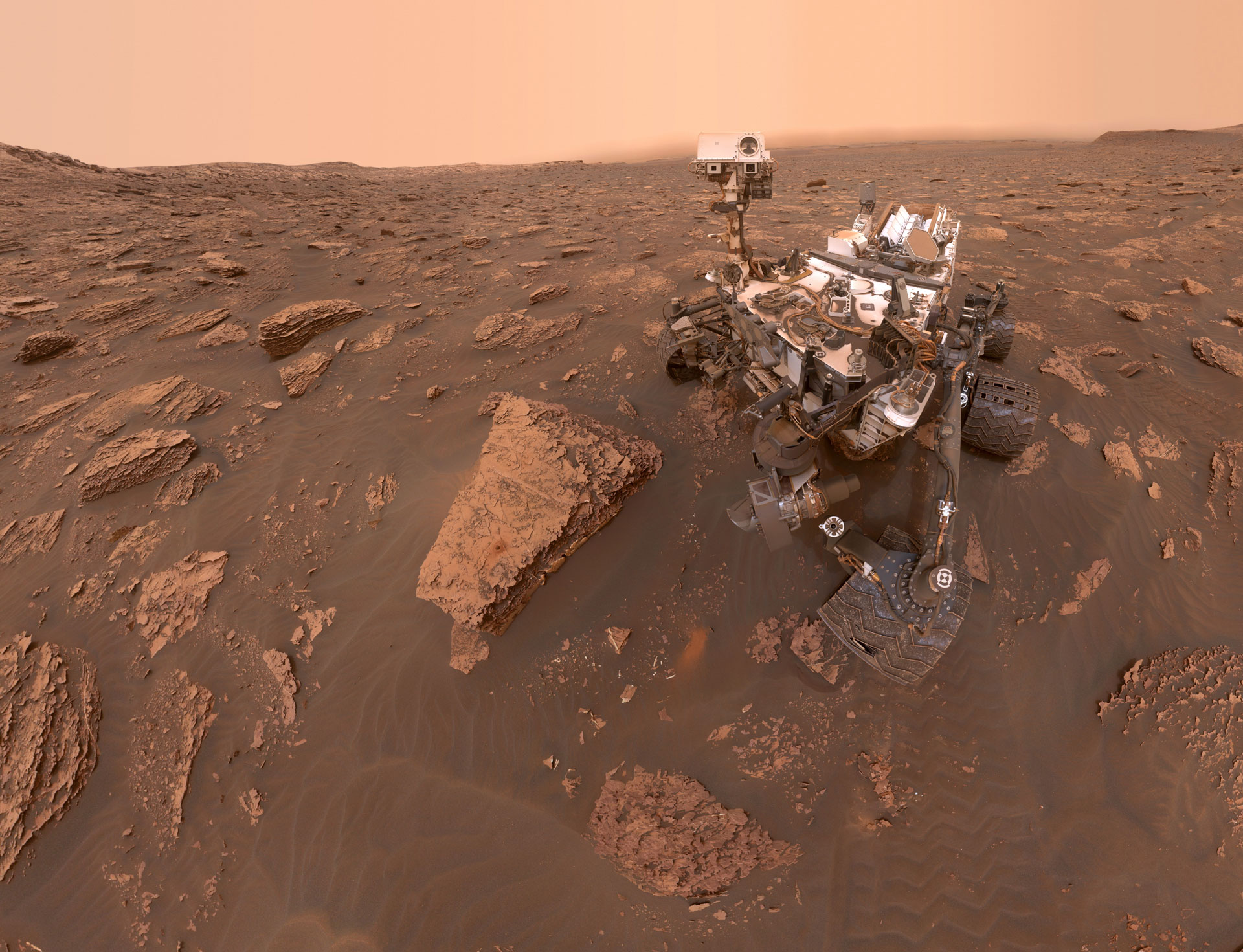
A new scientific investigation suggests that known non-biological processes may not be enough to explain the amount of organic material discovered in a Martian rock sample collected by NASA’s Curiosity rover. Organic compounds are molecules built around carbon atoms. On Earth, carbon-based chemistry forms the foundation of life, although some organic molecules can also arise through nonliving chemical reactions.
Curiosity, which has been exploring Gale Crater since 2012, carries a compact chemistry laboratory known as SAM, short for Sample Analysis at Mars. This instrument heats drilled rock powder and studies the gases that are released, allowing scientists to identify different molecules trapped inside.
Largest Organic Compounds Yet Found on Mars
In March 2025, researchers announced they had detected small quantities of decane, undecane, and dodecane in a rock sample analyzed onboard the rover. These hydrocarbons, which consist only of carbon and hydrogen, are the largest organic molecules ever identified on Mars.
Scientists believe these compounds may be fragments of fatty acids that were preserved in ancient mudstone in Gale Crater. Mudstone forms from fine sediment that once settled in water, suggesting that the area may have hosted lakes billions of years ago. On Earth, fatty acids are essential components of cell membranes and are most often produced by living organisms, although certain geological processes can generate similar molecules under the right conditions.
Testing Non Biological Sources Such as Meteorites
Curiosity’s instruments can detect and measure molecules, but they cannot determine whether those molecules were created by life. Because of that limitation, researchers launched a follow-up study to examine whether non-biological sources could explain the findings.
One possibility is that meteorites delivered organic compounds to the Martian surface. Meteorites are known to contain carbon-rich materials, and Mars has experienced frequent impacts throughout its history. Scientists evaluated whether this type of external delivery, along with other abiotic chemical reactions, could account for the levels of organic compounds measured in the rock.
In a February 4 article in the journal Astrobiology, the team reported that the non-biological sources they analyzed could not fully account for the observed abundance of organic material. Based on these results, they say it is reasonable to consider the hypothesis that living organisms may have contributed to producing the molecules.
Reconstructing 80 Million Years of Radiation Exposure
To better understand how much organic material may have originally been present, the researchers combined laboratory radiation experiments with computer simulations and Curiosity’s data. Mars lacks a thick atmosphere and global magnetic field like Earth, leaving its surface exposed to cosmic radiation. Over long periods of time, this radiation can gradually break down complex molecules.
The team attempted to “rewind the clock” by about 80 million years, which is the estimated length of time the rock has been exposed at the Martian surface. By modeling how radiation would have destroyed organic compounds over that span, they estimated how much material would have existed before degradation occurred. Their calculations indicate that the original quantity was likely much greater than what standard non-biological processes are known to produce.
More Research Needed Before Conclusions About Life
The researchers caution that additional studies are required to determine how quickly organic molecules decay in Mars-like rock under Mars-like environmental conditions. Better laboratory simulations will help refine these estimates.
For now, the findings do not confirm past life on Mars. Instead, they highlight that the chemical story preserved in Martian rocks may be more complex than previously understood, and that non-living explanations alone may not fully solve the mystery.
Reference: “Does the Measured Abundance Suggest a Biological Origin for the Ancient Alkanes Preserved in a Martian Mudstone?” by Alexander A. Pavlov, Caroline Freissinet, Daniel P. Glavin, Christopher H. House, Jennifer C. Stern, Amy C. McAdam, Anais Roussel, Jason P. Dworkin, Luoth Chou, Andrew Steele, Paul R. Mahaffy, Denise Buckner and Felipe Gomez, 15 July 2025, Astrobiology.
DOI: 10.1177/15311074261417879
Never miss a breakthrough: Join the SciTechDaily newsletter.
Follow us on Google and Google News.