
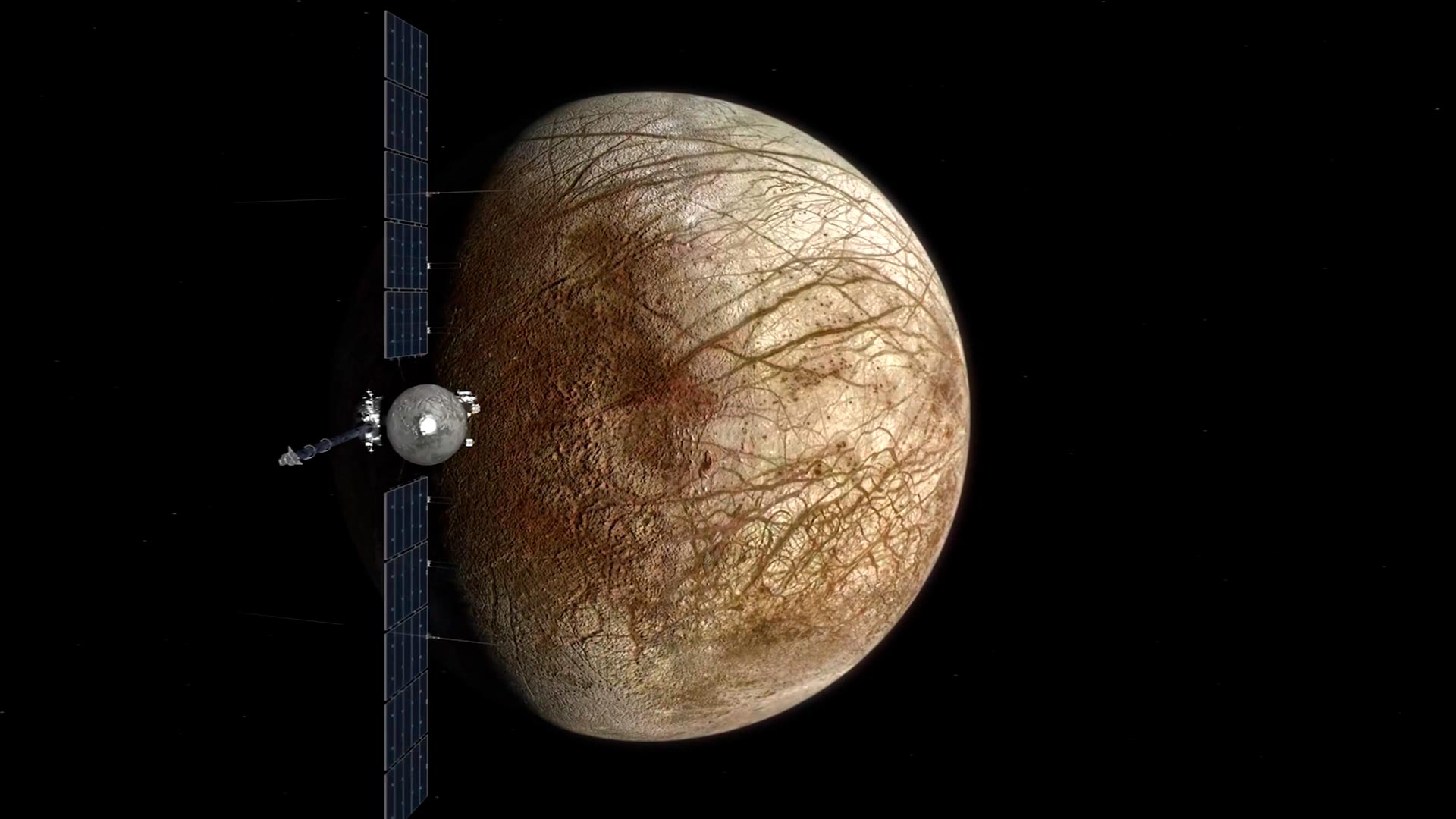
NASA’s Europa Clipper is well on its way to Jupiter’s icy moon, Europa, set to arrive in 2030. While its science instruments remain dormant for now, its star trackers are actively working, snapping images of distant stars to help orient the spacecraft.
These starfield images, which include the constellation Corvus, are crucial for navigation and ensuring the spacecraft can correctly align its antennas and instruments.
Star Trackers: A Cosmic Compass
Three months after launching from NASA’s Kennedy Space Center in Florida, the Europa Clipper spacecraft still has 1.6 billion miles (2.6 billion kilometers) to travel before reaching Jupiter’s orbit in 2030. Once there, it will use its scientific cameras to capture detailed images of Europa, the planet’s icy moon.
But even as it makes its long journey, another set of cameras is already at work. These cameras, known as star trackers, don’t take pictures for research — they help the spacecraft navigate. By capturing images of stars and using them as reference points, the star trackers determine the spacecraft’s precise orientation. This is essential for keeping its antennas aligned with Earth to ensure smooth communication.
First Glimpse of Space
In early December, the star trackers captured and transmitted Europa Clipper’s first images from deep space (see below). The composite image, made up of three snapshots, reveals faint pinpricks of light from stars located 150 to 300 light-years away. Though the image represents just 0.1% of the sky surrounding the spacecraft, this small starfield provides enough data for the orbiter to confirm its orientation.
Among the stars in the image are the four brightest in the constellation Corvus — Gienah, Algorab, Kraz, and Alchiba. Corvus, meaning “crow” in Latin, is linked to Apollo in Greek mythology.

Hardware Checkout: Ensuring a Smooth Mission
Besides being interesting to stargazers, the photos signal the successful checkout of the star trackers. The spacecraft checkout phase has been going on since Europa Clipper launched on a SpaceX Falcon Heavy rocket on October 14, 2024.
“The star trackers are engineering hardware and are always taking images, which are processed on board,” said Joanie Noonan of NASA’s Jet Propulsion Laboratory in Southern California, who leads the mission’s guidance, navigation and control operations. “We usually don’t downlink photos from the trackers, but we did in this case because it’s a really good way to make sure the hardware — including the cameras and their lenses — made it safely through launch.”

Preparing for Europa’s Close-Ups
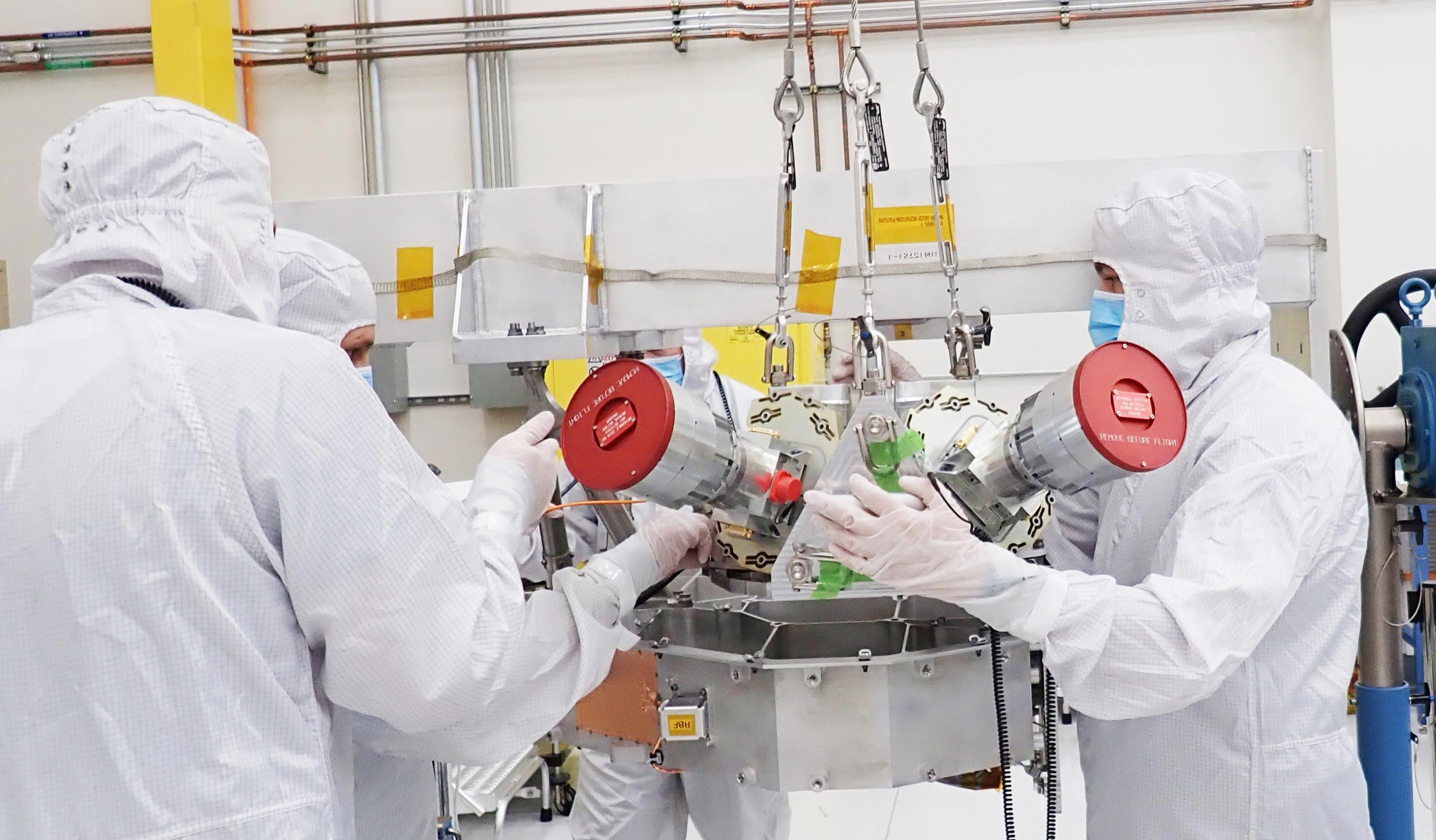
Pointing the spacecraft correctly is not about navigation, which is a separate operation. But orientation using the star trackers is critical for telecommunications as well as for the science operations of the mission. Engineers need to know where the science instruments are pointed. That includes the sophisticated Europa Imaging System (EIS), which will collect images that will help scientists map and examine the moon’s mysterious fractures, ridges, and valleys. For at least the next three years, EIS has its protective covers closed.
Europa Clipper carries nine science instruments, plus the telecommunications equipment that will be used for a gravity science investigation. During the mission’s 49 flybys of Europa, the suite will gather data that will tell scientists if the icy moon and its internal ocean have the conditions to harbor life.
The spacecraft already is 54 million miles (85 million kilometers) from Earth, zipping along at 17 miles per second (27 kilometers per second) relative to the Sun, and soon will fly by Mars. On March 1, engineers will steer the craft in a loop around the Red Planet, using its gravity to gain speed.
More About Europa Clipper
Europa Clipper is NASA’s ambitious mission to explore Jupiter’s moon Europa, a world believed to harbor a vast subsurface ocean beneath its icy crust. Set to arrive in Jupiter’s orbit in 2030, the spacecraft will conduct detailed flybys of Europa to investigate its potential for supporting life.
The mission has three primary science objectives: determining the thickness of the moon’s ice shell and its interaction with the ocean below, analyzing Europa’s composition, and characterizing its surface geology. By studying these aspects, scientists aim to better understand Europa’s habitability and the broader potential for life beyond Earth.
Europa Clipper is a collaborative effort led by NASA’s Jet Propulsion Laboratory (JPL) in partnership with the Johns Hopkins Applied Physics Laboratory (APL) and several NASA centers, including Goddard, Marshall, and Langley. APL designed the spacecraft body, while NASA’s Kennedy Space Center oversaw the launch. Managed under NASA’s Planetary Missions Program, Europa Clipper represents a major step forward in the search for extraterrestrial life in our solar system.
Never miss a breakthrough: Join the SciTechDaily newsletter.
Follow us on Google and Google News.
1 Comment
New Horizons provided the first starfield images from deep space a couple of years ago. From 2020: https://www.space.com/nasa-new-horizons-star-shift-parallax-photos.html