

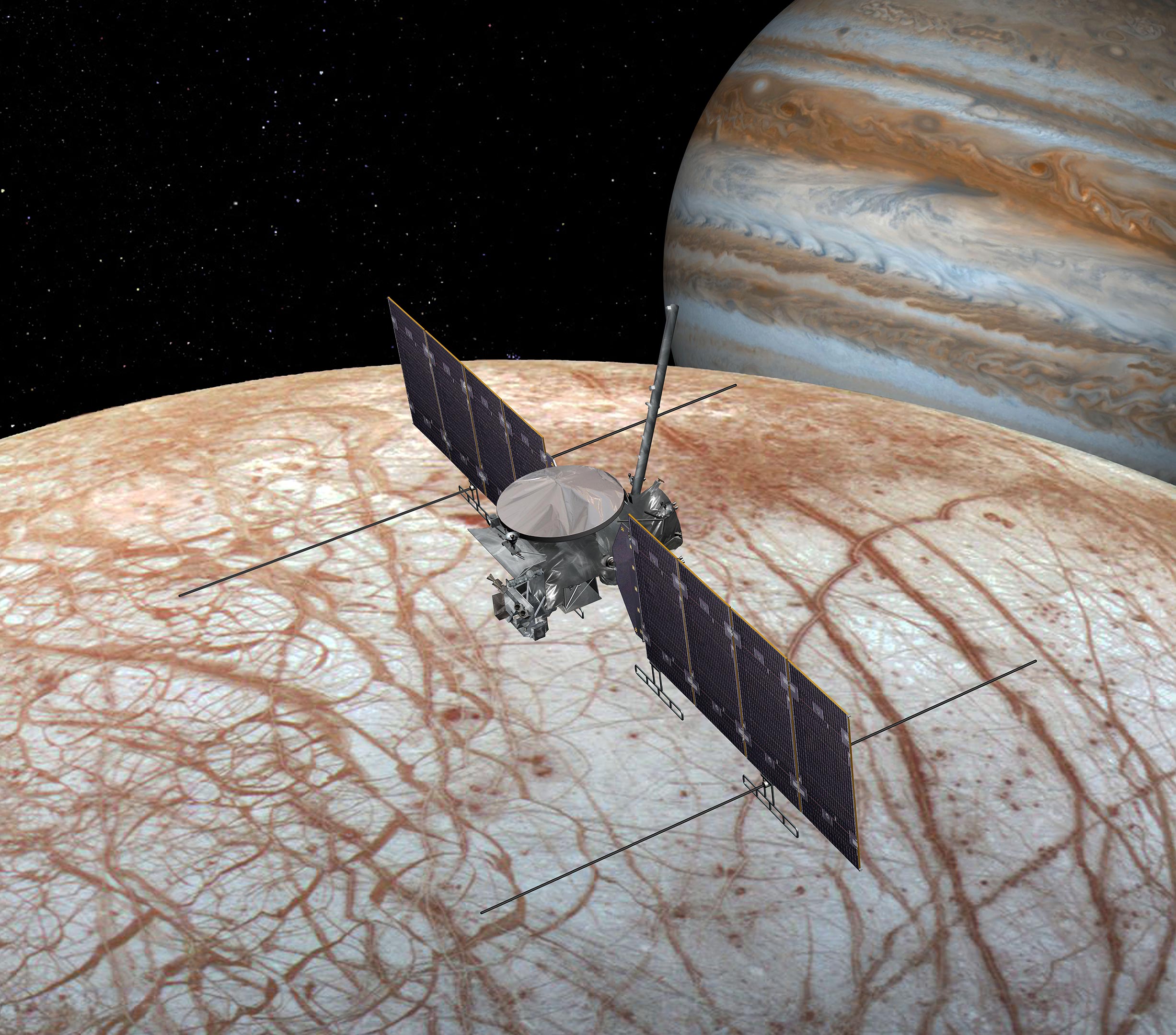
NASA’s Europa Clipper is on a mission to uncover whether Jupiter’s frozen moon Europa could harbor life. But before reaching its distant target, the spacecraft will slingshot around Mars, borrowing its gravity to gain momentum for the long trek into deep space.
On March 1, NASA’s Europa Clipper will pass just 550 miles (884 kilometers) above Mars, using the planet’s gravity to adjust its course toward Jupiter’s moon, Europa. This maneuver, known as a gravity assist, will help fine-tune the spacecraft’s trajectory without using extra fuel. As an added bonus, mission scientists will take this opportunity to test the probe’s radar instrument and thermal imager.
At 12:57 p.m. EST, Europa Clipper will make its closest approach to Mars, moving at 15.2 miles per second (24.5 kilometers per second) relative to the Sun. The Red Planet’s gravity will slow the spacecraft down slightly over the course of 24 hours, reshaping its orbit. After the flyby, Europa Clipper will continue on its journey, now traveling at 14 miles per second (22.5 kilometers per second).
Next Stop: Earth for Another Boost
The flyby sets up Europa Clipper for its second gravity assist — a close encounter with Earth in December 2026 that will act as a slingshot and give the spacecraft a velocity boost. After that, it’s a straightforward trek to the outer solar system; the probe is set to arrive at Jupiter’s orbit in April 2030.
“We come in very fast, and the gravity from Mars acts on the spacecraft to bend its path,” said Brett Smith, a mission systems engineer at NASA’s Jet Propulsion Laboratory in Southern California. “Meanwhile, we’re exchanging a small amount of energy with the planet, so we leave on a path that will bring us back past Earth.”
Harnessing Gravity for Efficiency
Europa Clipper launched from Kennedy Space Center in Florida on October 14, 2024, via a SpaceX Falcon Heavy, embarking on a 1.8-billion-mile (2.9-billion-kilometer) trip to Jupiter, which is five times farther from the Sun than Earth is. Without the assists from Mars in 2025 and from Earth in 2026, the 12,750-pound (6,000-kilogram) spacecraft would require additional propellant, which adds weight and cost, or it would take much longer to get to Jupiter.
Gravity assists are baked into NASA’s mission planning, as engineers figure out early on how to make the most of the momentum in our solar system. Famously, the Voyager 1 and Voyager 2 spacecraft, which launched in 1977, took advantage of a once-in-a-lifetime planetary lineup to fly by the gas giants, harnessing their gravity and capturing data about them.
While navigators at JPL, which manages Europa Clipper and Voyager, have been designing flight paths and using gravity assists for decades, the process of calculating a spacecraft’s trajectory in relation to planets that are constantly on the move is never simple.
“It’s like a game of billiards around the solar system, flying by a couple of planets at just the right angle and timing to build up the energy we need to get to Jupiter and Europa,” said JPL’s Ben Bradley, Europa Clipper mission planner. “Everything has to line up — the geometry of the solar system has to be just right to pull it off.”
Fine-Tuning the Flight Path
Navigators sent the spacecraft on an initial trajectory that left some buffer around Mars so that if anything were to go wrong in the weeks after launch, Europa Clipper wouldn’t risk impacting the planet. Then the team used the spacecraft’s engines to veer closer to Mars’ orbit in what are called trajectory correction maneuvers, or TCMs.
Mission controllers have performed three TCMs to set the stage for the Mars gravity assist — in early November, late January, and on Feb. 14. They will conduct another TCM about 15 days after the Mars flyby to ensure the spacecraft is on track and are likely to conduct additional ones — upwards of 200 — throughout the mission, which is set to last until 2034.
Science Opportunity: Testing Instruments on Mars
While navigators are relying on the gravity assist for fuel efficiency and to keep the spacecraft on their planned path, scientists are looking forward to the event to take advantage of the close proximity to the Red Planet and test two of the mission’s science instruments.
About a day prior to the closest approach, the mission will calibrate the thermal imager, resulting in a multicolored image of Mars in the months following as the data is returned and scientists process the data. And near closest approach, they’ll have the radar instrument perform a test of its operations — the first time all its components will be tested together. The radar antennas are so massive, and the wavelengths they produce so long that it wasn’t possible for engineers to test them on Earth before launch.
More About Europa Clipper
NASA’s Europa Clipper is a flagship mission designed to explore Jupiter’s moon Europa, one of the most promising places in the solar system to search for signs of life. The spacecraft will conduct dozens of close flybys of Europa to investigate whether the moon has the necessary conditions to support life.
Europa Clipper’s three main science goals are to:
- Determine the thickness of Europa’s icy shell and how it interacts with the subsurface ocean.
- Study the moon’s surface and subsurface composition, including potential organic materials.
- Characterize the geology of the surface, such as ridges, fractures, and potential plumes.
These investigations will help scientists assess the habitability of Europa and expand our understanding of potentially life-supporting environments beyond Earth.
The mission is led by NASA’s Jet Propulsion Laboratory (JPL), managed by Caltech, in partnership with the Johns Hopkins Applied Physics Laboratory (APL). The spacecraft’s body was developed collaboratively by APL, JPL, and NASA centers including Goddard, Marshall, and Langley. NASA’s Planetary Missions Program Office at Marshall oversees mission execution, while the Launch Services Program at Kennedy Space Center managed the spacecraft’s launch.
Never miss a breakthrough: Join the SciTechDaily newsletter.
Follow us on Google and Google News.