

NASA’s Europa Clipper, en route to Jupiter’s moon Europa, captured infrared images of Mars during a gravity-assist flyby to calibrate its thermal imaging camera.
This crucial step ensures the spacecraft can accurately map heat signatures on Europa’s surface—key to identifying possible signs of life beneath its icy crust.
Europa Clipper’s Infrared Snapshot of Mars
As it cruised past Mars, NASA’s Europa Clipper snapped a stunning series of infrared images of the Red Planet. This wasn’t just a photo op. The data is being used to fine-tune the spacecraft’s heat-sensing camera, ensuring it’s working perfectly by the time Clipper reaches the Jupiter system in 2030.
The real target? Europa, one of Jupiter’s largest moons, where a vast global ocean lies hidden beneath a thick shell of ice. A year after arriving at Jupiter, Europa Clipper will begin flying past the moon again and again, 49 times in total, to find out if this icy world might actually support life.
One of the spacecraft’s most powerful tools will be thermal imaging. By scanning Europa’s surface and measuring temperature changes, Clipper will help scientists figure out how geologically active the moon is. Areas that are warmer than expected may point to recent or ongoing activity beneath the surface.

Hunting for Heat Along Europa’s Icy Fractures
Thermal data could also reveal where Europa’s hidden ocean comes closest to the surface. The moon is marked by long ridges and deep fractures, which many scientists believe are caused by ocean water moving beneath the ice and breaking through the crust.
“We want to measure the temperature of those features,” said Arizona State University’s Phil Christensen, principal investigator of Europa Clipper’s infrared camera, called the Europa Thermal Imaging System (E-THEMIS). “If Europa is a really active place, those fractures will be warmer than the surrounding ice where the ocean comes close to the surface. Or if water erupted onto the surface hundreds to thousands of years ago, then those surfaces could still be relatively warm.”
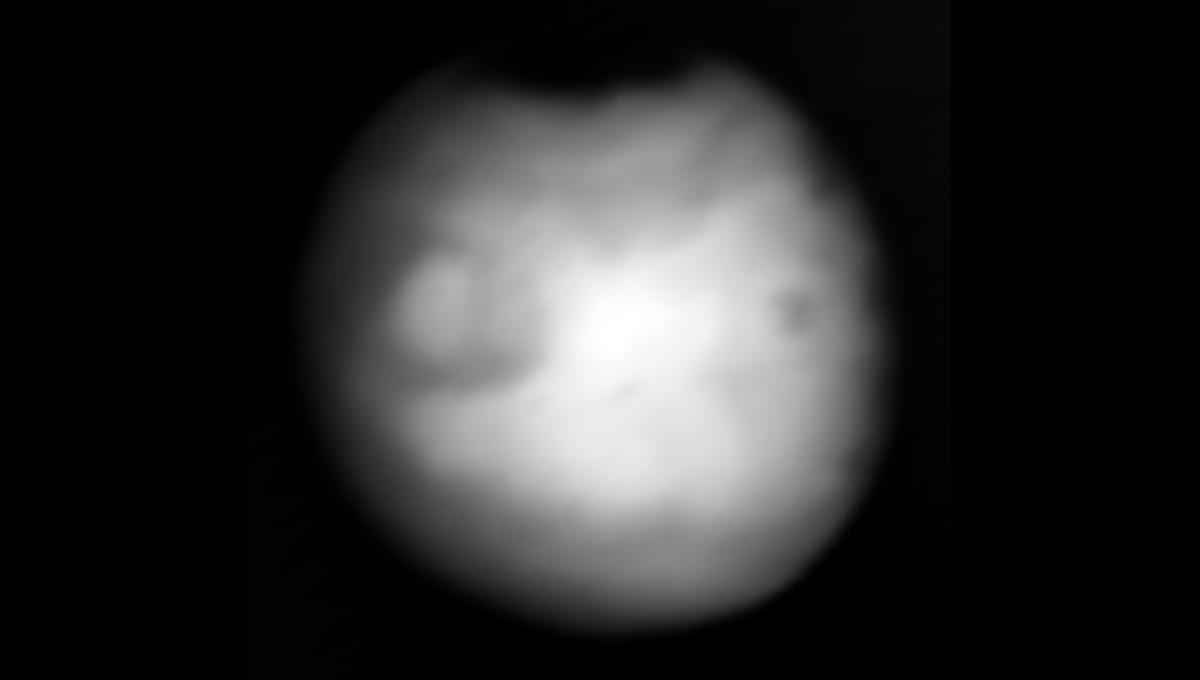
Why NASA Chose Mars for Testing
On March 1, Europa Clipper flew just 550 miles (884 kilometers) above the surface of Mars in order to use the planet’s gravitational pull to reshape the spacecraft’s trajectory. Ultimately, the assist will get the mission to Jupiter faster than if it made a beeline for the gas giant, but the flyby also offered a critical opportunity for Europa Clipper to test E-THEMIS.
For about 18 minutes on March 1, the instrument captured one image per second, yielding more than a thousand grayscale pictures that were transmitted to Earth starting on May 5. After compiling these images into a global snapshot of Mars, scientists applied color, using hues with familiar associations: Warm areas are depicted in red, while colder areas are shown as blue.
Benchmarking E-THEMIS Against Proven Mars Data
By comparing E-THEMIS images with those made from established Mars data, scientists can judge how well the instrument is working.
“We wanted no surprises in these new images,” Christensen said. “The goal was to capture imagery of a planetary body we know extraordinarily well and make sure the dataset looks exactly the way it should, based on 20 years of instruments documenting Mars.”
NASA’s Mars Odyssey orbiter, launched in 2001, carries a sister instrument named THEMIS that has been capturing its own thermal images of the Red Planet for decades. To be extra thorough, the Odyssey team collected thermal images of Mars before, during, and after Europa Clipper’s flyby so that Europa scientists can compare the visuals as an additional gauge of how well E-THEMIS is calibrated.
Radar Systems and Gravity Experiments Get a Trial Run
Europa Clipper also took advantage of the close proximity to Mars to test all the components of its radar instrument in unison for the first time. The radar antennas and the wavelengths they produce are so long that it wasn’t possible for engineers to can do that in a clean room before launch. The radar data will be returned and analyzed in the coming weeks and months, but preliminary assessments of the real-time telemetry indicate that the test went well.
To leverage the flyby even further, the science team took the opportunity to ensure that the spacecraft’s telecommunication equipment will be able to conduct gravity experiments at Europa. By transmitting signals to Earth while passing through Mars’ gravity field, they were able to confirm that a similar operation is expected to work at Europa.
A Journey Through the Solar System Begins
Europa Clipper launched from NASA’s Kennedy Space Center in Florida on October 14, 2024, via a SpaceX Falcon Heavy, embarking on a 1.8 billion-mile (2.9 billion-kilometer) journey to Jupiter, which is five times farther from the Sun than Earth is. Now that the probe has harnessed the gravity of Mars, its next gravity assist will be from Earth in 2026.
More About Europa Clipper
Europa Clipper is NASA’s ambitious mission to explore Jupiter’s icy moon Europa, a world believed to harbor a vast subsurface ocean beneath its frozen shell. Scheduled to arrive in the Jupiter system in 2030, the spacecraft will conduct nearly 50 close flybys of Europa to gather detailed data that could reveal whether this distant moon has the conditions necessary to support life.
The mission centers around three main science objectives:
- Measure the thickness of Europa’s icy shell and assess how it interacts with the ocean below.
- Analyze the moon’s surface composition, searching for compounds relevant to habitability.
- Characterize Europa’s surface geology, mapping terrain, ridges, and fractures to understand its dynamic processes.
This in-depth investigation will help scientists assess Europa’s astrobiological potential—in other words, whether a moon orbiting a giant planet could sustain the ingredients for life.
Europa Clipper is led by NASA’s Jet Propulsion Laboratory (JPL) in Southern California and managed by Caltech for NASA’s Science Mission Directorate. The mission is a collaboration with the Johns Hopkins Applied Physics Laboratory (APL), which designed the main spacecraft body, alongside contributions from NASA centers including Goddard, Marshall, and Langley. NASA’s Launch Services Program at Kennedy Space Center oversaw the launch.
With its cutting-edge instruments and sweeping mission design, Europa Clipper is poised to revolutionize our understanding of ocean worlds—and the potential for life beyond Earth.
Never miss a breakthrough: Join the SciTechDaily newsletter.
Follow us on Google and Google News.
2 Comments
I thought we were told to leave Europa alone.
The third image (B&W) suggests to me that the intensity (brightness) may be an additive combination of thermal emissions and reflected solar infrared (IR) electromagnetic radiation (EMR). That is, I suspect that the bi-directional reflectance distribution function (BRDF) of the regolith on Mars has a strong forward lobe in IR, thus reducing the retro-reflection intensity for oblique incidence (large angles of incidence). The surface is going to behave as though it were optically smoother in IR than it would in visible wavelengths. I’m not privy to the geometry of the collection and there is no link for a peer-reviewed paper that might explain things in more detail. However, I’d be more comfortable with the claim if the calculated temperatures had been based on the peak wavelength of the IR EMR instead of just the intensity of emissions/reflections in the thermal IR band. I think it is highly likely that forward scattering into space has reduced the diffuse retro-reflectance. Why else would the image have the circular symmetry exhibited?