
Close Menu
    Facebook X (Twitter) Instagram
    SciTechDaily
    • Biology
    • Chemistry
    • Earth
    • Health
    • Physics
    • Science
    • Space
    • Technology
    Facebook X (Twitter) Pinterest YouTube RSS
    SciTechDaily
    Home»Space»NASA’s Ingenuity Mars Helicopter Spots Perseverance Rover From Above – Can You See It?
    Space

    NASA’s Ingenuity Mars Helicopter Spots Perseverance Rover From Above – Can You See It?

    By Jet Propulsion LaboratoryAugust 12, 2021No Comments3 Mins Read
    Facebook Twitter Pinterest Telegram LinkedIn WhatsApp Email Reddit
    Share
    Facebook Twitter LinkedIn Pinterest Telegram Email Reddit
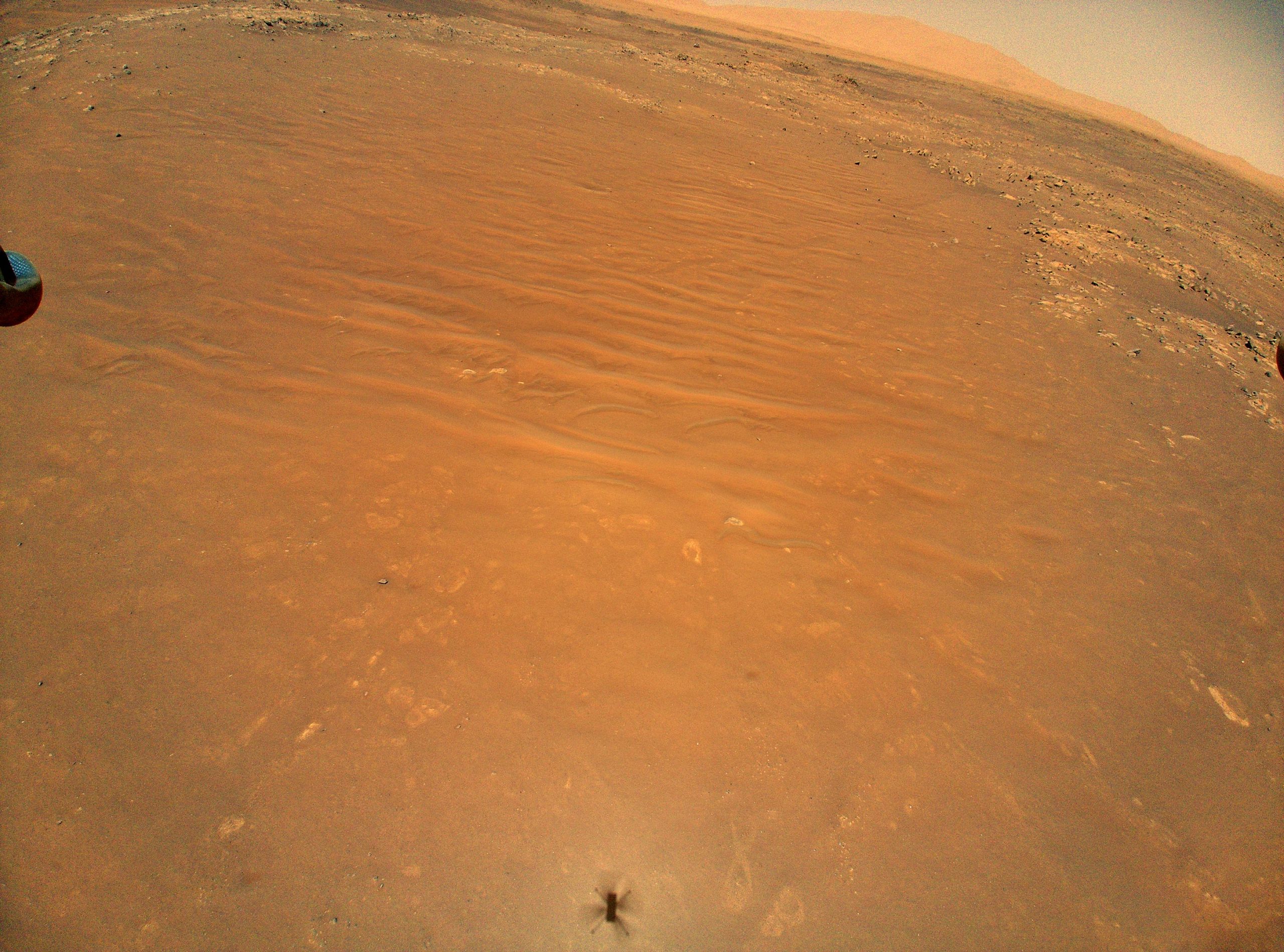
    Séítah From 39 Feet Up
    This image of the “South Séítah” region of Jezero Crater was taken by NASA’s Ingenuity Mars Helicopter during its 11th flight on August 4. Credit: NASA/JPL-Caltech

    Can You See NASA’s Newest Rover in This Picture From Jezero Crater?

    NASA’s Ingenuity Mars Helicopter recently completed its 11th flight at the Red Planet, snapping multiple photographs during its trip. Along with capturing the boulders, sand dunes, and rocky outcrops prevalent in the “South Séítah” region of Jezero Crater, a few of the images capture NASA’s Perseverance rover amid its first science campaign.

    Ingenuity began as a technological demonstration to prove that powered, controlled flight on Mars is possible. It is now an operations demonstration intended to investigate how a rotorcraft can add an aerial dimension to missions like Perseverance, scouting possible areas of scientific interest and offering detailed views of nearby areas too hazardous for the rover to explore.

    “Ingenuity’s aerial images are awesome – but even better when you get to play ‘Where’s Perseverance?’ with them,” said Robert Hogg. “Once you find our rover and zoom in, you can make out some details, like the wheels, remote sensing mast, and the MMRTG” – the Multi-Mission Radioisotope Thermoelectric Generator – “on the aft end.”

    So where is Perseverance? At the bottom center of the image, you can find Ingenuity’s shadow. From there, go straight up. Just beyond South Seítah’s dune field near the top of the image and just to the right of center is a bright white speck. That’s what a Mars rover looks like from about 1,600 feet (500 meters) away and 39 feet (12 meters) up.

    Séítah From 39 Feet Up Close Up
    Ingenuity captured the Perseverance rover in an image taken during its 11th flight at Mars on August 4. Credit: NASA/JPL-Caltech

    Flight 11 was essentially designed to keep Ingenuity ahead of the rover, allowing it to continue to support Perseverance’s science goals by photographing intriguing geologic features from the air. Flying north-by-northwest at 11 mph (five meters per second), it took Ingenuity 130.9 seconds to make the trip to its 8th airfield. From this new staging area, the helicopter is scheduled to make at least one reconnaissance flight of the geologically intriguing South Séítah area.

    More About Ingenuity

    The Ingenuity Mars Helicopter was built by JPL, which also manages the technology demonstration project for NASA Headquarters. It is supported by NASA’s Science, Aeronautics Research, and Space Technology mission directorates. NASA’s Ames Research Center in California’s Silicon Valley, and NASA’s Langley Research Center in Hampton, Virginia, provided significant flight performance analysis and technical assistance during Ingenuity’s development. AeroVironment Inc., Qualcomm, and SolAero also provided design assistance and major vehicle components. Lockheed Martin Space designed and manufactured the Mars Helicopter Delivery System.

    More About Perseverance

    A key objective for Perseverance’s mission on Mars is astrobiology, including the search for signs of ancient microbial life. The rover will characterize the planet’s geology and past climate, pave the way for human exploration of the Red Planet, and be the first mission to collect and cache Martian rock and regolith.

    Subsequent NASA missions, in cooperation with ESA (European Space Agency), would send spacecraft to Mars to collect these sealed samples from the surface and return them to Earth for in-depth analysis.

    The Mars 2020 Perseverance mission is part of NASA’s Moon to Mars exploration approach, which includes Artemis missions to the Moon that will help prepare for human exploration of the Red Planet.

    JPL, which is managed for NASA by Caltech in Pasadena, California, built and manages operations of the Perseverance rover.

    Never miss a breakthrough: Join the SciTechDaily newsletter.
    Follow us on Google and Google News.

    Ingenuity Mars Helicopter JPL Mars Mars 2020 Perseverance Rover NASA
    Share. Facebook Twitter Pinterest LinkedIn Email Reddit

    Related Articles

    Charting the Red Planet: How Open Science Fuels Mars Exploration

    NASA’s Ingenuity Helicopter Spots Perseverance Mars Rover From the Air

    NASA’s Mars Helicopter to Make Historic First Flight Attempt – “Martian Wright Brothers Moment”

    Epic Mars Selfie: NASA’s Perseverance Rover With the Ingenuity Helicopter

    NASA’s Ingenuity Mars Helicopter Survives First Frigid Martian Night on Its Own

    It’s Cold on Mars – What Temperatures As Low as -130°F Mean for NASA’s Ingenuity Helicopter

    NASA Ingenuity Mars Helicopter – With a Piece of the Wright Brothers’ Plane – Prepares for First Flight on Another Planet

    NASA’s Ingenuity Helicopter Reports In From Mars

    NASA’s Mars Helicopter Gets an Ingenious Name From Alabama High School Student

    Leave A Reply Cancel Reply

    • Facebook
    • Twitter
    • Pinterest
    • YouTube

    Don't Miss a Discovery

    Subscribe for the Latest in Science & Tech!

    Trending News

    Millions Take These IBS Drugs, But a New Study Finds Serious Risks

    Scientists Unlock Hidden Secrets of 2,300-Year-Old Mummies Using Cutting-Edge CT Scanner

    Bread Might Be Making You Gain Weight Even Without Eating More Calories

    Scientists Discover Massive Magma Reservoir Beneath Tuscany

    Europe’s Most Active Volcano Just Got Stranger – Here’s Why Scientists Are Rethinking It

    Alzheimer’s Symptoms May Start Outside the Brain, Study Finds

    Millions Take This Popular Supplement – Scientists Discover a Concerning Link to Heart Failure

    The Universe Is Expanding Too Fast and Scientists Can’t Explain Why

    Follow SciTechDaily
    • Facebook
    • Twitter
    • YouTube
    • Pinterest
    • Newsletter
    • RSS
    SciTech News
    • Biology News
    • Chemistry News
    • Earth News
    • Health News
    • Physics News
    • Science News
    • Space News
    • Technology News
    Recent Posts
    • U.S. Waste Holds $5.7 Billion Worth of Crop Nutrients
    • Scientists Say a Hidden Structure May Exist Inside Earth’s Core
    • Doctors Surprised by the Power of a Simple Drug Against Colon Cancer
    • Why Popular Diabetes Drugs Like Ozempic Don’t Work for Everyone: The “Genetic Glitch”
    • Scientists Create Improved Insulin Cells That Reverse Diabetes in Mice
    Copyright © 1998 - 2026 SciTechDaily. All Rights Reserved.
    • Science News
    • About
    • Contact
    • Editorial Board
    • Privacy Policy
    • Terms of Use

    Type above and press Enter to search. Press Esc to cancel.