

For the first time in history, NASA’s Parker Solar Probe has flown through a region of the Sun where explosive magnetic forces snap and reconnect, directly confirming a theory that scientists have debated for 70 years.
This breakthrough explains how the Sun unleashes immense bursts of energy that drive solar flares and storms powerful enough to disrupt satellites, power grids, and communications here on Earth.
Confirming Decades-Old Solar Theories
A team led by the Southwest Research Institute (SwRI) has provided the first direct confirmation of long-standing theories about magnetic reconnection, a powerful process that unleashes stored magnetic energy and fuels solar flares, coronal mass ejections, and other space weather events. The breakthrough was made possible by NASA’s Parker Solar Probe (PSP), the only spacecraft to travel through the Sun’s upper atmosphere.
Magnetic reconnection takes place when magnetic field lines inside superheated plasma break apart and then link up again in a different arrangement. This sudden shift releases tremendous energy. On the Sun, the process drives eruptions that can ripple across the solar system and interfere with technology on Earth, including satellites, communications, and power grids. Developing accurate models of how reconnection works on the Sun is key to predicting these disruptive solar storms before they reach our planet.

From Earth’s Magnetosphere to the Sun
“Reconnection operates at different spatial and temporal scales, in space plasmas ranging from the Sun to Earth’s magnetosphere to laboratory settings to cosmic scales,” said Dr. Ritesh Patel, a research scientist in SwRI’s Solar System Science and Exploration Division in Boulder, Colorado, and lead author of a new paper published in Nature Astronomy. “Since the late 1990s, we have been able to identify reconnection in the solar corona through imaging and spectroscopy. In-situ detection was possible in Earth’s magnetosphere with the launch of missions like NASA’s Magnetospheric Multiscale (MMS) mission. Similar studies in the solar corona, however, only became possible when NASA’s Parker Solar Probe launched in 2018.”
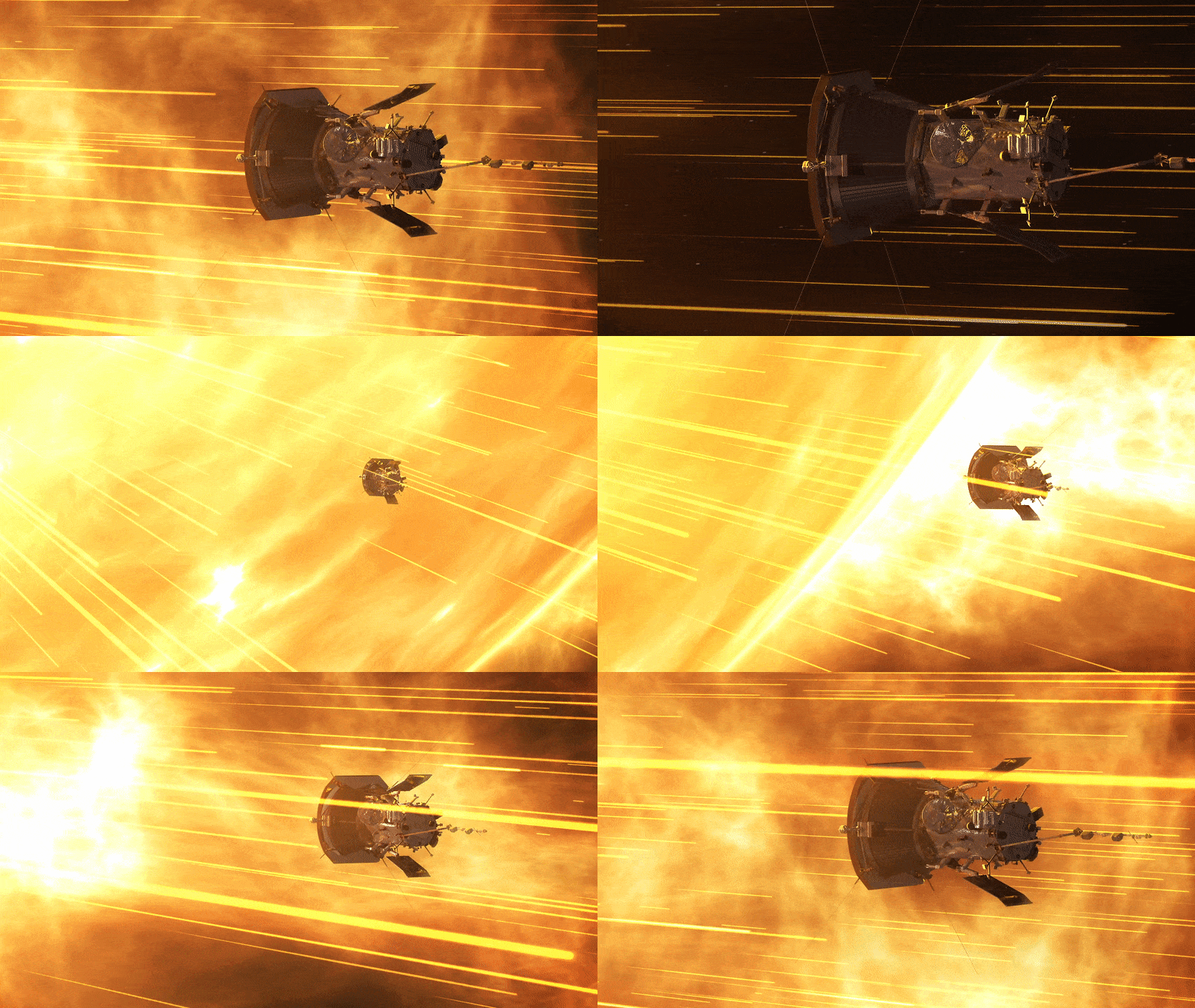
PSP’s unprecedented closeness to the Sun has opened the door to discoveries once thought impossible. During a close pass on September 6, 2022, the spacecraft encountered a massive eruption and gathered the first detailed images and measurements of plasma and magnetic field activity in such an event. By combining these observations with data from the European Space Agency’s Solar Orbiter, the SwRI-led team confirmed that PSP had indeed flown through a magnetic reconnection zone in the Sun’s atmosphere for the first time.
Long-Standing Models Finally Validated
“We’ve been developing the theory of magnetic reconnection for almost 70 years, so we had a basic idea of how different parameters would behave,” Patel said. “The measurements and observations received from the encounter have validated numerical simulation models that have existed for decades within some degree of uncertainty. The data will serve as strong constraints for future models and provide a path to understand PSP’s solar measurements from other timeframes and events.”
NASA’s MMS mission, led by SwRI, provided researchers with an idea of how reconnection occurs in the near-Earth environment on a smaller scale. The 2022 PSP observations now provide researchers with the missing piece connecting Earth scale to solar scale reconnection. SwRI will next work to identify whether reconnection mechanisms accompanied by turbulence or fluctuations and waves of the magnetic fields are present in the solar regions PSP identified as having active reconnection.
Unlocking Energy Transfer Secrets
“Ongoing work provides discoveries at different scales, which allows us to see how energy is transferred and how particles are accelerated,” Patel said. “Understanding these processes at the Sun can help better predict solar activity and improve our understanding of the near-Earth environment.”
Reference: “Direct in situ observations of eruption-associated magnetic reconnection in the solar corona” by Ritesh Patel, Tatiana Niembro, Xiaoyan Xie, Daniel B. Seaton, Samuel T. Badman, Soumya Roy, Yeimy J. Rivera, Katharine K. Reeves, Guillermo Stenborg, Phillip Hess, Matthew J. West, Alex Feller, Johann Hirzberger, David Orozco Suárez, Sami K. Solanki, Hanna Strecker and Gherardo Valori, 13 August 2025, Nature Astronomy.
DOI: 10.1038/s41550-025-02623-6
The Parker Solar Probe is a NASA mission designed to study the Sun up close and uncover how its activity shapes the environment around Earth. It is part of NASA’s Living with a Star program, which focuses on the Sun-Earth system and its impact on daily life and society. The program is managed by NASA’s Goddard Space Flight Center in Maryland for the agency’s Science Mission Directorate in Washington. The spacecraft itself was designed and built by the Johns Hopkins University Applied Physics Laboratory, which also operates and manages the mission.
Never miss a breakthrough: Join the SciTechDaily newsletter.
Follow us on Google and Google News.