
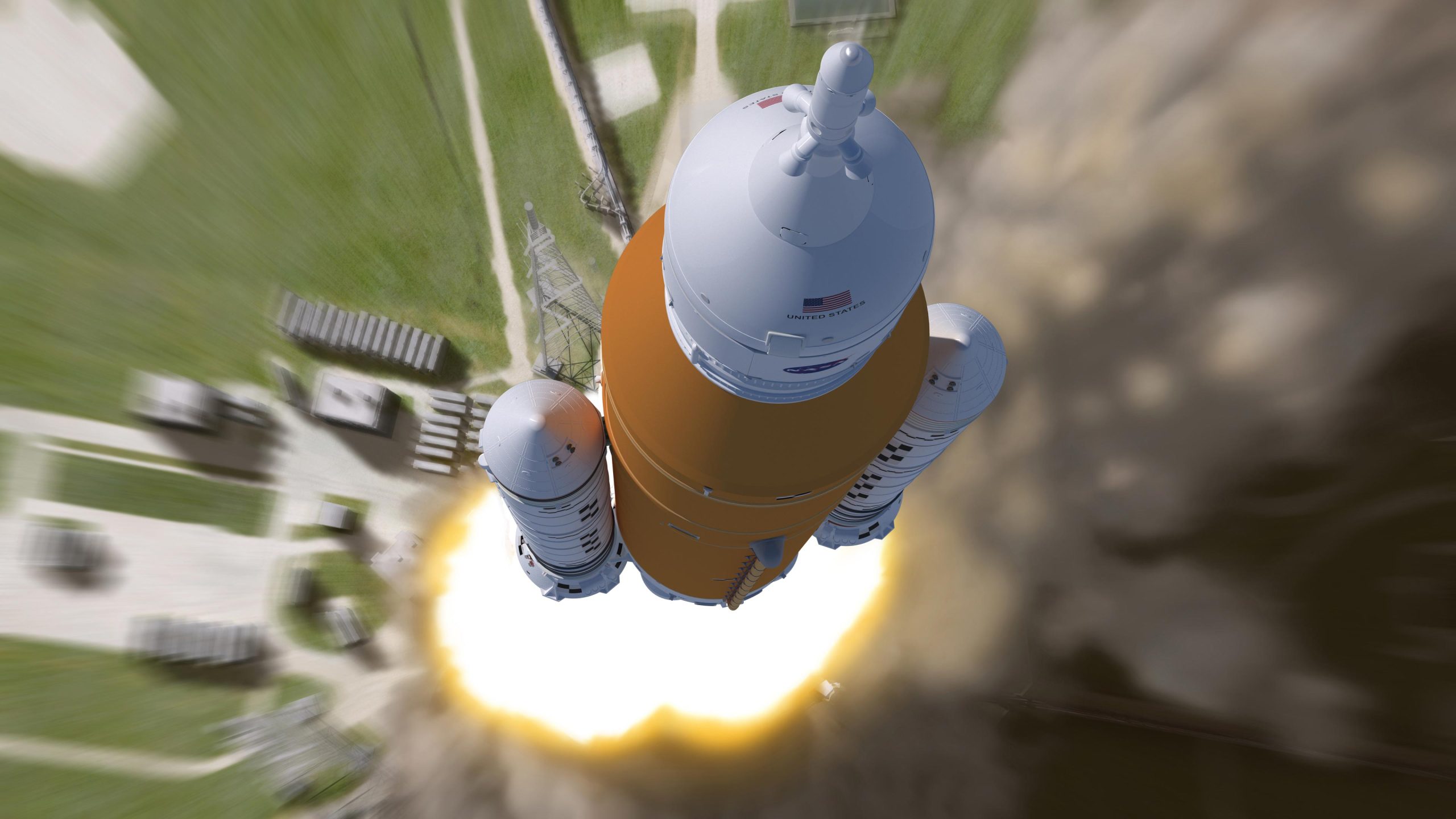
In this video, managers and engineers from NASA’s Marshall Space Flight Center in Alabama share their thoughts about the Space Launch System (SLS) rocket for Artemis I. Van L. Strickland, SLS program operations manager; John Blevins, SLS chief engineer; and Sharon Cobb, SLS associate program manager, commend a diverse workforce for its effort and dedication to prepare the backbone of NASA’s return to the Moon. SLS will launch the Orion spacecraft on its half-a-million-mile mission beyond the Moon and back to Earth. Artemis I is scheduled to launch no earlier than Monday, August 29, 2022, at 8:33 a.m. EDT (5:33 a.m. PDT) from Kennedy Space Center’s Launch Complex 39B in Florida.
Video Transcript:
The Space Launch System is really the backbone of the Artemis missions. It’s the truck. It’s the big carry vehicle.
It allows us to carry both crew, as well as the equipment that we need to live and work on the Moon.
Sixty years ago, NASA was in a race to get to the Moon. This time is more than just a race. It’s about establishing a long-term presence on the Moon.
Can you imagine rolling the Statue of Liberty out to put at the pad? That’s what we’re doing.
It will lift up from Earth with more power than the Saturn V, which was the first vehicle to take us to the Moon.
Artemis is our next giant leap.
The difference between the Apollo program and the Artemis program is really the focus on sustainability, and using the Moon as an outpost for further exploration.
This time we’re going back to learn how to live and work on the Moon.
The Space Launch System really is a culmination of our knowledge for 60 years of building rockets.
We started by looking at over 1,700 different potential components that would go into the rocket, and by looking at the way we could reuse some of the most reliable equipment that was flown on the shuttle.
We took those and we put them together into a system that had enough energy to make sense to do the mission that we’ve been asked to do to.
We’re moving from low-Earth orbit, as you see in the International Space Station today, to moving beyond that to taking the next step in exploration.
It’s 322 feet tall. It’s got 700,000 gallons (2.65 million liters) of cryogenic propellant in the core stage alone. It can produce 8.8 million pounds (4 million kilograms) of vacuum thrust.
The Space Launch System is really a national rocket, a national asset, too.
We have worked with contractors as well as with our NASA experts, our science and engineering department, and our safety and mission assurance team.
To get the Space Launch System designed, developed, and produced, it has taken thousands of companies across the country.
It comes together by train. It comes together by plane. It comes together by barges.
So, all of that culminates at the Kennedy Space Center for the launch of the first Artemis mission.
Everybody has worked together to make sure we have a safe and reliable rocket.
At NASA, safety and testing are extremely important because ultimately this rocket isn’t meant just to carry cargo, it’s meant to carry people.
It takes all types of education, all types of backgrounds, all types of diversity to do the things we do, and it’ll be great to see a diverse crew land on the moon.
Where the Space Launch System comes in is providing that reliable transportation, so that we can start flying these rockets on a routine basis. To take people and to take payload to that outpost, the Moon, and also the Gateway system.
We have a generation who have never seen deep space exploration, and this will give them an opportunity to see that this is something that they can potentially do themselves.
It’s going to be a paradigm shift for NASA. We’re going to be back to looking at things that nobody’s ever done before.
Never miss a breakthrough: Join the SciTechDaily newsletter.
Follow us on Google and Google News.