
NASA’s mission management team for Artemis I met yesterday morning to review the status of operations and have polled “go” to proceed with the launch countdown. The countdown commenced at 10:23 a.m. EDT (7:23 a.m. PDT) on August 27, after the launch team arrived at their stations in the Rocco A. Petrone Launch Control Center at NASA’s Kennedy Space Center in Florida. Throughout the day, teams powered up the Orion spacecraft and the Space Launch System (SLS) rocket’s core stage and prepared the four RS-25 engines.
Meteorologists with Space Launch Delta 45 predict a 70% chance of favorable weather for launch on Monday, August 29. The weather guidelines for NASA’s Artemis I flight test identify conditions to launch the agency’s Space Launch System and Orion spacecraft.
NASA held a prelaunch media briefing. Participants included:
- Mike Sarafin, Artemis mission manager, NASA Headquarters
- Charlie Blackwell-Thompson, Artemis launch director, Exploration Ground Systems Program, Kennedy
- Judd Freiling, ascent and entry flight director, Johnson
- Rick LaBrode, lead flight director, Johnson
- Melissa Jones, recovery director, Exploration Ground Systems Program, Kennedy
- Melody Lovin, weather officer, Space Launch Delta 45
- Jacob Bleacher, chief exploration scientist, Exploration Systems Development Mission Directorate, NASA Headquarters
Artemis I management team provides a pre-launch briefing following the Mission Management Team meeting ahead of the Artemis I launch. NASA’s Space Launch System and Orion spacecraft will launch from the center’s launch pad 39B on a flight test around the Moon on August 29. The uncrewed mission will demonstrate the ability of the SLS rocket to safely carry the Orion spacecraft around the Moon and its return and recovery to Earth for the agency’s Artemis Program.
NASA also held a briefing (embedded above) on their Moon to Mars exploration plans with the following participants:
- Bill Nelson, NASA administrator
- Bhavya Lal, NASA associate administrator for technology, policy, and strategy
- Jim Free, NASA associate administrator, Exploration Systems Development Mission Directorate
- Kathy Lueders, NASA associate administrator, Space Operations Mission Directorate
- Thomas Zurbuchen, NASA associate administrator, Science Mission Directorate
- Prasun Desai, NASA deputy associate administrator, Space Technology Mission Directorate
- Randy Bresnik, NASA astronaut
NASA’s Space Launch System rocket and Orion spacecraft are scheduled to lift off from Kennedy’s Launch Pad 39B during a two-hour launch window that opens at 8:33 a.m. EDT (5:33 a.m. PDT) on Monday, August 29.
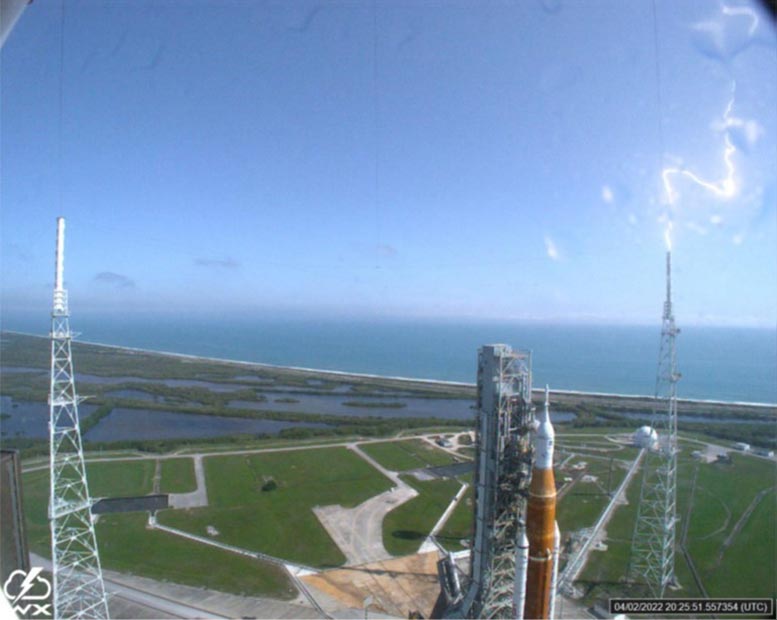
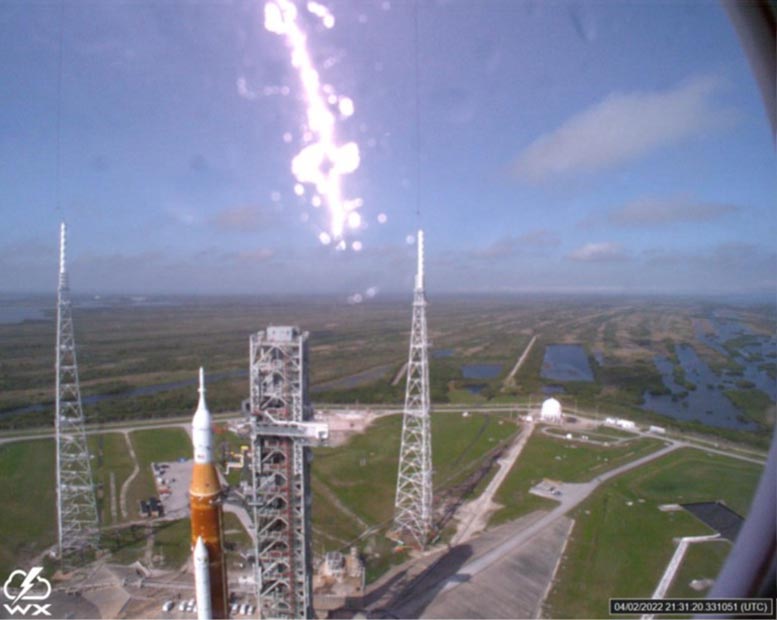
As the Artemis I countdown progresses, rain and thunderstorms continued throughout yesterday afternoon at NASA’s Kennedy Space Center in Florida. Earlier yesterday afternoon, there were three lightning strikes to the lightning protection system towers at Launch Pad 39B – a strike to Tower 1, and two strikes to Tower 2. Fortunately, the initial indications are that the strikes were of low magnitude.
A weather team has begun an assessment that includes collecting voltage and current data, as well as imagery. The data will be shared with a team of experts on electromagnetic environment efforts who will determine if any constraints on vehicle or ground systems were violated. Engineers will conduct a walkdown at the pad overnight, and if needed, conduct additional assessments with subsystems experts.
Take a look at various lightning strikes over the years at Launch Complex 39B at NASA’s Kennedy Space Center in Florida. The event was captured by high-speed cameras stationed at the pad and mobile launcher as well as the Vehicle Assembly Building. For the images that seem to be in daylight, a special filter called a “clear day frame” was used, which provides an overlay of the raw frame on a reference image. At pad 39B, there are three, 600-foot-tall masts with overhead wires used to transmit electrical energy around the perimeter of the pad to provide lightning protection for launch vehicles as they are processed and launched from the pad. Click here to learn more about the lightning towers.
The lightning protection system at the launch pad includes three 600-foot-tall towers and catenary wires positioned to protect the rocket, spacecraft, and mobile launcher. The wires run to the ground almost diagonally, steering the lightning current away from the rocket.
Overnight, engineers will also conduct preparations on the umbilicals, power up the core stage, and begin charging the Orion and Space Launch System core stage batteries.
The first in a series of increasingly complex missions, Artemis I will be an uncrewed flight test that will provide a foundation to extend human presence to the Moon and beyond. The mission will demonstrate the performance of the SLS rocket and test Orion’s capabilities over the course of about six weeks as it travels about 40,000 miles (64,000 kilometers) beyond the Moon and back to Earth.
Never miss a breakthrough: Join the SciTechDaily newsletter.
Follow us on Google and Google News.
3 Comments
Not jealous of those lightening strikes but hopefully they’ll be able to get an idea of how to harness it to power up the 🚀
While the voltages and currents of lightning are very high, the durations are so short that the available energy is too low to be of practical use.
Each of these launches creates massive amounts of pollution that astronomically contributes to the greenhouse effect of biosphere collapse while extreme flooding in Pakistan gets no mention in “science news.”