
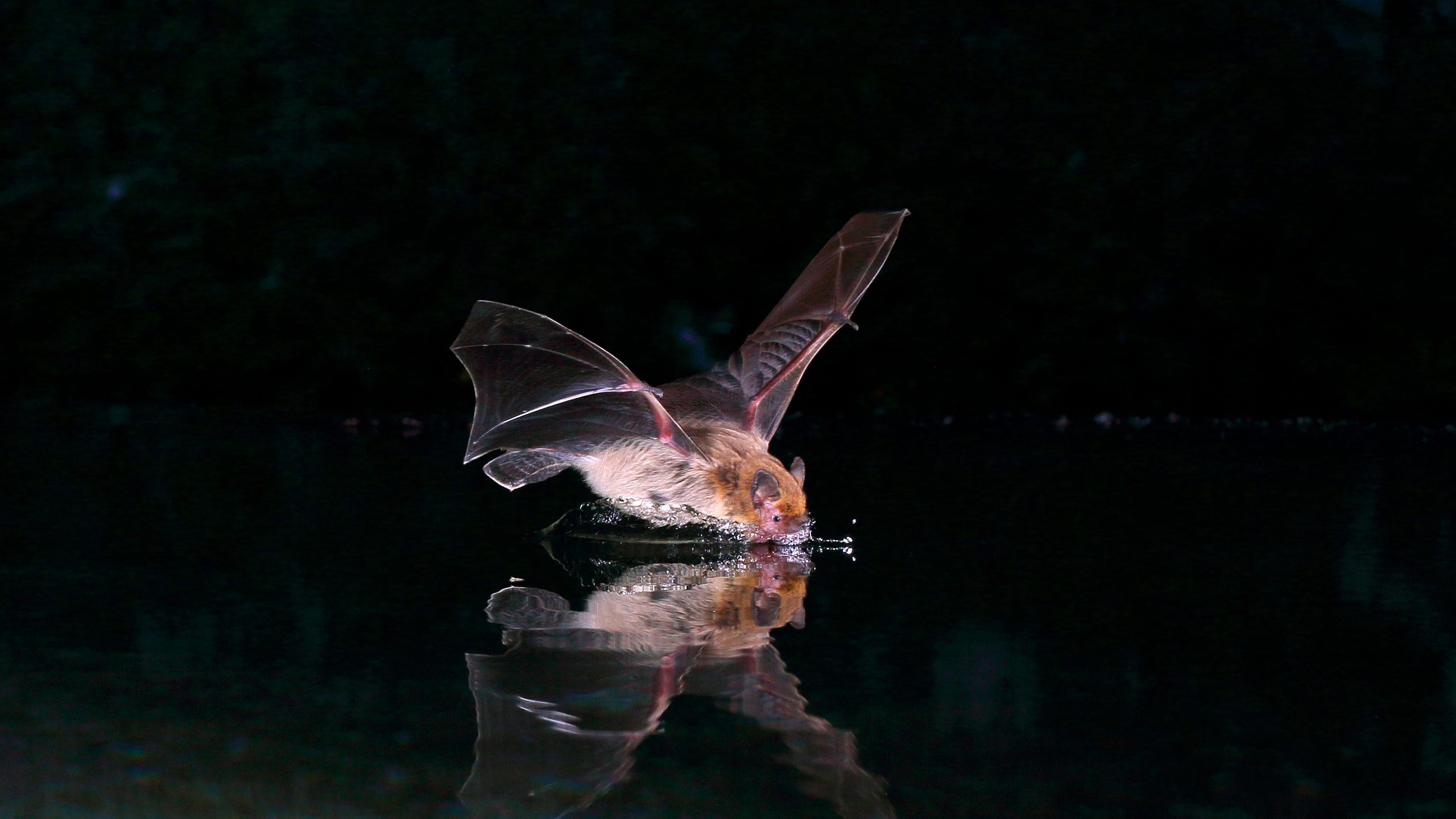
Researchers have demonstrated that echolocating bats use an acoustic cognitive map to navigate long distances in complete darkness, identifying their locations and finding their way home.
This study, conducted with Kuhl’s pipistrelle bats in Israel’s Hula Valley, reveals that bats utilize echolocation, and, surprisingly, vision as well, to perform map-based navigation, challenging previous assumptions about their sensory capabilities.
Cognitive Mapping in the Dark: How Bats Navigate
Echolocating bats have been shown to possess an “acoustic cognitive map” of their home range, allowing them to navigate over large distances using only echolocation. This breakthrough discovery, published on October 31 in Science, was made by researchers from the Max Planck Institute of Animal Behavior, the Cluster of Excellence Centre for the Advanced Study of Collective Behaviour at the University of Konstanz in Germany, Tel Aviv University, and the Hebrew University of Jerusalem.
Imagine being placed in complete darkness, up to three kilometers (~2 miles) from home, with only a flashlight to guide you—could you find your way back? Echolocating bats face a similar task, relying on a focused beam of sound rather than light to navigate. While bats have long been known to use echolocation to avoid obstacles and orient themselves, the research team, led by Aya Goldshtein from Iain Couzin’s group at the Max Planck Institute of Animal Behavior and the Cluster of Excellence Centre for the Advanced Study of Collective Behaviour at the University of Konstanz, has now shown that bats can recognize their location after being displaced and can use echolocation to perform map-based navigation over extended distances.
Video from the paper showing a reconstructed map of the valley. Credit: Xing Chen
Empirical Insights From Field Experiments
To explore this, the team conducted experiments with Kuhl’s pipistrelle (Pipistrellus kuhlii), a bat species weighing only 6 grams, in Israel’s Hula Valley. Over several nights, the researchers tracked 76 bats near their roosts and relocated them to various points within a three-kilometer radius, but still within their home range. Each bat was tagged with an innovative lightweight reverse GPS tracking system called ATLAS, which provided high-resolution, real-time tracking.
Some bats were fitted solely with the ATLAS system, while others were additionally manipulated to assess how their vision, sense of smell, magnetic sense, and echolocation influenced their ability to navigate back to their roosts. Remarkably, even with echolocation alone, 95 percent of the bats returned to their roosts within minutes, demonstrating that bats can conduct kilometer-scale navigation using only this highly directional, and relatively local, mode of sensing. However, it was also shown that, when available, bats improve their navigation using vision. “We were surprised to discover that these bats also use vision,” notes Aya Goldshtein. “That was not what we expected. It was incredible to see that, even with such small eyes, they can rely on vision under these conditions.”
Analyzing Flight Patterns and Sensory Integration
In addition to the field experiments, the team created a detailed map of the entire valley. “We wanted to visualize what each bat experienced during flight and understand how they used acoustic information to navigate,” explains Xing Chen, from Yossi Yovel’s lab at Tel Aviv University, who developed the valley’s reconstruction.
The model revealed that bats tend to fly near environmental features with higher ‘echoic entropy’—areas that provide richer acoustic information. “During the localization phase, bats conduct a meandering flight that, at a certain point, changes to a directional flight toward their destination, suggesting they already know where they are,” says Goldshtein. “Bats fly near environmental features with more acoustic information and make navigation decisions.” Bats can use this acoustic information to distinguish between environmental features such as a tree and a road, and thus use them as acoustic landmarks.
Conclusion: Bats’ Remarkable Navigational Skills
The study concludes that Kuhl’s pipistrelles can navigate over several kilometers using echolocation alone. However, when vision is available, they enhance their navigation performance by combining both senses. After being displaced, these small bats first identify their new location and then fly home, using environmental features with distinctive acoustic cues as landmarks. This behavior suggests they possess an acoustic mental map of their home range.
For more on this study, see Blindfolded and Unstoppable: The Echolocation Mastery of Bats.
Reference: “Acoustic cognitive map–based navigation in echolocating bats” by Aya Goldshtein, Xing Chen, Eran Amichai, Arjan Boonman, Lee Harten, Omer Yinon, Yotam Orchan, Ran Nathan, Sivan Toledo, Iain D. Couzin and Yossi Yovel, 31 October 2024, Science.
DOI: 10.1126/science.adn6269
Never miss a breakthrough: Join the SciTechDaily newsletter.
Follow us on Google and Google News.