

When they emerge at night in large numbers, bats avoid colliding with each other by adjusting both their flight patterns and the way they use echolocation.
Aya Goldshtein, Omer Mazar, and Yossi Yovel have spent many evenings observing bats outside cave entrances. Still, the sight of thousands of bats bursting out into the night sky, sometimes in such dense numbers that they look like a flowing liquid, never fails to amaze them. What surprises the scientists even more is what they don’t see. “The bats don’t run into each other,” says Goldshtein from the Max Planck Institute of Animal Behavior, “even in colonies of hundreds of thousands of bats all flying out of a small opening.”
A “nightmare” cocktail party
How bats manage to avoid crashing into one another as they emerge in massive swarms to forage at night has long puzzled scientists. Many bats rely primarily on echolocation to sense their surroundings. They emit calls and then listen for the returning echoes, which help them build a mental map of their environment.
But when thousands of bats are echolocating at the same time, especially in a tight space, the overlapping calls should interfere with one another. This phenomenon, known as “jamming,” was expected to overwhelm the bats’ ability to navigate and lead to frequent collisions.
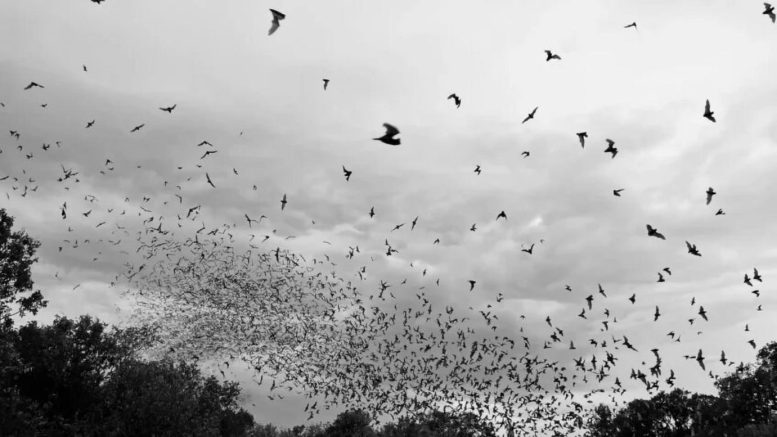
Yet collisions outside caves are so rare that “you’re almost excited when you witness one,” says Goldshtein.
For years, researchers have been trying to understand how bats overcome this problem, often compared to the “cocktail party nightmare,” where background noise makes it nearly impossible to focus on a single voice. One approach scientists took was to study how bats echolocate in groups. In laboratory settings, they found that individual bats in small groups tend to use slightly different frequencies for their calls. In theory, this frequency separation could reduce the effects of jamming. Was this the answer?
Yovel says that past studies like these are important stepping stones, but they have fallen short of providing a compelling answer to the cocktail party mystery because of a crucial missing piece. “No one had looked at this situation from the point of view of an individual bat during emergence. How can we understand a behavior if we don’t study it in action?”
Video showing the evening emergence of thousands of Greater mouse-tailed bats, as they take to the sky in search of insects. The video shows rare collisions of bats in mid air. Credit: Yossi Yovel and Eran Amichay
Stepping into the bat cave
For the first time, Goldshtein and colleagues have collected data from wild bats emerging from a cave at dusk. They used a combination of high-resolution tracking, developed by Ran Nathan and Sivan Toledo, ultrasonic recording, and sensorimotor computer modeling—all of which allowed the researchers to step into the bats’ sensory world as the animals squeezed out of the cave opening and flew through the landscape to forage.
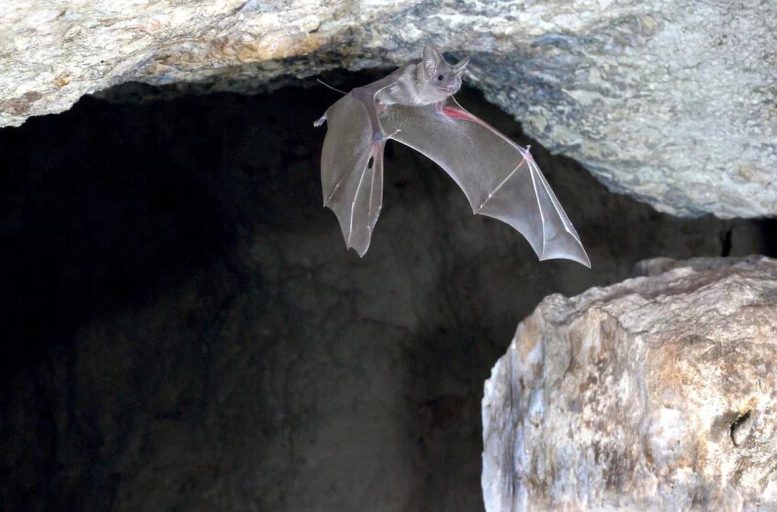
The team, which was led by scientists from Tel Aviv University, studied greater mouse-tailed bats in Israel’s Hula Valley. Over two years, they tagged tens of bats with lightweight trackers that recorded the bats’ location every second. Some of these tags also included ultrasonic microphones that recorded the auditory scene from the individual bat’s point of view. Each year, data was collected on the same night that bats were tagged.
A caveat: the tagged bats were released outside the cave and into the emerging colony, meaning that real data were missing at the cave opening when density is highest. The team filled in this gap with a computational model that was developed by Omer Mazar and simulated emergence. The model incorporated data collected by the trackers and microphones to recreate the full behavioral sequence starting from the entrance of the cave and ending after bats had flown two kilometers through the valley. “The simulation allows us to verify our assumptions of how bats solve this complex task during emergence,” says Mazar.
Sidestepping a sonic dilemma
And the picture that emerged was remarkable. When exiting the cave, bats experience a cacophony of calls, with 94 percent of echolocations being jammed. Yet, within five seconds of leaving the cave, bats significantly reduced the echolocation jamming. They also made two important behavioral changes: first, they fanned out from the dense colony core while maintaining the group structure; and second, they emitted shorter and weaker calls at higher frequency.
The researchers suspected that bats would reduce jamming by quickly dispersing from the cave. But why did bats change their echolocation to a higher frequency? Wouldn’t more calling only increase the problem of jamming and therefore collision risk? To understand that result, the authors had to approach the scene from a bat’s point of view.
Says Mazar: “Imagine you’re a bat flying through a cluttered space. The most important object you need to know about is the bat directly in front. So you should echolocate in such a way that gives you the most detailed information about only that bat. Sure, you might miss most of the information available because of jamming, but it doesn’t matter because you only need enough detail to avoid crashing into that bat.”
In other words, bats change the way they echolocate to gain detailed information about their near neighbors—a strategy that ultimately helps them to successfully maneuver and avoid collisions.
The authors emphasize that this unexpected result of how bats solve the cocktail party dilemma was made possible by studying bats in their natural environment as they perform the relevant task. “Theoretical and lab studies of the past have allowed us to imagine the possibilities,” says Goldshtein. “But only by putting ourselves, as close as possible, into the shoes of an animal will we ever be able to understand the challenges they face and what they do to solve them.”
Reference: “Onboard recordings reveal how bats maneuver under severe acoustic interference” by Aya Goldshtein, Omer Mazar, Lee Harten, Eran Amichai, Reut Assa, Anat Levi, Yotam Orchan, Sivan Toledo, Ran Nathan and Yossi Yovel, 31 March 2025, Proceedings of the National Academy of Sciences.
DOI: 10.1073/pnas.2407810122
Never miss a breakthrough: Join the SciTechDaily newsletter.
Follow us on Google and Google News.
1 Comment
great