
Close Menu
    Facebook X (Twitter) Instagram
    SciTechDaily
    • Biology
    • Chemistry
    • Earth
    • Health
    • Physics
    • Science
    • Space
    • Technology
    Facebook X (Twitter) Pinterest YouTube RSS
    SciTechDaily
    Home»Biology»Bats Tune Frequency of Echolocation to Change Field Perception
    Biology

    Bats Tune Frequency of Echolocation to Change Field Perception

    By SciTechDailyNovember 25, 20122 Comments3 Mins Read
    Facebook Twitter Pinterest Telegram LinkedIn WhatsApp Email Reddit
    Share
    Facebook Twitter LinkedIn Pinterest Telegram Email Reddit
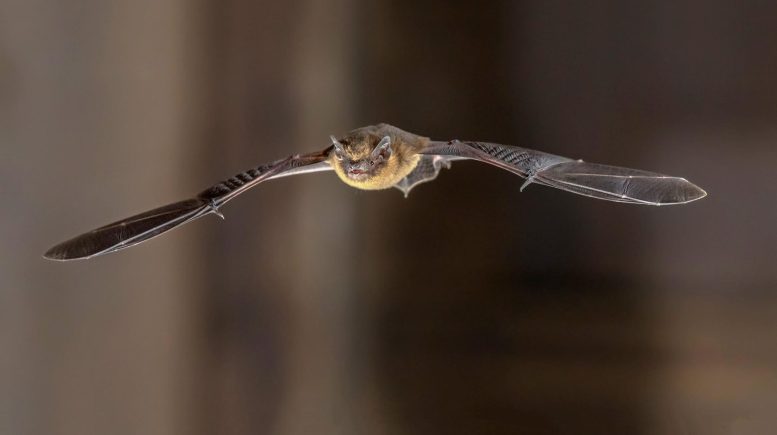
    Pipistrelle Bat Flying
    Bats adjust vocalization frequency to broaden or narrow their visual field for navigation and prey detection.

    Bats can broaden and narrow their visual field by modulating the frequency of their vocalizations they use to navigate and find prey.

    The scientists published their findings in the journal Nature. Bats find their way through the depths of night by emitting sonar signal and using the return echoes to create a map of their surroundings. This process, called echolocation, allows them to be proficient nocturnal predators. It’s been long known that smaller bats emit higher-frequency squeaks, and it was thought that the difference arises because the smaller animals must catch smaller insects, from which low-frequency sound waves with long wavelengths do not reflect well.

    Annemarie Surlykke, a neurobiologist who studies bat echolocation at the University of Southern Denmark in Odense, states that smaller bats would be able to detect even the smallest prey they take with a lower frequency. So there must be another reason why there is a modulation in the squeaks of bats.

    Surlykke and her team studied six related species of bats, which varied in size. The animals were captured, and released in a flight room, which was a pitch-dark netted corridor, 2.5 meters (8.2 feet) high, 4.8 meters (15.7 feet) wide, and 7 meters (23 feet) long. It was rigged on all sides with microphones and IR cameras. The confined space should be equivalent to flying close to vegetation in the wild.

    The scientists measured the time it took for a bat’s echolocation signals to hit different microphones. This allowed them to measure the exact location of the animals in flight. Then, they analyzed the intensity of each signal as well as the size of their mouths to reconstruct the width of the sound beam.

    They discovered that the animals adjusted the frequency of their signals and the openings of their mouths to come up with the same beam width for their echolocation calls, which was about 37°, no matter their size.

    Small species need to use high frequencies because their mouths are smaller. A lower-frequency call would broaden the beam, making it hit more obstacles and increasing the noise of the signal.

    While this does bring new understanding to this field, other researchers note that “It now has to be documented for other species and for flying out in nature — in the open, in the forest, in different habitats” for the conclusion to be definitive.

    Reference: “Convergent acoustic field of view in echolocating bats” by Lasse Jakobsen, John M. Ratcliffe and Annemarie Surlykke, 21 November 2012, Nature.
    DOI: 10.1038/nature11664

    Never miss a breakthrough: Join the SciTechDaily newsletter.
    Follow us on Google and Google News.

    Bats Chiroptology Echolocation Neuroscience
    Share. Facebook Twitter Pinterest LinkedIn Email Reddit

    Related Articles

    Researchers Solve “Cocktail Party” Mystery of Bat Echolocation

    Blindfolded and Unstoppable: The Echolocation Mastery of Bats

    Echolocation: Bats Use Different Inner Ear Structures To Help Navigate the World Through Sound

    Corrugated Pipes Installed to Help Bats Access Their Roosts May Actually Interfere With Echolocation

    Kitti’s Hog-Nosed Bat Is World’s Smallest Mammal

    Mother’s Nurturing Results in Larger Hippocampus in Children

    Transcranial Direct Current Stimulation: The Ethics of Brain Boosting

    Neuroscientists Discover that Drosophila Orb2 Plays Role in Long-Term Memory

    Neuroscientists Study Cortical Areas Specialized in Processing Visual Inputs in Mice

    2 Comments

    1. Michelle on November 27, 2012 1:25 pm

      The content of the article is interesting and accurate, however the photos you used feature bats that do not utilize echolocation. Both are megabats and use their sense of sight and smell to navigate the tropics searching for fruit (not insects).

      Reply
      • Staff on November 27, 2012 1:41 pm

        Thanks for the feedback…Photos were changed.

        Reply
    Leave A Reply Cancel Reply

    • Facebook
    • Twitter
    • Pinterest
    • YouTube

    Don't Miss a Discovery

    Subscribe for the Latest in Science & Tech!

    Trending News

    Millions Take These IBS Drugs, But a New Study Finds Serious Risks

    Scientists Unlock Hidden Secrets of 2,300-Year-Old Mummies Using Cutting-Edge CT Scanner

    Bread Might Be Making You Gain Weight Even Without Eating More Calories

    Scientists Discover Massive Magma Reservoir Beneath Tuscany

    Europe’s Most Active Volcano Just Got Stranger – Here’s Why Scientists Are Rethinking It

    Alzheimer’s Symptoms May Start Outside the Brain, Study Finds

    Millions Take This Popular Supplement – Scientists Discover a Concerning Link to Heart Failure

    The Universe Is Expanding Too Fast and Scientists Can’t Explain Why

    Follow SciTechDaily
    • Facebook
    • Twitter
    • YouTube
    • Pinterest
    • Newsletter
    • RSS
    SciTech News
    • Biology News
    • Chemistry News
    • Earth News
    • Health News
    • Physics News
    • Science News
    • Space News
    • Technology News
    Recent Posts
    • Simple Blood Test May Predict Alzheimer’s Years Before Brain Scans Show Signs
    • Scientists Say Adding This Unusual Seafood to Your Diet Could Reverse Signs of Aging
    • U.S. Waste Holds $5.7 Billion Worth of Crop Nutrients
    • Scientists Say a Hidden Structure May Exist Inside Earth’s Core
    • Doctors Surprised by the Power of a Simple Drug Against Colon Cancer
    Copyright © 1998 - 2026 SciTechDaily. All Rights Reserved.
    • Science News
    • About
    • Contact
    • Editorial Board
    • Privacy Policy
    • Terms of Use

    Type above and press Enter to search. Press Esc to cancel.