
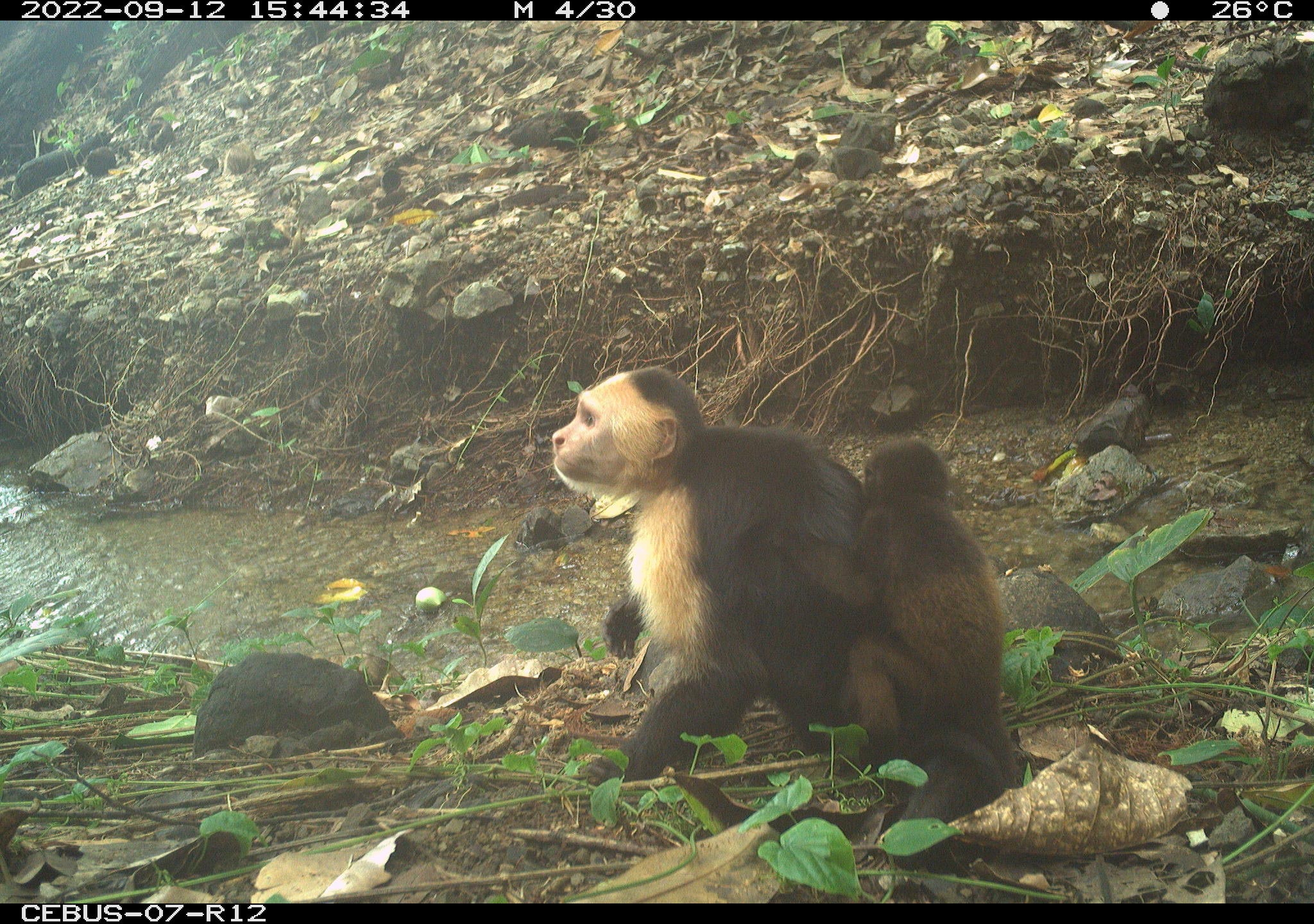
Cameras on a remote island captured how a novel social tradition originated and spread.
Off the coast of Panama, on a remote island called Jicarón, lives a fascinating group of wild monkeys with an incredible culture. These white-faced capuchins, found in Coiba National Park, are known for using stone tools to crack open hard foods like nuts and shellfish.
Since 2017, scientists have been studying this rare behavior using motion-triggered cameras set up around the island. Then in 2022, doctoral researcher Zoë Goldsborough spotted something extraordinary in the footage: a capuchin monkey carrying a baby howler monkey on his back—something no one had seen in years of observations.
“It was so weird that I went straight to my advisor’s office to ask him what it was,” remembers Goldsborough who is conducting her dissertation at MPI-AB. The biologists knew it was a rare animal behavior and so they immediately started investigating. If there was to be more evidence of this occurring on the island, they were confident they would find it: “We had all the footage from cameras on Jicarón for the whole year,” says Brendan Barrett, a group leader at MPI-AB and Goldsborough’s advisor, “so we could reconstruct the scene to see if this weird behavior was just a one-off, or something bigger.”
The influencer
Goldsborough manually dug through the tens of thousands of images and videos collected by all cameras deployed around this time period. She found not one, but four different howler infants being carried. In nearly all cases, the carrier was the same individual: a subadult male she named Joker. These observations raised several questions. How did Joker get these infants? And why did he carry them for days at a time?
“At first, we thought it could be adoption,” says Goldsborough. Anecdotes exist of some animals adopting babies of other species. In a well-known case from 2006, a pair of capuchins adopted a baby marmoset and succeeded in raising it into adulthood. But there was a problem with this interpretation: animal adoption is almost always carried out by females, who presumably do it to practice “caring” for infants. “The fact that a male was the exclusive carrier of these babies was an important piece of the puzzle,” she adds.
Then, the trail went cold. Goldsborough found no evidence of howler carrying for months. “We’d decided that it was one individual trying something new,” says Barrett, “which is not uncommon to see among capuchins. These are deeply curious animals who are constantly exploring the forest and figuring out how they can interact with their world.”
Eventually, though, the researchers struck the motherlode: they discovered a series of images and video, timestamped five months later, of more howler infants being carried. The authors called on a howler monkey expert, Lisa Corewyn at Ithaca College, who verified that the babies were separate individuals. “We assumed that Joker was at it again,” says Goldsborough. But they soon realized that the carrying behavior had in fact spread to four other capuchins—all young males.
The spread
Over the course of 15 months, these five capuchins carried 11 different howler monkeys for up to 9-day periods. The camera footage showed the howler babies clinging to the backs or bellies of their young male carriers who appeared to be going about their normal business of travelling or using tools to crack open food sources. The researchers collated the footage on an interactive website documenting the spread of the behavior.
“The complete timeline tells us a fascinating story of one individual who started a random behavior, which was taken up with increasing speed by other young males,” says Barrett. The authors describe this as a social tradition or cultural fad—a behavior that spreads in a population through social learning. It parallels trends observed in other animals, such as killer whales donning “salmon hats” or chimpanzees wearing a blade of grass in their ears like an accessory.
Social learning gone wrong?
The implications of the capuchins’ fashion fad, however, are more than skin deep. The howler babies, all less than four weeks old, appear to have been abducted from their parents who were captured on camera calling to infants from nearby trees. Four babies were observed to have perished. The authors suspect that none of the babies survived. “The capuchins didn’t hurt the babies,” stresses Goldsborough, “but they couldn’t provide the milk that infants need to survive.”
As is often the case in the natural world, one animal’s loss is another animal’s gain. But what the capuchins gain from this social tradition is a mystery. The males don’t eat the infants, they don’t play with them, and they don’t receive more attention from their group mates while carrying an infant. “We don’t see any clear benefit to the capuchins,” says Goldsborough, “but we also don’t see any clear costs, although it might make tool use a little trickier.”
Rethinking animal culture
The research offers the first known documentation of a social tradition in which animals repeatedly abduct and carry infants of another species—without any clear benefit to themselves. It highlights the ways in which animal culture can parallel our own. Says Barrett: “We show that non-human animals also have the capacity to evolve cultural traditions without clear functions but with destructive outcomes for the world around them.”
This, he says, points to a compelling line of inquiry. “The more interesting question is not ‘why did this tradition arise?’ but rather ‘why here?’”
Not just tool users
The white-faced capuchins on Jicarón Island have developed a unique tradition of using stone tools to crack open hard foods like nuts and shellfish. Interestingly, the capuchins that use tools on Jicarón are only males, just like the howler kidnappers, hinting that these two socially learned traditions might spring from the same source: boredom.
Meg Crofoot, managing director at the MPI-AB and one of the founders of this project, says: “Survival appears easy on Jicarón. There are no predators and few competitors, which gives capuchins lots of time and little to do. It seems this ‘luxurious’ life set the scene for these social animals to be innovators. This new tradition shows us that necessity need not be the mother of invention. For a highly intelligent monkey living in a safe, perhaps even under-stimulating environment, boredom and free time might be sufficient.”
Looking forward
The study’s camera trapping period ran from January 2022 to July 2023, and the team does not know to what extent the tradition persisted afterwards, as all data has not yet been analyzed. But, if the behavior spreads to other capuchin groups or continues to impact howlers, which are an endangered species on Jicarón, it could become a conservation issue in Coiba National Park.
“Witnessing the spread of this behavior had a profound effect on all of us,” says Crofoot. “We therefore feel even more responsible to keep learning from this natural population of primates who, to our knowledge, are the only ones on earth to be practicing this strange tradition.”
Reference: “Rise and spread of a social tradition of interspecies abduction” by Zoë Goldsborough, Margaret C. Crofoot, Odd T. Jacobson, Lisa Corewyn, Evelyn del Rosario-Vargas, Julián León and Brendan J. Barrett, 19 May 2025, Current Biology.
DOI: 10.1016/j.cub.2025.03.056
Never miss a breakthrough: Join the SciTechDaily newsletter.
Follow us on Google and Google News.
4 Comments
Bored Monkey = Grumpy Monkey = Kidnapper Monkey…they sound more human every day.
I’ve watched BBC Macaques. The alpha males kidnap and kill infants of their own species to ensure the future infants are from his seed. I don’t think it’s a hard stretch that an isolated island of limited food sources one species kills the infants of a possible usurper of common food sources.
As I read this story, I began to read more quickly to find out what happened to the infant howlers. I was devastated to learn the babies are died and that their parents had called to them from the trees. Also that the howlers are an endangered group on Jicarón, I hope this “fad” ends quickly!! This made me so sad!
It could be boredom, but it could also be that the kidnapper monkeys all had the same mother monkey who neglected them as infants so they are adults now with unmet emotional needs that they fill by taking baby howler monkeys as pets. When the babies die, they go steal another one. Emotional support animals unintentionally starved/dehydrated to death.
Another question is why don’t the howler monkey mothers kill or fight off the capuchins when they try to steal their babies? Maybe this is part of the problem. Perhaps there are some howler monkey moms who are leaving their babies unattended or abandoning them or don’t protect them or something.
This is really sad and tragic for the howler monkeys.